
The primary function of a forced air drying oven in the processing of Moringa oleifera seed shells is to aggressively remove free moisture from the washed biomass prior to thermal conversion. By maintaining a steady temperature of 65°C with continuous air circulation for 24 hours, the device stabilizes the raw material. This specific pre-treatment is essential for preventing biological decay and ensuring the feedstock is optimized for high-yield pyrolysis.
Core Takeaway Reliable biochar production begins with moisture control; the forced air oven transforms raw, washed shells into stable feedstock. By eliminating variable moisture, you prevent storage decay and secure a consistent, high-yield outcome during the critical pyrolysis stage.
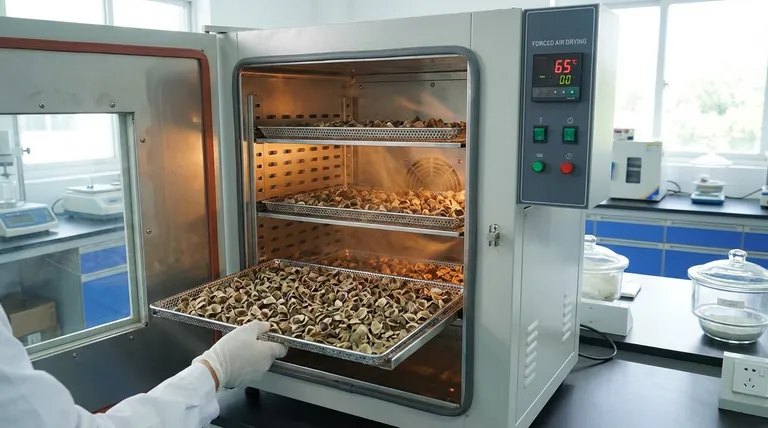
The Critical Role of Moisture Removal
Mechanism of Forced Air Circulation
Unlike passive drying methods, a forced air oven actively circulates heated air around the biomass. This constant airflow disrupts the boundary layer of moisture surrounding the seed shells.
By maintaining 65°C for a continuous 24-hour cycle, the process ensures that free moisture is effectively carried away from the material surface and internal pores.
Preventing Biological Degradation
One of the most immediate risks to raw biomass like Moringa shells is decay. Wet organic material is prone to fungal growth and bacterial decomposition if stored for any length of time.
The forced air drying process brings the moisture content down to a level that inhibits biological activity. This allows you to store the raw material without improved risk of rotting, preserving the structural integrity of the carbon source.
Optimizing Pyrolysis Yield
The presence of water during high-temperature pyrolysis is detrimental to efficiency. If the shells enter the reactor wet, significant energy is wasted evaporating water rather than converting carbon.
By ensuring a consistent low moisture content before the material enters the pyrolysis stage, the oven allows for a more controlled thermal reaction. This direct consistency leads to an improved yield of the final biochar product.
Understanding the Trade-offs
Energy Consumption vs. Process Control
Using a forced air oven for 24 hours represents a distinct energy cost compared to ambient air drying. You are trading operational expenditure (electricity) for process reliability and speed.
Temperature Sensitivity
It is vital to adhere to the recommended 65°C limit for Moringa shells. While higher temperatures might dry the material faster, excessive heat during the pre-drying phase could trigger premature volatile release or structural changes before the actual pyrolysis begins.
Batch Processing Limitations
The 24-hour drying cycle creates a potential bottleneck in production. You must align your drying capacity with your pyrolysis schedule to prevent the oven from becoming the limiting factor in your workflow.
Making the Right Choice for Your Goal
- If your primary focus is Process Consistency: Adhere strictly to the 65°C/24-hour protocol to ensure every batch of feedstock enters the reactor with identical moisture properties.
- If your primary focus is Storage Logistics: Prioritize this drying step immediately after washing to allow for long-term stockpiling of shells without the risk of biological decay.
- If your primary focus is Energy Efficiency: Ensure the oven is fully loaded (without blocking circulation) to maximize the utility of the 24-hour heating cycle.
Consistent moisture control is not merely a preparatory step; it is the fundamental baseline required to produce high-quality biochar.
Summary Table:
| Feature | Specification/Requirement | Impact on Biochar Production |
|---|---|---|
| Temperature | 65°C | Prevents premature volatile loss while removing moisture |
| Duration | 24 Hours | Ensures complete removal of free moisture for stability |
| Airflow Type | Forced/Active Circulation | Disrupts moisture boundary layers for uniform drying |
| Primary Goal | Moisture Stabilization | Inhibits biological decay and preserves carbon structure |
| Pyrolysis Effect | Energy Efficiency | Reduces energy waste on water evaporation during heating |
Maximize Your Biochar Yield with KINTEK Precision
Achieving consistent, high-quality biochar results starts with the perfect pre-treatment environment. KINTEK provides industry-leading thermal solutions, including high-performance Forced Air Drying Ovens, Muffle, Tube, and Vacuum systems. Backed by expert R&D and manufacturing, our equipment is fully customizable to meet the unique needs of your biomass research and production.
Ready to optimize your feedstock preparation? Contact KINTEK Today to find your ideal lab furnace solution
References
- Caio Henrique da Silva, Wardleison Martins Moreira. Synthesis of Activated Biochar from the Bark of Moringa oleifera for Adsorption of the Drug Metronidazole Present in Aqueous Medium. DOI: 10.3390/pr12030560
This article is also based on technical information from Kintek Furnace Knowledge Base .
Related Products
- High Temperature Muffle Oven Furnace for Laboratory Debinding and Pre Sintering
- Electric Rotary Kiln Pyrolysis Furnace Plant Machine Small Rotary Kiln Calciner
- Electric Rotary Kiln Continuous Working Small Rotary Furnace Kiln for Pyrolysis Plant Heating
- Vacuum Heat Treat Sintering and Brazing Furnace
- Multi Heating Zones CVD Tube Furnace Machine for Chemical Vapor Deposition Equipment
People Also Ask
- What thermal phenomena occur during polymer binder burnout in ceramic green bodies? Lab Furnace Guide
- Why is controlled heat treatment in a muffle furnace necessary for calcined clay? Achieve Optimal Pozzolanic Activity
- What role does a high-temperature muffle furnace play in STFO synthesis? Achieve Pure Perovskite Results
- How does a high-temperature muffle furnace facilitate the formation of LaNbxAl1−xO3+δ perovskite structures? Key Roles
- What role does a high-temperature muffle furnace play in the multi-stage synthesis of Li0.5MnFe1.5O4? Key to Pure Spinel



















