Knowledge How does the use of a stainless steel high-pressure autoclave affect ZnS/CeO2@CNT formation? Optimize Catalyst Growth
Author avatar

Tech Team · Kintek Furnace

Updated 20 hours ago

How does the use of a stainless steel high-pressure autoclave affect ZnS/CeO2@CNT formation? Optimize Catalyst Growth


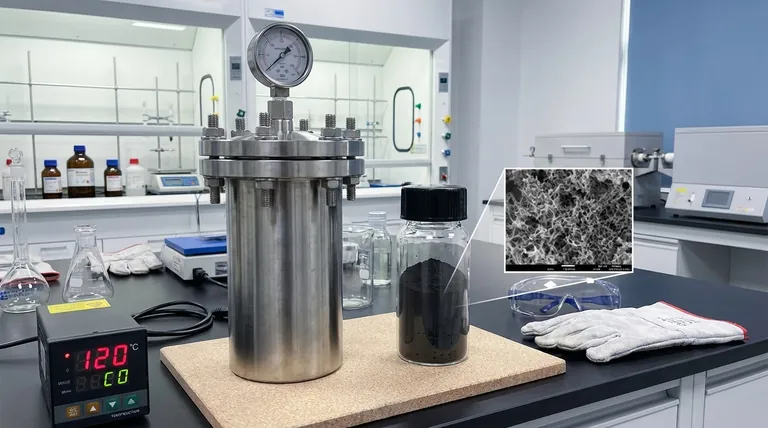
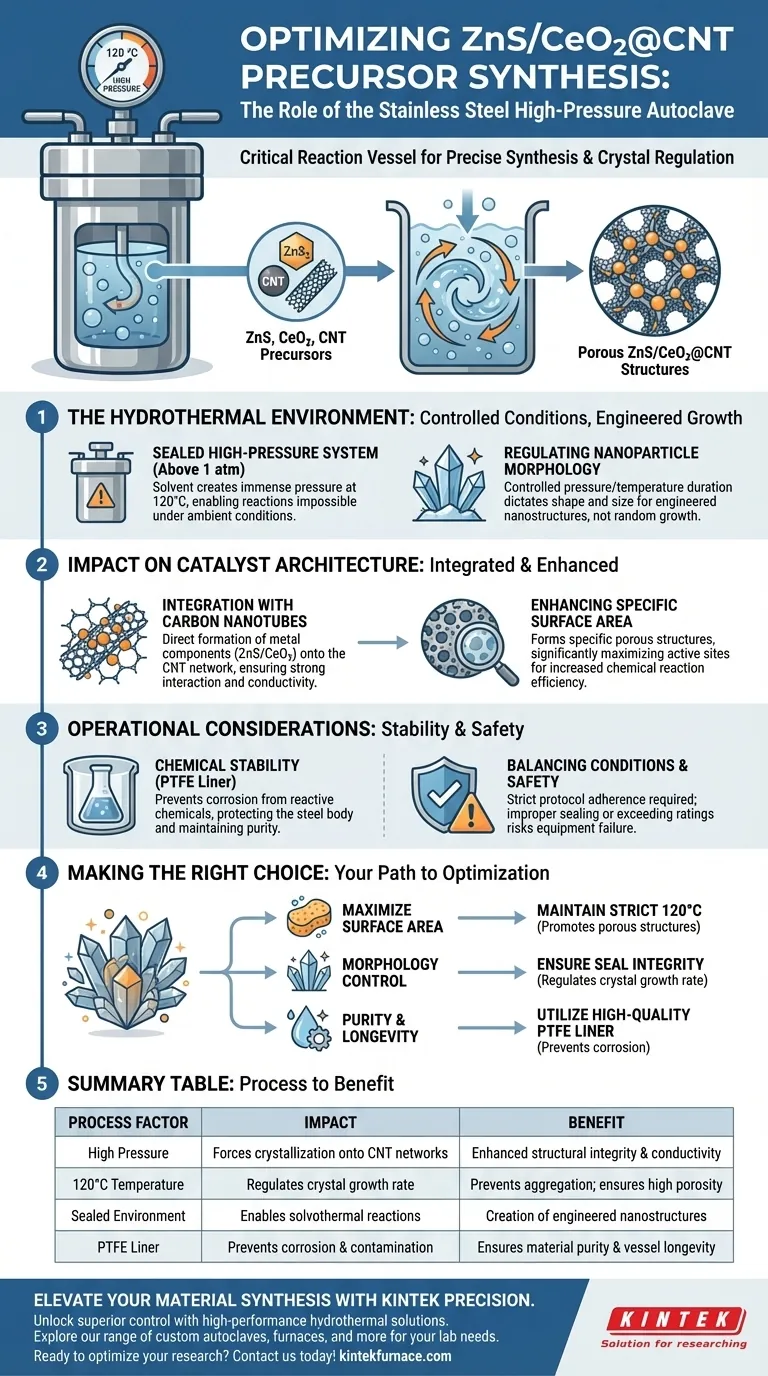
The stainless steel high-pressure autoclave serves as the critical reaction vessel that enables the precise synthesis of ZnS/CeO2@CNT precursors. By maintaining a sealed environment at 120 °C, creates the high-pressure conditions necessary to force metal components to crystallize into specific porous structures directly onto the Carbon Nanotube (CNT) network.

The core function of the autoclave in this process is to provide a stable, high-pressure environment that regulates crystal growth rates. This control is essential for creating high-porosity structures on the CNT network, which significantly maximizes the catalyst's specific surface area.
How does the use of a stainless steel high-pressure autoclave affect ZnS/CeO2@CNT formation? Optimize Catalyst Growth

The Role of the Hydrothermal Environment

Creating Controlled Reaction Conditions

The autoclave provides a sealed, high-pressure system.

When the internal temperature reaches 120 °C, the solvent creates pressure that far exceeds atmospheric levels. This environment allows for solvothermal or hydrothermal reactions that would not occur under standard ambient conditions.

Regulating Nanoparticle Morphology

The high-pressure environment allows for the precise regulation of crystal growth rates.

By controlling the pressure and temperature duration, you dictate the final shape and size of the nanoparticles. This ensures the material does not grow randomly, but rather forms specific, engineered nanostructures.

Impact on Catalyst Architecture

Integration with Carbon Nanotubes

The synthesis process within the autoclave specifically encourages metal components (ZnS/CeO2) to form directly on the Carbon Nanotube network.

The autoclave environment facilitates a strong interaction between the metal precursors and the CNTs. This integration is vital for the structural integrity and electrical conductivity of the final composite material.

Enhancing Specific Surface Area

The primary outcome of this controlled growth is the formation of specific porous structures.

These porous architectures significantly increase the specific surface area of the catalyst. A higher surface area provides more active sites for future chemical reactions, directly improving the efficiency of the material.

Operational Considerations and Trade-offs

The Necessity of Chemical Stability

While the stainless steel provides structural strength against pressure, it is reactive to certain chemicals.

To prevent corrosion from strong alkaline or acidic solutions, the autoclave typically utilizes a Polytetrafluoroethylene (PTFE) liner. This liner ensures exceptional chemical stability, protecting the steel body while maintaining the purity of the reaction.

Balancing Conditions and Safety

Operating under high pressure and temperature requires strict adherence to safety protocols.

While extreme conditions can induce unique growths (such as nanowires or nanotubes), failing to properly seal the autoclave or exceeding its rating can lead to equipment failure or inconsistent synthesis results.

Making the Right Choice for Your Goal

To optimize your ZnS/CeO2@CNT synthesis, consider the following aspects of autoclave usage:

  • If your primary focus is maximizing surface area: Ensure the temperature is maintained strictly at 120 °C to promote the formation of porous structures rather than dense aggregates.
  • If your primary focus is morphology control: Focus on the seal integrity of the autoclave to maintain consistent high pressure, which regulates the crystal growth rate and shape.
  • If your primary focus is purity and equipment longevity: Always utilize a high-quality PTFE liner to prevent the reaction solution from corroding the stainless steel shell.

The autoclave is not just a container; it is an active tool that shapes the microscopic architecture of your catalyst through pressure and heat.

Summary Table:

Process Factor Impact on ZnS/CeO2@CNT Precursors Benefit for Catalyst Architecture
High Pressure Forces crystallization onto CNT networks Enhanced structural integrity and conductivity
120°C Temperature Regulates crystal growth rate Prevents aggregation; ensures high porosity
Sealed Environment Enables solvothermal reactions Creation of engineered nanostructures
PTFE Liner Prevents corrosion and contamination Ensures material purity and vessel longevity

Elevate Your Material Synthesis with KINTEK Precision

Unlock superior control over your catalyst morphology with high-performance hydrothermal solutions from KINTEK. Backed by expert R&D and manufacturing, we offer a comprehensive range of Muffle, Tube, Rotary, Vacuum, and CVD systems, along with customizable high-pressure autoclaves designed for your unique laboratory needs. Whether you are developing porous ZnS/CeO2@CNT precursors or advanced nanomaterials, our equipment ensures the chemical stability and thermal precision required for groundbreaking results.

Ready to optimize your research? Contact us today to find the perfect lab high-temp furnace or autoclave solution!

Visual Guide
How does the use of a stainless steel high-pressure autoclave affect ZnS/CeO2@CNT formation? Optimize Catalyst Growth Visual Guide

References

  1. Yulin Luo, Qi-Hui Wu. Carbon Nanotubes-Doped Metal Oxides and Metal Sulfides Heterostructure Achieves 3D Morphology Deposition of Li2S and Stable Long-Cycle Lithium–Sulfur Batteries. DOI: 10.3390/inorganics13060181

This article is also based on technical information from Kintek Furnace Knowledge Base .

Related Products

People Also Ask

Related Products

1700℃ High Temperature Laboratory Tube Furnace with Quartz or Alumina Tube

1700℃ High Temperature Laboratory Tube Furnace with Quartz or Alumina Tube

KINTEK's Tube Furnace with Alumina Tube: Precision heating up to 1700°C for material synthesis, CVD, and sintering. Compact, customizable, and vacuum-ready. Explore now!

High Pressure Laboratory Vacuum Tube Furnace Quartz Tubular Furnace

High Pressure Laboratory Vacuum Tube Furnace Quartz Tubular Furnace

KINTEK High Pressure Tube Furnace: Precision heating up to 1100°C with 15Mpa pressure control. Ideal for sintering, crystal growth, and lab research. Customizable solutions available.

High Temperature Muffle Oven Furnace for Laboratory Debinding and Pre Sintering

High Temperature Muffle Oven Furnace for Laboratory Debinding and Pre Sintering

KT-MD Debinding & Pre-Sintering Furnace for ceramics - precise temperature control, energy-efficient design, customizable sizes. Boost your lab efficiency today!

Vacuum Hot Press Furnace Machine Heated Vacuum Press Tube Furnace

Vacuum Hot Press Furnace Machine Heated Vacuum Press Tube Furnace

Discover KINTEK's advanced Vacuum Tube Hot Press Furnace for precise high-temperature sintering, hot pressing, and material bonding. Customizable solutions for labs.

Small Vacuum Heat Treat and Tungsten Wire Sintering Furnace

Small Vacuum Heat Treat and Tungsten Wire Sintering Furnace

Compact vacuum tungsten wire sintering furnace for labs. Precise, mobile design with superior vacuum integrity. Ideal for advanced material research. Contact us!

Vacuum Heat Treat Sintering Furnace with Pressure for Vacuum Sintering

Vacuum Heat Treat Sintering Furnace with Pressure for Vacuum Sintering

KINTEK's Vacuum Pressure Sintering Furnace offers 2100℃ precision for ceramics, metals, and composites. Customizable, high-performance, and contamination-free. Get a quote now!

1200℃ Controlled Inert Nitrogen Atmosphere Furnace

1200℃ Controlled Inert Nitrogen Atmosphere Furnace

KINTEK 1200℃ Controlled Atmosphere Furnace: Precision heating with gas control for labs. Ideal for sintering, annealing, and material research. Customizable sizes available.

9MPa Air Pressure Vacuum Heat Treat and Sintering Furnace

9MPa Air Pressure Vacuum Heat Treat and Sintering Furnace

Achieve superior ceramic densification with KINTEK's advanced air pressure sintering furnace. High-pressure up to 9MPa, precise 2200℃ control.

600T Vacuum Induction Hot Press Vacuum Heat Treat and Sintering Furnace

600T Vacuum Induction Hot Press Vacuum Heat Treat and Sintering Furnace

600T Vacuum Induction Hot Press Furnace for precise sintering. Advanced 600T pressure, 2200°C heating, vacuum/atmosphere control. Ideal for research & production.

Vacuum Heat Treat Sintering Furnace Molybdenum Wire Vacuum Sintering Furnace

Vacuum Heat Treat Sintering Furnace Molybdenum Wire Vacuum Sintering Furnace

KINTEK's Vacuum Molybdenum Wire Sintering Furnace excels in high-temperature, high-vacuum processes for sintering, annealing, and material research. Achieve precise 1700°C heating with uniform results. Custom solutions available.

304 316 Stainless Steel High Vacuum Ball Stop Valve for Vacuum Systems

304 316 Stainless Steel High Vacuum Ball Stop Valve for Vacuum Systems

KINTEK's 304/316 stainless steel vacuum ball valves and stop valves ensure high-performance sealing for industrial and scientific applications. Explore durable, corrosion-resistant solutions.

Vacuum Heat Treat Furnace with Ceramic Fiber Liner

Vacuum Heat Treat Furnace with Ceramic Fiber Liner

KINTEK's Vacuum Furnace with Ceramic Fiber Lining offers precise high-temperature processing up to 1700°C, ensuring uniform heat distribution and energy efficiency. Ideal for labs and production.

Vacuum Hot Press Furnace Machine for Lamination and Heating

Vacuum Hot Press Furnace Machine for Lamination and Heating

KINTEK Vacuum Lamination Press: Precision bonding for wafer, thin-film & LCP applications. 500°C max temp, 20-ton pressure, CE certified. Custom solutions available.

Mesh Belt Controlled Atmosphere Furnace Inert Nitrogen Atmosphere Furnace

Mesh Belt Controlled Atmosphere Furnace Inert Nitrogen Atmosphere Furnace

KINTEK Mesh Belt Furnace: High-performance controlled atmosphere furnace for sintering, hardening & heat treatment. Customizable, energy-efficient, precise temperature control. Get a quote now!

Vacuum Dental Porcelain Sintering Furnace for Dental Laboratories

Vacuum Dental Porcelain Sintering Furnace for Dental Laboratories

KinTek Vacuum Porcelain Furnace: Precision dental lab equipment for high-quality ceramic restorations. Advanced firing control & user-friendly operation.

Vacuum Heat Treat Sintering and Brazing Furnace

Vacuum Heat Treat Sintering and Brazing Furnace

KINTEK Vacuum Brazing Furnaces deliver precision, clean joints with superior temperature control. Customizable for diverse metals, ideal for aerospace, medical, and thermal applications. Get a quote!

Chairside Dental Porcelain Zirconia Sintering Furnace with Transformer for Ceramic Restorations

Chairside Dental Porcelain Zirconia Sintering Furnace with Transformer for Ceramic Restorations

Dental Porcelain Speedy Sintering Furnace: Fast 9-minute zirconia sintering, 1530°C precision, SiC heaters for dental labs. Boost productivity today!

1700℃ Controlled Inert Nitrogen Atmosphere Furnace

1700℃ Controlled Inert Nitrogen Atmosphere Furnace

KT-17A Controlled Atmosphere Furnace: Precise 1700°C heating with vacuum & gas control. Ideal for sintering, research & material processing. Explore now!

Controlled Inert Nitrogen Hydrogen Atmosphere Furnace

Controlled Inert Nitrogen Hydrogen Atmosphere Furnace

Discover KINTEK's Hydrogen Atmosphere Furnace for precise sintering & annealing in controlled environments. Up to 1600°C, safety features, customizable.

Stainless Steel Quick Release Vacuum Chain Three Section Clamp

Stainless Steel Quick Release Vacuum Chain Three Section Clamp

Stainless steel quick release vacuum clamps ensure leak-free connections for high vacuum systems. Durable, corrosion-resistant, and easy to install.


Leave Your Message

