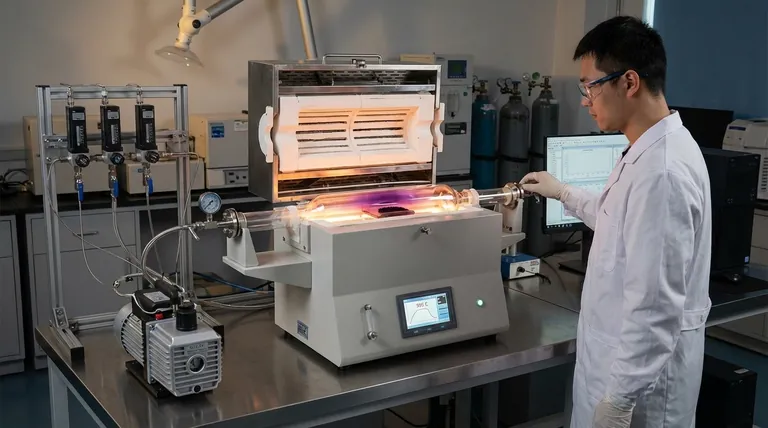
High-purity quartz acts as the definitive barrier between the harsh synthesis environment and the integrity of the crystal growth process. In the Chemical Vapor Deposition (CVD) of Molybdenum Phosphide (MoP), this material is selected because it combines exceptional thermal stability with chemical inertness. This ensures the reaction chamber withstands the high temperatures required for synthesis without reacting with precursors like red phosphorus or molybdenum, thereby preventing contamination.
The selection of high-purity quartz is a strategic necessity to create a contaminant-free environment, ensuring that the resulting Molybdenum Phosphide crystals exhibit their true intrinsic electrocatalytic properties rather than artifacts from impurities.
The Role of Chemical Inertness
Preventing Wall Reactions
The primary risk in high-temperature crystal growth is the potential for the reaction vessel to become a reactant itself.
High-purity quartz is chemically inert to the aggressive precursors used in this process, specifically red phosphorus vapor and molybdenum foil. By refusing to react with these materials, the quartz tube ensures that the chemical potential is directed entirely toward the formation of the crystal, rather than the corrosion of the chamber walls.
Ensuring Intrinsic Purity
For researchers studying the electrocatalytic properties of MoP, purity is paramount.
Even trace amounts of contamination from a reaction chamber can alter the electronic structure of a single crystal. By using high-purity quartz, you eliminate external variables, guaranteeing that the performance data collected accurately reflects the intrinsic nature of the Molybdenum Phosphide.
Thermal Stability and Process Control
Withstanding Synthesis Temperatures
The CVD process for MoP requires a rigorous thermal environment to drive the reaction.
Liquid-metal-assisted CVD typically operates within a furnace temperature range of 700°C to 900°C. High-purity quartz maintains its structural integrity and mechanical strength within this window, preventing deformation that could compromise the vacuum seal or the physical shape of the growing crystal.
Facilitating Precision Growth
The stability of the quartz tube allows for precise regulation of the internal environment.
Because the tube does not degrade at these temperatures, it enables the furnace to effectively manage the diffusion kinetics of molybdenum atoms. This stability is critical for controlling specific growth facets, such as the (0001) or (1010) planes, allowing for tailored crystal structures.
Understanding the Trade-offs
The Requirement for "High Purity"
It is critical to distinguish between standard quartz and high-purity quartz.
Using lower-grade quartz or glass substitutes can introduce trace mineral impurities that diffuse into the reaction zone at 900°C. If the quartz is not of sufficient purity, it may devitrify (crystallize) or release contaminants, negating the benefits of the CVD process and ruining the sample.
Mechanical Vulnerability
While thermally robust, quartz remains a brittle ceramic material.
It requires careful handling during loading and unloading, particularly when establishing the vacuum environment (often around 4×10^-6 Torr). Any micro-fractures introduced during handling can propagate under thermal stress, leading to catastrophic failure of the sealed environment.
Making the Right Choice for Your Goal
When designing a CVD experiment for metal phosphides, the reaction vessel determines the reliability of your data.
- If your primary focus is Electrocatalytic Analysis: Prioritize chemical inertness; use certified high-purity quartz to ensure that any catalytic activity observed is inherent to the MoP crystal and not a result of doping from the tube walls.
- If your primary focus is Crystal Morphology Control: Prioritize thermal stability; ensure the tube is rated for continuous operation at 900°C to allow for the precise temperature regulation required to grow specific crystal facets.
By isolating the reaction in high-purity quartz, you convert a volatile chemical process into a controlled environment for precision materials science.
Summary Table:
| Property | Benefit for MoP Synthesis | Impact on Crystal Quality |
|---|---|---|
| Chemical Inertness | Resists red phosphorus & Mo vapor | Prevents contamination and doping artifacts |
| Thermal Stability | Maintains integrity at 700°C - 900°C | Ensures vacuum seal & precise diffusion kinetics |
| High Purity Grade | Zero trace mineral diffusion | Guarantees intrinsic electrocatalytic properties |
| Structural Strength | Supports high-vacuum environments | Stable growth of specific facets like (0001) |
Elevate Your Research with KINTEK’s Precision Engineering
Don't let impurities compromise your crystal growth. KINTEK provides high-performance, high-purity quartz components and advanced thermal solutions designed for the most demanding CVD processes.
Backed by expert R&D and manufacturing, KINTEK offers a comprehensive range of Muffle, Tube, Rotary, Vacuum, and CVD systems. Our lab high-temp furnaces are fully customizable to meet your unique synthesis needs, ensuring your MoP single crystals achieve their true intrinsic potential.
Ready to optimize your lab's performance?
Contact our specialists today to find your custom solution!
Visual Guide

References
- Seo Hyun Kim, Hyeuk Jin Han. Facet‐Controlled Growth of Molybdenum Phosphide Single Crystals for Efficient Hydrogen Peroxide Synthesis. DOI: 10.1002/adma.202500250
This article is also based on technical information from Kintek Furnace Knowledge Base .
Related Products
- Vacuum Heat Treat Sintering Furnace Molybdenum Wire Vacuum Sintering Furnace
- Molybdenum Vacuum Heat Treat Furnace
- Custom Made Versatile CVD Tube Furnace Chemical Vapor Deposition CVD Equipment Machine
- Multi Heating Zones CVD Tube Furnace Machine for Chemical Vapor Deposition Equipment
- Split Chamber CVD Tube Furnace with Vacuum Station CVD Machine
People Also Ask
- What are the main structural components of a vacuum sintering furnace? Unlock Precision in High-Temperature Processing
- How does vacuum sintering improve dimensional tolerances? Achieve Uniform Shrinkage and Precision
- What is the purpose of setting a mid-temperature dwell stage? Eliminate Defects in Vacuum Sintering
- What are the key components of a vacuum sintering furnace? Essential Parts for Precision Material Processing
- How does vacuum sintering contribute to cost reduction in material processing? Lower Expenses with Superior Parts