
Precise thermal decoupling is the mechanism that drives success. A dual-temperature zone furnace facilitates the synthesis of non-stoichiometric copper selenide (beta-Cu2-xSe) by creating two independently controlled thermal environments within a single AP-CVD system. This separation allows the selenium precursor to sublime at a stable, lower temperature (400 °C) while the copper substrate undergoes the chemical reaction at a much higher temperature (650 °C).
Core Insight: The dual-zone configuration solves the conflict between volatile precursors and high-energy reaction requirements. By decoupling the vaporization of selenium from the crystallization of copper selenide, you gain control over vapor pressure and reaction kinetics, directly resulting in material with high crystallinity, large flake size, and superior phase purity.
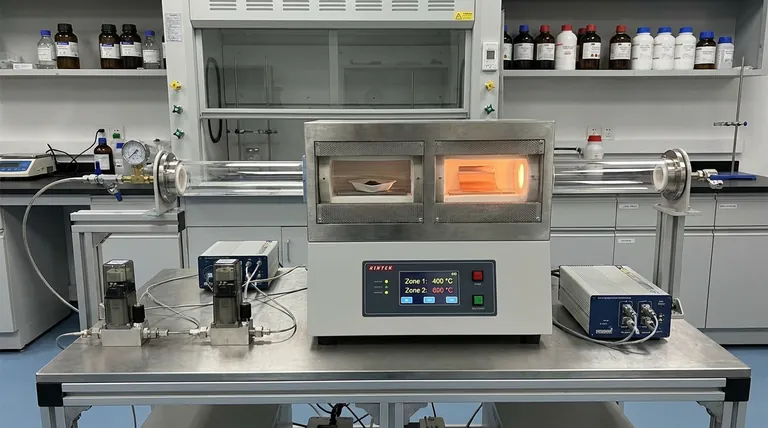
The Architecture of Dual-Zone Synthesis
To understand why this method works, you must look at the specific functions of the two distinct temperature zones. This setup moves beyond simple heating to active process control.
Zone 1: The Precursor Environment (400 °C)
This zone is dedicated to the selenium powder precursor.
Selenium is highly volatile. If exposed immediately to high reaction temperatures, it would vaporize uncontrollably, leading to poor film quality or wasted material.
By maintaining this zone at 400 °C, the furnace ensures precise, steady sublimation. This generates a consistent stream of selenium vapor essential for uniform transport to the substrate.
Zone 2: The Reaction Environment (650 °C)
This zone houses the copper foil substrate.
While the precursor needs a moderate environment, the actual chemical synthesis of beta-Cu2-xSe requires significant thermal energy.
This zone is held at 650 °C. This high temperature activates the copper surface and provides the necessary thermodynamic conditions for the incoming selenium vapor to react and crystallize effectively.
Why Independent Control Defines Quality
The ability to maintain a 250 °C temperature difference between the source and the substrate is not just a feature; it is the primary driver of material quality.
Regulating Vapor Pressure
The concentration of selenium in the system is dictated by the temperature of Zone 1.
By locking this zone at 400 °C, you establish a stable vapor pressure. This prevents "flooding" the system with too much reactant or starving it with too little.
Controlling Deposition Kinetics
The rate at which the crystal grows—the deposition kinetics—is governed by the substrate temperature in Zone 2.
The 650 °C environment ensures the atoms have enough energy to arrange themselves into an ordered crystal lattice. This specific thermal balance is responsible for producing large flake sizes and ensuring high crystallinity.
Understanding the Trade-offs
While a dual-zone furnace offers superior control compared to single-zone systems, it introduces specific operational challenges you must manage.
Complexity of Gradient Management
You are maintaining a sharp thermal gradient within a continuous tube.
There is a risk of the temperature "bleeding" between zones. If Zone 2 heats Zone 1 excessively, you lose control of the vapor rate. Careful calibration of the distance between the source and substrate is required to maintain the integrity of the 400 °C / 650 °C split.
Sensitivity to Calibration
Because the variables are decoupled, you have more parameters to tune.
A mismatch in the flow rate of the carrier gas relative to the sublimation rate in Zone 1 can lead to non-uniform deposition. This system requires precise synchronization between gas flow and the thermal profiles of both zones.
Making the Right Choice for Your Synthesis
When utilizing a dual-temperature zone AP-CVD system for copper selenide, tailor your approach based on your specific material requirements.
- If your primary focus is Phase Purity: Prioritize the stability of Zone 1 (400 °C) to ensure the selenium supply never fluctuates, preventing stoichiometric imbalances.
- If your primary focus is Crystal Size: Focus on optimizing Zone 2 (650 °C) and the reaction time, as the high-temperature dwell time directly influences flake growth and crystallinity.
By respecting the distinct thermal needs of the precursor and the substrate, you transform a chaotic chemical reaction into a controlled manufacturing process.
Summary Table:
| Feature | Zone 1 (Precursor) | Zone 2 (Reaction/Substrate) |
|---|---|---|
| Temperature | 400 °C | 650 °C |
| Material | Selenium Powder | Copper Foil |
| Function | Stable Sublimation | Chemical Reaction & Crystallization |
| Outcome | Consistent Vapor Pressure | High Crystallinity & Large Flakes |
Elevate Your CVD Research with KINTEK Precision
Precise thermal gradients are the difference between poor film quality and high-purity crystalline materials. KINTEK provides industry-leading Muffle, Tube, Rotary, Vacuum, and CVD systems engineered to deliver the exact thermal decoupling required for complex synthesis like non-stoichiometric copper selenide.
Backed by expert R&D and world-class manufacturing, our lab high-temperature furnaces are fully customizable to meet your unique research parameters. Don't let thermal bleeding compromise your results—leverage our expertise to optimize your deposition kinetics today.
Ready to upgrade your synthesis capabilities? Contact KINTEK today for a tailored solution.
References
- Srijith Srijith, Gilbert Daniel Nessim. Chemical-Vapor-Deposition-Synthesized Two-Dimensional Non-Stoichiometric Copper Selenide (β-Cu2−xSe) for Ultra-Fast Tetracycline Hydrochloride Degradation under Solar Light. DOI: 10.3390/molecules29040887
This article is also based on technical information from Kintek Furnace Knowledge Base .
Related Products
- Multi Heating Zones CVD Tube Furnace Machine for Chemical Vapor Deposition Equipment
- Split Multi Heating Zone Rotary Tube Furnace Rotating Tube Furnace
- Multi Zone Laboratory Quartz Tube Furnace Tubular Furnace
- 1700℃ Controlled Inert Nitrogen Atmosphere Furnace
- 1200℃ Controlled Inert Nitrogen Atmosphere Furnace
People Also Ask
- What is the function of a multi-zone tube furnace in CVD synthesis? Master 2D In2Se3 Nanosheet Precision
- What environmental protection applications utilize multi zone tube furnaces? Unlock Precision in Waste Treatment and Green Tech
- Why are multi zone tube furnaces particularly useful for nanomaterial research? Unlock Precise Thermal Control for Advanced Synthesis
- What role do multi zone tube furnaces play in new energy research? Unlock Precise Thermal Control for Innovation
- What temperature-related capabilities make multi zone tube furnaces valuable for research? Unlock Precision Thermal Control



















