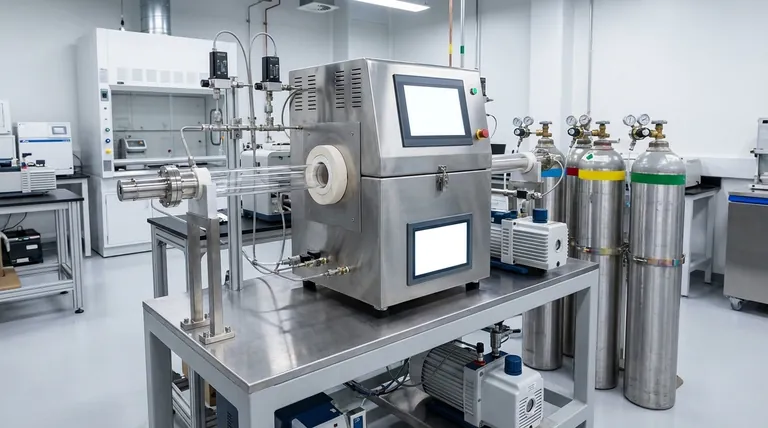
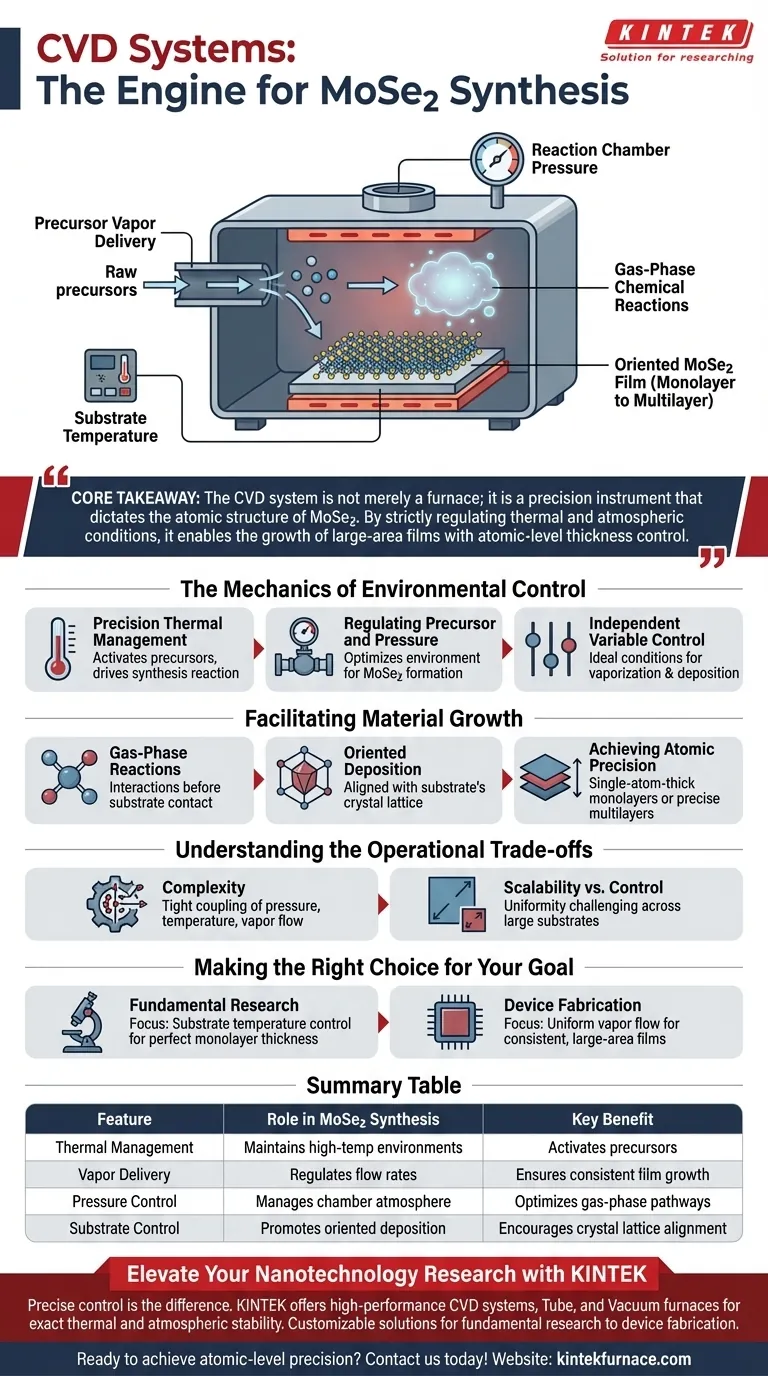
Chemical Vapor Deposition (CVD) systems serve as the critical infrastructure for synthesizing Molybdenum diselenide (MoSe2) by establishing a precisely controlled high-temperature reaction environment. They actively manage three specific variables—precursor vapor delivery, reaction chamber pressure, and substrate temperature—to facilitate gas-phase chemical reactions. This control is the deciding factor in transforming raw precursors into oriented, high-quality films on a target substrate.
Core Takeaway The CVD system is not merely a furnace; it is a precision instrument that dictates the atomic structure of MoSe2. By strictly regulating thermal and atmospheric conditions, it enables the growth of large-area films with atomic-level thickness control, ranging from monolayers to specific multilayer structures.
The Mechanics of Environmental Control
Precision Thermal Management
The fundamental role of the CVD system is to generate and maintain a high-temperature environment. This heat provides the necessary energy to activate the chemical precursors and drive the synthesis reaction.
Regulating Precursor and Pressure
The system governs the rate at which precursor vapors enter the reaction zone. Simultaneously, it controls the chamber pressure, ensuring the environment is optimized for the specific chemical pathways required to form MoSe2.
Independent Variable Control
While the reaction occurs in a single system, the ability to manage substrate temperature independently from precursor delivery is vital. This separation ensures that the conditions are ideal for both the vaporization of raw materials and their subsequent deposition.
Facilitating Material Growth
Gas-Phase Chemical Reactions
The CVD system creates the conditions necessary for reactions to occur in the gas phase. This ensures that the precursors interact chemically before or during their contact with the substrate, rather than simply settling as dust.
Oriented Deposition
The system promotes oriented deposition, meaning the material does not grow randomly. Instead, the controlled environment encourages the MoSe2 molecules to align effectively with the substrate's crystal lattice.
Achieving Atomic Precision
The ultimate output of this controlled process is atomic-level accuracy. The system allows researchers to target specific thicknesses, reliably producing either single-atom-thick monolayers or precisely defined multilayers.
Understanding the Operational Trade-offs
The Complexity of Interdependent Variables
The primary challenge in using CVD for MoSe2 is the tight coupling of variables. Because the system relies on the precise balance of pressure, temperature, and vapor flow, a deviation in one area (e.g., a slight pressure drop) can disrupt the gas-phase reaction dynamics.
Scalability vs. Control
While CVD systems enable the growth of large-area films, maintaining uniformity across larger substrates becomes increasingly difficult. The "precise control" highlighted in the primary reference must be maintained across the entire physical zone, which requires rigorous system calibration.
Making the Right Choice for Your Goal
To maximize the effectiveness of a CVD system for MoSe2 synthesis, align your focus with your specific output requirements:
- If your primary focus is Fundamental Research: Prioritize systems with the finest control over substrate temperature to achieve perfect monolayer atomic thickness.
- If your primary focus is Device Fabrication: Focus on systems capable of maintaining uniform precursor vapor flow to ensure consistent, high-quality large-area films.
The CVD system acts as the bridge between raw chemistry and functional nanotechnology, turning volatile precursors into structured, atomic-scale precision materials.
Summary Table:
| Feature | Role in MoSe2 Synthesis | Key Benefit |
|---|---|---|
| Thermal Management | Maintains high-temperature environments | Activates precursors for chemical reactions |
| Vapor Delivery | Regulates precursor flow rates | Ensures consistent film growth and thickness |
| Pressure Control | Manages reaction chamber atmosphere | Optimizes specific gas-phase chemical pathways |
| Substrate Control | Promotes oriented deposition | Encourages crystal lattice alignment for monolayers |
Elevate Your Nanotechnology Research with KINTEK
Precise control is the difference between random deposition and high-quality MoSe2 monolayers. Backed by expert R&D and manufacturing, KINTEK offers high-performance CVD systems, Tube, and Vacuum furnaces designed to deliver the exact thermal and atmospheric stability your synthesis requires.
Whether you are conducting fundamental research on atomic structures or scaling up for device fabrication, our customizable systems are engineered to meet your unique lab needs.
Ready to achieve atomic-level precision? Contact us today to find your solution!
Visual Guide
References
- Guilherme Araújo, Andrea Capasso. Interface Engineering of Chemical Vapor‐Deposited 2D MoSe<sub>2</sub>. DOI: 10.1002/pssr.202500124
This article is also based on technical information from Kintek Furnace Knowledge Base .
Related Products
- 915MHz MPCVD Diamond Machine Microwave Plasma Chemical Vapor Deposition System Reactor
- Custom Made Versatile CVD Tube Furnace Chemical Vapor Deposition CVD Equipment Machine
- RF PECVD System Radio Frequency Plasma Enhanced Chemical Vapor Deposition
- MPCVD Machine System Reactor Bell-jar Resonator for Lab and Diamond Growth
- HFCVD Machine System Equipment for Drawing Die Nano Diamond Coating
People Also Ask
- What is the MPCVD method and why is it considered effective for diamond deposition? Superior Purity & High Growth Rates
- What factors influence the quality of diamond deposition in the MPCVD method? Master the Critical Parameters for High-Quality Diamond Growth
- What are some key features and benefits of the microwave plasma chemical vapor deposition system? Achieve Unmatched Material Synthesis
- What is the purpose of a microwave plasma chemical vapor deposition system? Grow High-Purity Diamonds and Advanced Materials
- What is the basic principle of operation for the microwave plasma chemical vapor deposition system? Unlock High-Purity Material Growth