
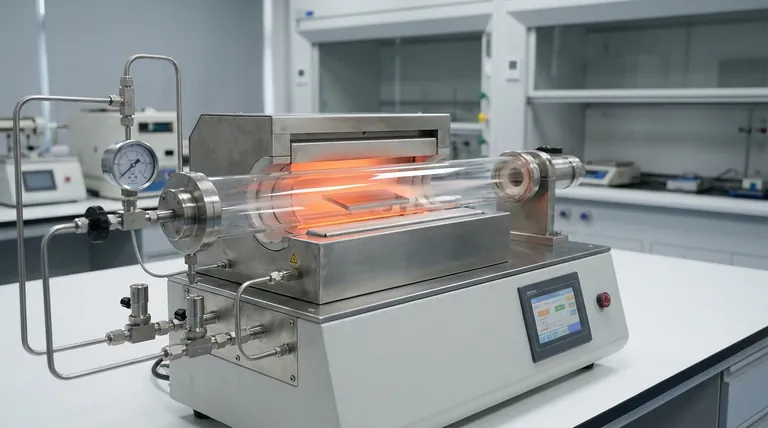
The role of an open-flow cold-wall Chemical Vapor Deposition (CVD) system is to create a precisely targeted thermal environment for the synthesis of Hafnium Dioxide (HfO2). By concentrating thermal energy exclusively on the substrate, the system facilitates the directional flow of the HfCl4 precursor, ensuring efficient redox reactions occur only where intended. This configuration is the defining factor in achieving HfO2 coatings that possess both high purity and uniform thickness.
The cold-wall design separates the reaction zone from the rest of the chamber, preventing premature chemical reactions on the vessel walls. This isolation, combined with controlled gas flow, is essential for high-precision HfO2 deposition.
The Mechanics of Thermal Control
Concentrating Heat on the Substrate
Unlike systems that heat the entire chamber, a cold-wall design restricts heating elements to the substrate holder or the substrate itself.
This ensures that the high temperatures required for the reaction exist only at the target surface. The chamber walls remain relatively cool, preventing the deposition of material where it is not wanted.
Precision Temperature Distribution
Because the heat is localized, the system allows for granular control over the temperature distribution within the reaction zone.
This thermal precision is critical for HfO2 preparation. It ensures that the activation energy required for the reaction is available exactly across the surface of the component, promoting a consistent coating structure.
Optimizing Gas Flow and Chemistry
Directional Gas Flow
The "open-flow" aspect of the system manages the movement of the vaporized precursor.
It establishes a directional gas flow that carries the reactants over the substrate. This constant supply of fresh precursor ensures the reaction rate remains stable throughout the deposition process.
Efficient HfCl4 Redox Reactions
The system is specifically tuned to handle the HfCl4 precursor.
When the precursor gas hits the heated substrate, the thermal energy triggers an efficient redox reaction. This transforms the gaseous precursor into a solid HfO2 film directly on the surface.
Achieving High Purity and Uniformity
By combining localized heat with directional flow, the system minimizes gas-phase nucleation (powder formation in the air).
This ensures the coating grows via heterogeneous nucleation on the surface. The result is a film with uniform thickness and exceptional purity, free from the contaminants often found in hot-wall processes.
Understanding the Trade-offs
Sensitivity to Surface Geometry
While CVD is generally capable of coating non-line-of-sight areas, the physics of gas flow still apply.
Small, confined internal geometries, such as deep bores or needles, may restrict the flow of the precursor. This can result in thinner films in these areas compared to exposed surfaces.
Impact of Surface Finish
The substrate’s initial condition plays a significant role in the final quality of the HfO2 layer.
A rough surface finish can lead to uneven coating rates, as peaks on the surface may be coated preferentially. Precise surface preparation is often required to fully leverage the uniformity benefits of the cold-wall system.
Making the Right Choice for Your Goal
To maximize the effectiveness of an open-flow cold-wall CVD system, align your process parameters with your specific coating requirements.
- If your primary focus is high purity: Rely on the cold-wall architecture to prevent chamber wall off-gassing and minimize particle contamination in the HfO2 layer.
- If your primary focus is dimensional uniformity: Optimize the directional gas flow rates to ensure consistent precursor delivery across the entire substrate, reducing thickness variations.
By isolating the thermal reaction to the substrate surface, this system turns a complex chemical process into a controllable manufacturing solution.
Summary Table:
| Feature | Cold-Wall CVD Function | Impact on HfO2 Coating |
|---|---|---|
| Thermal Control | Heat concentrated on substrate only | Prevents wall deposition; enhances purity |
| Gas Flow | Open-flow directional movement | Ensures stable reaction rates & precursor supply |
| Reaction Type | Surface-specific redox reaction | Promotes heterogeneous nucleation & density |
| Uniformity | Controlled temperature distribution | Delivers consistent film thickness across surface |
| Purity | Reduced gas-phase nucleation | Minimizes powder formation & contamination |
Elevate Your Material Synthesis with KINTEK Precision
Are you looking to master complex deposition processes like HfO2 coating? KINTEK provides industry-leading CVD systems, Muffle, Tube, and Vacuum furnaces designed to meet the most rigorous laboratory standards. Backed by expert R&D and precision manufacturing, our high-temperature systems are fully customizable to your unique research or production needs.
Our value to you:
- Precision Engineering: Achieve unmatched thermal uniformity for high-purity results.
- Custom Solutions: Tailor gas flow and chamber configurations to your specific substrates.
- Expert Support: Leverage our deep knowledge in CVD and high-temp processing.
Ready to optimize your thin-film deposition? Contact KINTEK today to discuss your custom furnace solution!
Visual Guide

References
- Junyu Zhu, Xuxiang Zhang. Oxidation Resistance of Ir/HfO2 Composite Coating Prepared by Chemical Vapor Deposition: Microstructure and Elemental Migration. DOI: 10.3390/coatings14060695
This article is also based on technical information from Kintek Furnace Knowledge Base .
Related Products
- HFCVD Machine System Equipment for Drawing Die Nano Diamond Coating
- Custom Made Versatile CVD Tube Furnace Chemical Vapor Deposition CVD Equipment Machine
- Cylindrical Resonator MPCVD Machine System for Lab Diamond Growth
- MPCVD Machine System Reactor Bell-jar Resonator for Lab and Diamond Growth
- Slide PECVD Tube Furnace with Liquid Gasifier PECVD Machine
People Also Ask
- What is Hot-filament Chemical Vapor Deposition (HFCVD)? Achieve High-Quality Thin Films with Precision Control
- What are the equipment for chemical vapor deposition? A Guide to the 5 Essential Components
- What is the significance of the vacuum pressure control system in the CVD coating process for powders?
- What is the function of high-purity Argon (Ar) gas during CVD? Optimize Your Thin Film Uniformity and Purity
- What are the advantages of using Chemical Vapor Deposition (CVD) for coating turbine blades? Enhance Life & Performance










