Maintaining a continuous nitrogen flow is the critical factor that allows BN@C pyrolysis to occur without destroying the material. A steady flow, such as 100 mL min⁻¹, serves two distinct but equally vital functions: it creates an inert protective shield to prevent oxidation and acts as a sweeping agent to physically remove volatile byproducts like hydrogen.
Core Takeaway: Nitrogen flow is not merely a background condition; it is an active process variable that preserves the chemical integrity of carbon and boron nitride while driving the reaction toward completion by removing waste gases.
The Dual Function of Nitrogen Flow
Creating an Inert Protective Atmosphere
The primary danger during high-temperature pyrolysis is oxidation. Without a protective barrier, the carbon and boron nitride (BN) components would react with atmospheric oxygen.
Continuous nitrogen flow acts as this barrier. By displacing air within the tube furnace, it ensures the environment remains strictly anaerobic.
This prevents the degradation of the BN@C structure, allowing the formation of stable composite materials rather than oxidized ash or compromised structures.
Acting as a Sweeping Gas
Pyrolysis involves chemical decomposition that releases gaseous byproducts, such as hydrogen and other volatiles.
If these gases remain in the reaction zone, they can inhibit the reaction or destabilize the final product.
The nitrogen stream functions as a sweeping gas, efficiently carrying these byproducts out of the furnace. This removal ensures the reaction proceeds efficiently toward the desired equilibrium.
The Role of the Tube Furnace Environment
Enabling Precise Environmental Control
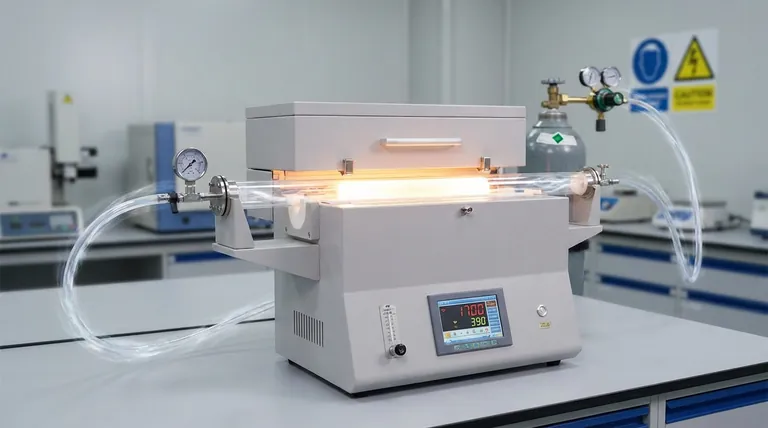
The tube furnace provides an enclosed, highly controlled heating environment essential for sensitive processes like BN@C synthesis.
Within this enclosed system, the nitrogen flow regulates the pyrolysis atmosphere.
This isolation reduces external interference, ensuring that the chemical changes are driven solely by thermal decomposition and not by fluctuating ambient conditions.
Ensuring Data Consistency
For researchers, particularly those generating datasets for modeling, environmental consistency is paramount.
A regulated nitrogen flow eliminates variables that could skew results, such as partial oxidation or byproduct re-deposition.
This leads to standardized data, which is vital for accurately measuring material properties or reaction efficiencies.
Understanding the Trade-offs
The Risk of Insufficient Flow
If the nitrogen flow is too low or intermittent, the "sweeping" effect is compromised.
Volatile byproducts may linger in the hot zone, potentially causing secondary reactions that contaminate the BN@C composite.
Furthermore, any breach in positive pressure could allow oxygen to backstream into the furnace, leading to immediate material degradation.
The Dynamics of Flow Rate
While the primary reference suggests a specific rate (e.g., 100 mL min⁻¹), the optimal flow is a balance.
The flow must be sufficient to clear volatiles immediately upon generation.
However, the flow must also be steady enough to maintain the uniform heat transfer provided by the furnace elements, ensuring the sample temperature remains consistent with the target setpoint.
Making the Right Choice for Your Goal
- If your primary focus is Material Purity: Ensure the nitrogen flow is established well before heating begins to fully purge oxygen and prevent early-stage oxidation.
- If your primary focus is Reaction Efficiency: Calibrate the flow rate to match the volume of volatiles generated; higher reaction rates may require aggressive sweeping to prevent byproduct accumulation.
- If your primary focus is Reproducibility: Use mass flow controllers to lock in the exact flow rate (e.g., 100 mL min⁻¹) for every run to minimize experimental variance.
Control the atmosphere, and you control the chemistry.
Summary Table:
| Function | Role in BN@C Pyrolysis | Primary Benefit |
|---|---|---|
| Inert Shielding | Displaces atmospheric oxygen | Prevents oxidation and structural degradation |
| Sweeping Gas | Removes hydrogen and volatiles | Drives reaction equilibrium and prevents contamination |
| Pressure Control | Maintains positive internal pressure | Prevents oxygen backstreaming into the hot zone |
| Atmosphere Stability | Standardizes the chemical environment | Ensures data consistency and experimental reproducibility |
Elevate Your Material Research with KINTEK Precision
Achieving perfect pyrolysis results like BN@C synthesis requires more than just heat; it requires absolute atmospheric control. KINTEK provides industry-leading Tube, Vacuum, and CVD systems designed to handle complex gas flows with precision.
Backed by expert R&D and manufacturing, our lab high-temp furnaces are fully customizable to meet your unique research needs, ensuring every run is free from oxidation and rich in data consistency.
Ready to optimize your thermal processing? Contact us today to discuss your specific requirements with our technical team!
References
- Carlos A. Castilla-Martinez, Umit B. Demirci. A boron nitride–carbon composite derived from ammonia borane and ZIF-8 with promises for the adsorption of carbon dioxide. DOI: 10.1039/d4nj00643g
This article is also based on technical information from Kintek Furnace Knowledge Base .
Related Products
- Electric Rotary Kiln Small Rotary Furnace Biomass Pyrolysis Plant Rotating Furnace
- 1200℃ Controlled Inert Nitrogen Atmosphere Furnace
- Magnesium Extraction and Purification Condensing Tube Furnace
- Electric Rotary Kiln Continuous Working Small Rotary Furnace Kiln for Pyrolysis Plant Heating
- Electric Rotary Kiln Pyrolysis Furnace Plant Machine Small Rotary Kiln Calciner
People Also Ask
- What are the main applications of a rotary kiln electric furnace? Achieve Uniform Heat Treatment for Powders
- What are the key components of a rotary kiln electric furnace? Unlock Efficient Thermal Processing
- What is the significance of the refractory lining in a rotary kiln electric furnace? Unlock Efficiency and Longevity
- What is the benefit of adjustable speed control in rotary kilns? Optimize Efficiency and Quality
- What are the main advantages of using rotary kilns for bulk solids processing? Achieve High-Volume, Uniform Thermal Processing