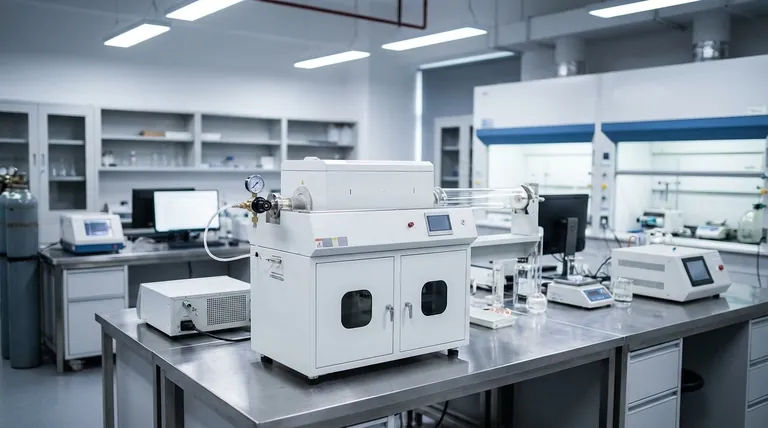
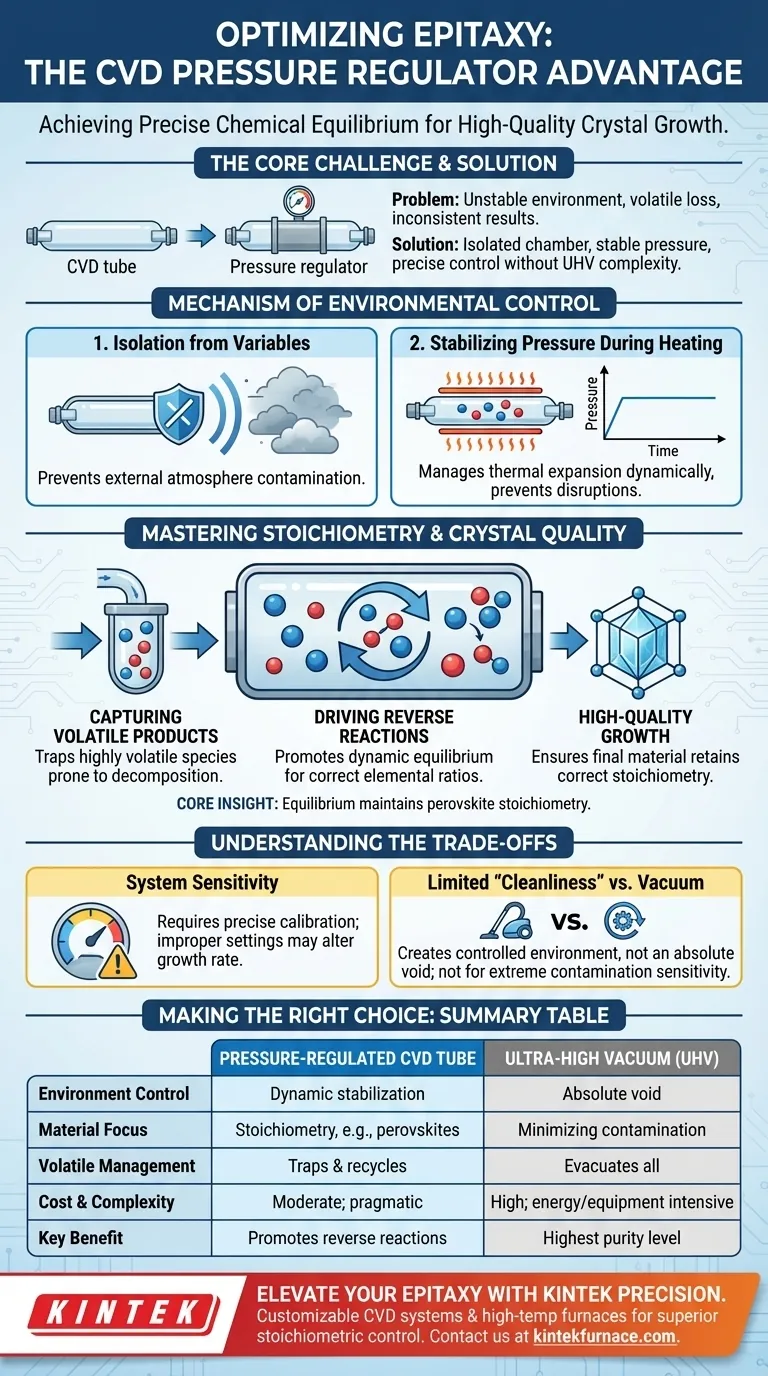
The primary advantage of a chemical vapor deposition (CVD) tube equipped with a pressure regulator is its ability to create a stable, isolated reaction environment without the cost or complexity of ultra-high vacuum systems. By isolating the internal chamber from the external atmosphere, the regulator allows for precise control over internal pressure even as temperatures rise.
Core Insight: High-quality crystal growth relies on chemical equilibrium. A pressure-regulated system traps volatile byproducts that would otherwise escape, forcing reverse reactions that maintain the correct stoichiometry of sensitive materials like perovskites.
The Mechanism of Environmental Control
Isolation from External Variables
The pressure regulator acts as a barrier between the reaction and the outside world. It ensures that the external atmosphere does not contaminate the delicate chemical processes occurring inside the tube.
Stabilizing Pressure During Heating
As the CVD tube heats up, gases inside naturally expand. The regulator manages this thermal expansion dynamically. It maintains a stable internal pressure profile throughout the temperature ramp, preventing fluctuations that could disrupt crystal formation.
Controlling Stoichiometry and Crystal Quality
Capturing Volatile Products
In contact transfer epitaxy, certain reaction byproducts or precursors are highly volatile and prone to decomposing. In an open system, these components would simply evaporate and be lost. The regulated environment traps these volatile species within the reaction zone.
Driving Reverse Reactions
Because these volatile components are captured rather than lost, they remain available to participate in the reaction chemistry. This availability promotes necessary reverse reactions. This dynamic equilibrium is critical for ensuring the final material retains the correct elemental ratios (stoichiometry).
Efficiency Without Ultra-High Vacuum
This setup offers a pragmatic balance for high-quality growth. It achieves the environmental control necessary for complex crystals without requiring the immense energy and equipment footprint of ultra-high vacuum conditions.
Understanding the Trade-offs
System Sensitivity
While effective, adding a pressure regulator introduces a variable that must be monitored. If the regulator is improperly calibrated, it may either vent too much precursor material or fail to release enough pressure, potentially altering the growth rate.
Limited "Cleanliness" Compared to Vacuum
This method creates a controlled environment, not a void. While it prevents external contamination, it does not evacuate background gases as thoroughly as an ultra-high vacuum system, which may be a limitation for extremely contamination-sensitive applications outside of standard perovskites.
Making the Right Choice for Your Goal
To determine if this setup is right for your specific synthesis, consider your material constraints:
- If your primary focus is stoichiometric precision: Use a pressure-regulated CVD tube to ensure volatile components are retained and chemical equilibrium is maintained.
- If your primary focus is absolute minimum contamination: You may still require an ultra-high vacuum system if your material cannot tolerate even trace background gases.
By managing pressure to control chemical volatility, you transform the reaction environment from a passive vessel into an active participant in crystal growth.
Summary Table:
| Feature | Pressure-Regulated CVD Tube | Ultra-High Vacuum (UHV) |
|---|---|---|
| Environment Control | Dynamic pressure stabilization | Absolute void/minimum gases |
| Material Focus | Maintaining stoichiometry (e.g., perovskites) | Minimizing total contamination |
| Volatile Management | Traps and recycles volatile byproducts | Evacuates all species |
| Cost & Complexity | Moderate; pragmatic for high-quality growth | High; energy and equipment intensive |
| Key Benefit | Promotes necessary reverse reactions | Highest possible purity level |
Elevate Your Epitaxy with KINTEK Precision
Ready to achieve superior stoichiometric control in your thin-film research? KINTEK provides industry-leading, customizable CVD systems and lab high-temp furnaces designed to meet the rigorous demands of modern material science.
Backed by expert R&D and manufacturing, our systems—including Tube, Muffle, Rotary, and Vacuum furnaces—are engineered to help you maintain the perfect chemical equilibrium for high-quality crystal growth.
Don't settle for inconsistent results. Contact our technical specialists today to find the ideal regulated CVD solution for your unique laboratory needs.
Visual Guide
References
- Hongyu Sun, Erik C. Garnett. Contact Transfer Epitaxy of Halide Perovskites. DOI: 10.1002/adma.202308892
This article is also based on technical information from Kintek Furnace Knowledge Base .
Related Products
- Custom Made Versatile CVD Tube Furnace Chemical Vapor Deposition CVD Equipment Machine
- Multi Heating Zones CVD Tube Furnace Machine for Chemical Vapor Deposition Equipment
- Split Chamber CVD Tube Furnace with Vacuum Station CVD Machine
- Slide PECVD Tube Furnace with Liquid Gasifier PECVD Machine
- Inclined Rotary Plasma Enhanced Chemical Deposition PECVD Tube Furnace Machine
People Also Ask
- Why are CVD tube furnace sintering systems indispensable for 2D material research and production? Unlock Atomic-Scale Precision
- What is a CVD tube furnace and what is its primary function? Discover Precision Thin-Film Deposition
- How does CVD tube furnace sintering enhance graphene growth? Achieve Superior Crystallinity and High Electron Mobility
- Which industries and research fields benefit from CVD tube furnace sintering systems for 2D materials? Unlock Next-Gen Tech Innovations
- What customization options are available for CVD tube furnaces? Tailor Your System for Superior Material Synthesis