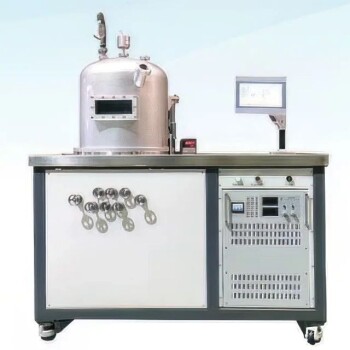
A Chemical Vapor Deposition (CVD) system achieves precise control over Indium Nitride (InN) nanowire growth through the synchronization of two critical subsystems: high-precision mass flow controllers regarding reactant supply and a tube furnace temperature control system regarding reaction kinetics. Specifically, the system regulates the flow rate of ammonia (NH3) gas and maintains a strictly stable reaction environment at approximately 900 degrees Celsius to facilitate the reaction between indium vapor and gold catalyst sites.
Core Takeaway The precision of InN nanowire growth relies on creating a stable thermodynamic "sweet spot." By locking the temperature at 900°C and strictly metering ammonia flow, the system forces the indium vapor to react specifically at gold catalyst sites, resulting in high-aspect-ratio, single-crystal structures rather than random bulk deposition.
The Mechanics of Environmental Control
To understand how the CVD system directs nanowire morphology, you must look at how it manages the reaction environment variables.
Regulating Reactant Supply
The primary lever for control is the mass flow controller (MFC).
This component is responsible for the exact metering of ammonia (NH3) gas entering the chamber.
Unlike a simple valve, an MFC actively measures and adjusts the mass of the gas ensuring a constant, repeatable molar supply of the reactant.
This precise allocation ensures that the reaction is never "starved" of nitrogen, nor is it overwhelmed by turbulent flow that could disrupt delicate nanowire formation.
Thermal Stability via Tube Furnace
The second pillar of control is the tube furnace temperature system.
For Indium Nitride nanowires, the system must maintain a target temperature of approximately 900 degrees Celsius.
This temperature is not arbitrary; it provides the necessary energy for the chemical reaction to occur efficiently without degrading the substrate or the growing crystal.
Stability here is paramount; fluctuations in temperature would lead to inconsistent crystal structures or halted growth.
The Growth Mechanism at the Micro-Scale
The hardware described above exists to support a specific chemical interaction at the substrate level.
Catalyst-Driven Deposition
The control system directs the growth to occur at specific locations defined by gold (Au) catalyst sites.
These gold particles act as the nucleation point where the gaseous indium vapor and the controlled ammonia gas meet.
Because the system maintains the environment at 900°C, the reaction is thermodynamically favored to occur at these catalyst sites.
Substrate Interaction
The process typically utilizes a carbon fiber substrate.
The high-precision environment ensures that the nanowires grow outward from the carbon fiber surface.
The result is the formation of high-aspect-ratio, single-crystal nanowires, meaning they are long, thin, and possess a continuous, unbroken crystal lattice.
Understanding the Trade-offs
While CVD offers high precision, it involves inherent complexities that must be managed to ensure success.
Temperature Sensitivity
The specific requirement of 900°C indicates a narrow processing window.
Deviating significantly from this temperature can alter the reaction kinetics.
Too low, and the reaction may not activate at the gold sites; too high, and you risk thermally damaging the delicate nanowires or the carbon substrate.
Flow Rate Balance
While the MFCs provide precision, the ratio of gases is critical.
As seen in broader CVD applications, the gas mixture often dictates the transport velocity and redox potential of the environment.
In this specific InN process, the ammonia flow must be perfectly balanced against the indium vapor supply to prevent defects in the crystal structure.
Making the Right Choice for Your Goal
When configuring a CVD system for nanowire growth, your priority defines your operational parameters.
- If your primary focus is Crystal Quality: Prioritize the thermal stability of the tube furnace to ensure the 900°C setpoint varies by less than a degree, ensuring single-crystal integrity.
- If your primary focus is Aspect Ratio (Length/Width): Focus on the fine-tuning of the Mass Flow Controllers to optimize the supply of ammonia, ensuring the catalyst sites are continuously fed without saturation.
Precision in CVD is not just about having the right hardware; it is about calibrating that hardware to maintain the specific thermodynamic conditions required for catalyst-mediated growth.
Summary Table:
| Control Parameter | Hardware Component | Target/Function |
|---|---|---|
| Temperature | High-Temp Tube Furnace | Stable ~900°C for reaction kinetics |
| Reactant Flow | Mass Flow Controller (MFC) | Precise NH3 metering for consistent supply |
| Growth Site | Gold (Au) Catalyst | Directs high-aspect-ratio nucleation |
| Substrate | Carbon Fiber | Provides the base for outward growth |
| Morphology | System-Wide Sync | Ensures single-crystal, high-aspect-ratio structures |
Precision Control for Your Nanomaterial Innovation
Achieving the perfect thermodynamic 'sweet spot' for InN nanowires requires more than just standard equipment; it requires precision engineering. KINTEK provides the advanced technology needed to lock in your success. Backed by expert R&D and manufacturing, we offer Muffle, Tube, Rotary, Vacuum, and CVD systems—all fully customizable to meet your unique lab requirements.
Whether you are focusing on crystal integrity or optimizing aspect ratios, our high-precision furnaces ensure your research is repeatable and reliable. Contact KINTEK today to discuss your custom furnace needs and see how our expertise can accelerate your material breakthroughs.
Visual Guide

References
- Tianqi Guo, Hong Yin. Indium Nitride Nanowires: Low Redox Potential Anodes for Lithium‐Ion Batteries. DOI: 10.1002/advs.202310166
This article is also based on technical information from Kintek Furnace Knowledge Base .
Related Products
- HFCVD Machine System Equipment for Drawing Die Nano Diamond Coating
- MPCVD Machine System Reactor Bell-jar Resonator for Lab and Diamond Growth
- Cylindrical Resonator MPCVD Machine System for Lab Diamond Growth
- Custom Made Versatile CVD Tube Furnace Chemical Vapor Deposition CVD Equipment Machine
- 915MHz MPCVD Diamond Machine Microwave Plasma Chemical Vapor Deposition System Reactor
People Also Ask
- What is Hot-filament Chemical Vapor Deposition (HFCVD)? Achieve High-Quality Thin Films with Precision Control
- What are the equipment for chemical vapor deposition? A Guide to the 5 Essential Components
- What is the significance of the vacuum pressure control system in the CVD coating process for powders?
- What is the function of high-purity Argon (Ar) gas during CVD? Optimize Your Thin Film Uniformity and Purity
- What are the advantages of using Chemical Vapor Deposition (CVD) for coating turbine blades? Enhance Life & Performance