
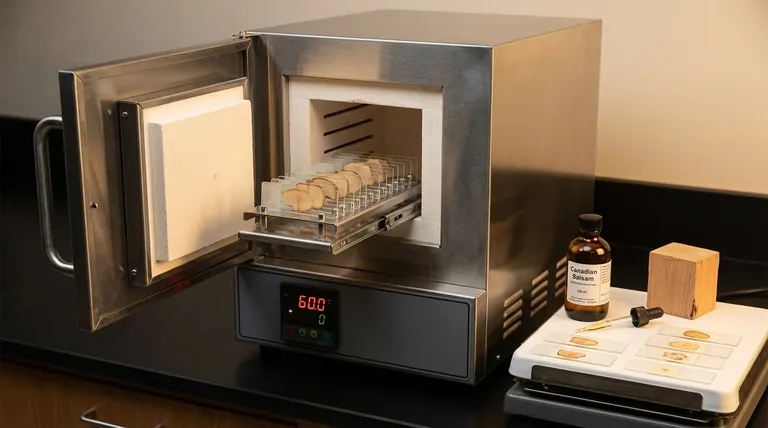
The combination of Canadian Balsam and a laboratory oven is the industry standard for creating professional-grade, permanent wood microscope slides. Canadian Balsam serves as a high-clarity mounting medium to enhance visibility, while the laboratory oven provides the thermal energy required to cure the slide effectively and ensure it lasts for years without deterioration.
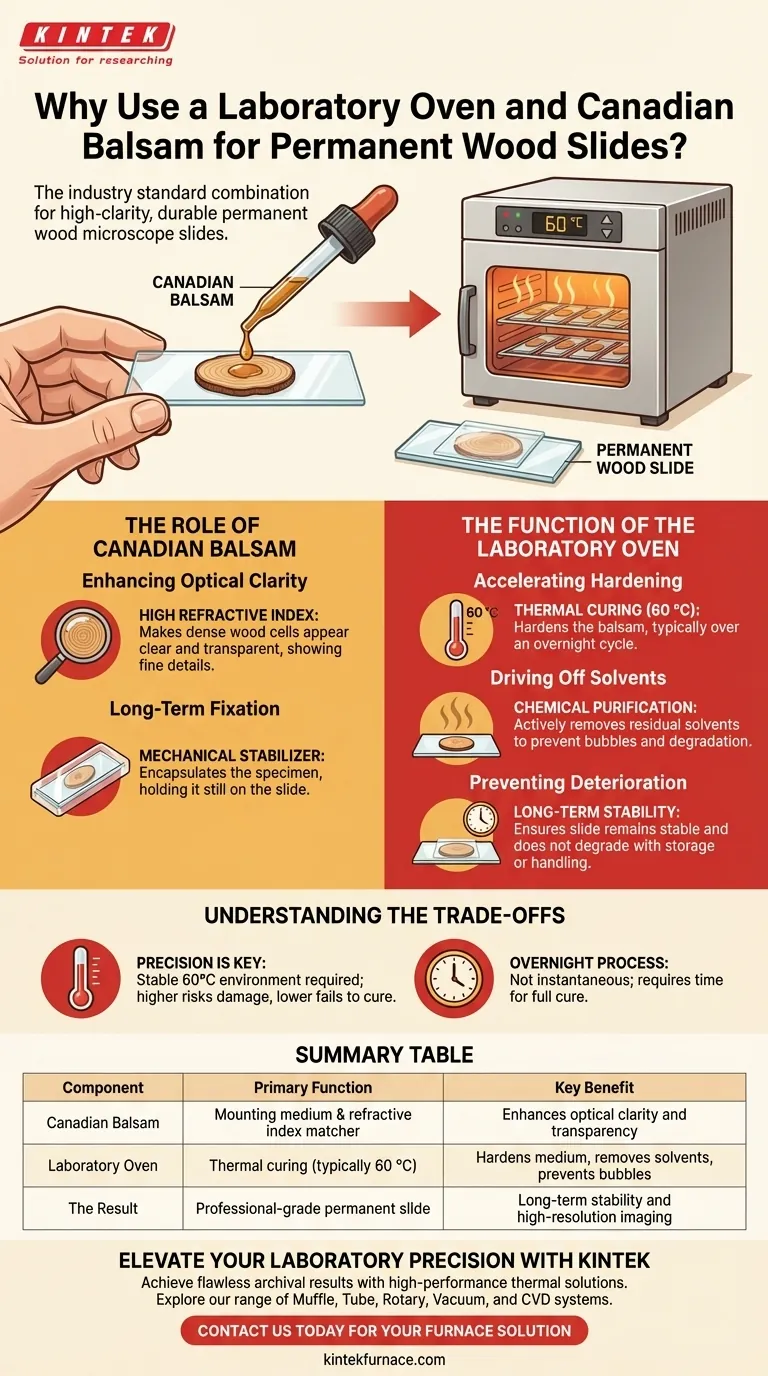
Canadian Balsam provides the high refractive index necessary to visualize dense wood cell structures, while the laboratory oven serves as the catalyst for permanence by driving off solvents and hardening the medium.
The Role of Canadian Balsam
Enhancing Optical Clarity
Wood is a naturally dense material that can be difficult to view under a microscope. Canadian Balsam is selected because of its high refractive index.
Creating Transparency
When applied, the balsam interacts with the wood tissue to make cell structures appear clearer and more transparent. This optical property is essential for distinguishing fine details within the wood grain.
Long-Term Fixation
Beyond optics, the balsam acts as a mechanical stabilizer. It encapsulates the wood specimen, holding it perfectly still on the glass slide.
The Function of the Laboratory Oven
Accelerating the Hardening Process
In its raw state, Canadian Balsam remains viscous for a long time. The laboratory oven is used to heat the slides at 60 °C, typically overnight.
Driving Off Residual Solvents
The heating process is not just about drying; it is about chemical purification. The sustained heat actively removes residual solvents trapped within the medium.
Preventing Deterioration
By removing solvents and hardening the balsam quickly, the oven prevents the formation of bubbles. This ensures the slide remains stable and does not degrade during long-term storage or repeated handling.
Understanding the Trade-offs
Temperature Precision
You cannot simply use any heat source. The process requires a stable 60 °C environment; higher temperatures could damage the wood specimen or discolor the balsam, while lower temperatures will fail to cure the medium.
Processing Time
Even with an oven, this is not an instantaneous process. It requires an overnight cycle to ensure the center of the slide is fully cured, meaning workflow planning is essential.
Making the Right Choice for Your Goal
To ensure your wood slides are both viewable and durable, consider the following principles:
- If your primary focus is image quality: Rely on Canadian Balsam for its refractive properties to make the cellular structure of the wood visible and distinct.
- If your primary focus is archival preservation: Do not skip the oven curing step, as removing solvents is the only way to prevent bubbling and deterioration over time.
By combining the optical chemistry of the balsam with the controlled physics of the oven, you create a specimen that is both clear to view and built to last.
Summary Table:
| Component | Primary Function | Key Benefit |
|---|---|---|
| Canadian Balsam | Mounting medium & refractive index matcher | Enhances optical clarity and transparency of wood cells |
| Laboratory Oven | Thermal curing (typically 60 °C) | Hardens medium, removes solvents, and prevents bubbles |
| The Result | Professional-grade permanent slide | Long-term stability and high-resolution imaging for years |
Elevate Your Laboratory Precision with KINTEK
Achieve flawless archival results in your material analysis with high-performance thermal solutions. Backed by expert R&D and manufacturing, KINTEK offers a wide range of laboratory equipment including Muffle, Tube, Rotary, Vacuum, and CVD systems, along with specialized lab high-temp furnaces. Whether you are preparing delicate biological slides or conducting advanced industrial heat treatments, our systems are fully customizable to meet your unique research needs.
Ready to optimize your lab's efficiency? Contact us today to find the perfect furnace solution for your application!
Visual Guide
References
- Issah Chakurah, Enoch Gbapenuo Tampori. The Effect of Thermal Modification on Anatomical Properties of Daniellia oliveri (Rolfe) Hutch and Dalziel from Ghana. DOI: 10.5552/drvind.2025.0218
This article is also based on technical information from Kintek Furnace Knowledge Base .
Related Products
- Laboratory Muffle Oven Furnace with Bottom Lifting
- 1200℃ Muffle Oven Furnace for Laboratory
- 1400℃ Muffle Oven Furnace for Laboratory
- 1800℃ High Temperature Muffle Oven Furnace for Laboratory
- 1700℃ High Temperature Muffle Oven Furnace for Laboratory
People Also Ask
- Why is a high-temperature laboratory muffle furnace essential for the alkali fusion process in zeolite synthesis?
- What is the importance of the calcination process? Master High-Purity Calcium Phosphate Nanopowder Production
- Why is a high-temperature muffle furnace required for FeOx-MOx/TiO2? Engineering High-Performance Nanocomposites
- What function does a muffle furnace perform in Ba0.75Ca0.25TiO3 calcination? Ensure Phase Purity & Synthesis
- What are the primary functions of a high-temperature laboratory muffle furnace in the preparation of biosorbent materials?



















