Knowledge How does the carbon reductant ratio influence the selective reduction of ferronickel? Mastering Alloy Purity
Author avatar

Tech Team · Kintek Furnace

Updated 4 hours ago

How does the carbon reductant ratio influence the selective reduction of ferronickel? Mastering Alloy Purity


The carbon reductant ratio is the primary lever for controlling the composition of ferronickel alloys. By adjusting the specific weight percentage of carbon—typically between 3 wt.% and 4 wt.%—metallurgists can precisely regulate the ratio of iron to nickel in the final product.

While increasing carbon acts as a medium to convert oxides into metal, there is a critical threshold for efficiency. The optimal balance for selective reduction generally lies between 3 wt.% and 4 wt.%; exceeding this limit risks compromising the alloy's purity.
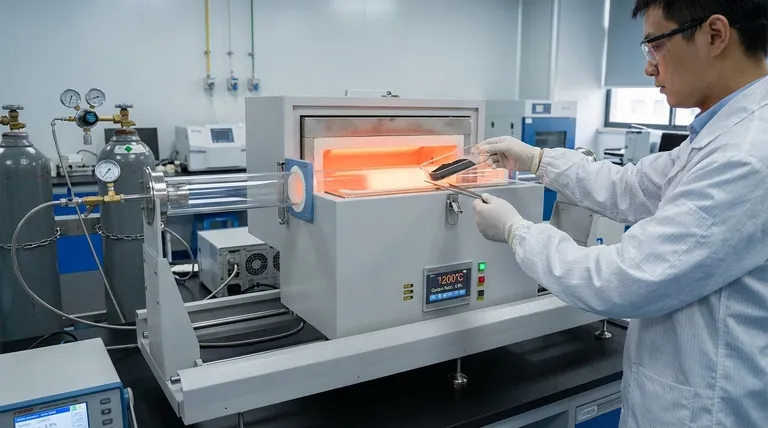
How does the carbon reductant ratio influence the selective reduction of ferronickel? Mastering Alloy Purity

The Mechanism of Selective Reduction

The Function of the Reductant

At high temperatures, carbon serves as the essential medium for chemical conversion. Its primary role is to strip oxygen from nickel and iron oxides, transforming them into their metallic forms.

Regulating Alloy Composition

The specific proportion of carbon added allows for fine-tuning of the final alloy. By staying within the 3 wt.% to 4 wt.% range, you can control the iron-to-nickel (Fe/Ni) ratio with high precision.

This control is vital for producing ferronickel grades that meet strict industrial specifications.

Understanding the Trade-offs

The Consequences of Excess Carbon

It may be tempting to increase carbon levels to maximize yield, but this comes with significant downsides. Exceeding a threshold of 5 wt.% carbon shifts the chemical dynamics of the reduction process.

Quality vs. Recovery

While higher carbon input may increase overall metal recovery, it leads to the over-reduction of impurities.

Specifically, excess carbon causes stable oxides like silicon and chromium to reduce into the metal phase. This results in an alloy with unwanted contaminants, degrading the quality of the final ferronickel product.

Making the Right Choice for Your Goal

To optimize your reduction process, you must weigh the need for volume against the requirement for chemical purity.

  • If your primary focus is Precise Alloy Composition: Maintain carbon addition between 3 wt.% and 4 wt.% to strictly regulate the Fe/Ni ratio.
  • If your primary focus is High Purity: Ensure carbon addition does not exceed 5 wt.% to prevent the contamination of the alloy with silicon and chromium.

Mastering the carbon reductant ratio is the key to balancing high metal recovery with superior alloy quality.

Summary Table:

Carbon Ratio (wt.%) Primary Impact Effect on Quality
3% - 4% Optimal Selective Reduction Precise Fe/Ni ratio; high purity
4% - 5% Increased Metal Recovery Moderate risk of over-reduction
> 5% Over-reduction of Impurities Contamination with Silicon & Chromium

Precision Heat Treatment for High-Purity Metallurgy

Achieving the perfect carbon reductant ratio requires rigorous thermal control and specialized equipment. Backed by expert R&D and manufacturing, KINTEK offers high-performance Muffle, Tube, Rotary, Vacuum, and CVD systems, along with other lab high-temperature furnaces—all fully customizable to meet your unique metallurgical research and production needs.

Ready to optimize your ferronickel selective reduction process? Contact KINTEK today to discover how our advanced furnace solutions can help you balance high metal recovery with superior alloy quality.

Visual Guide
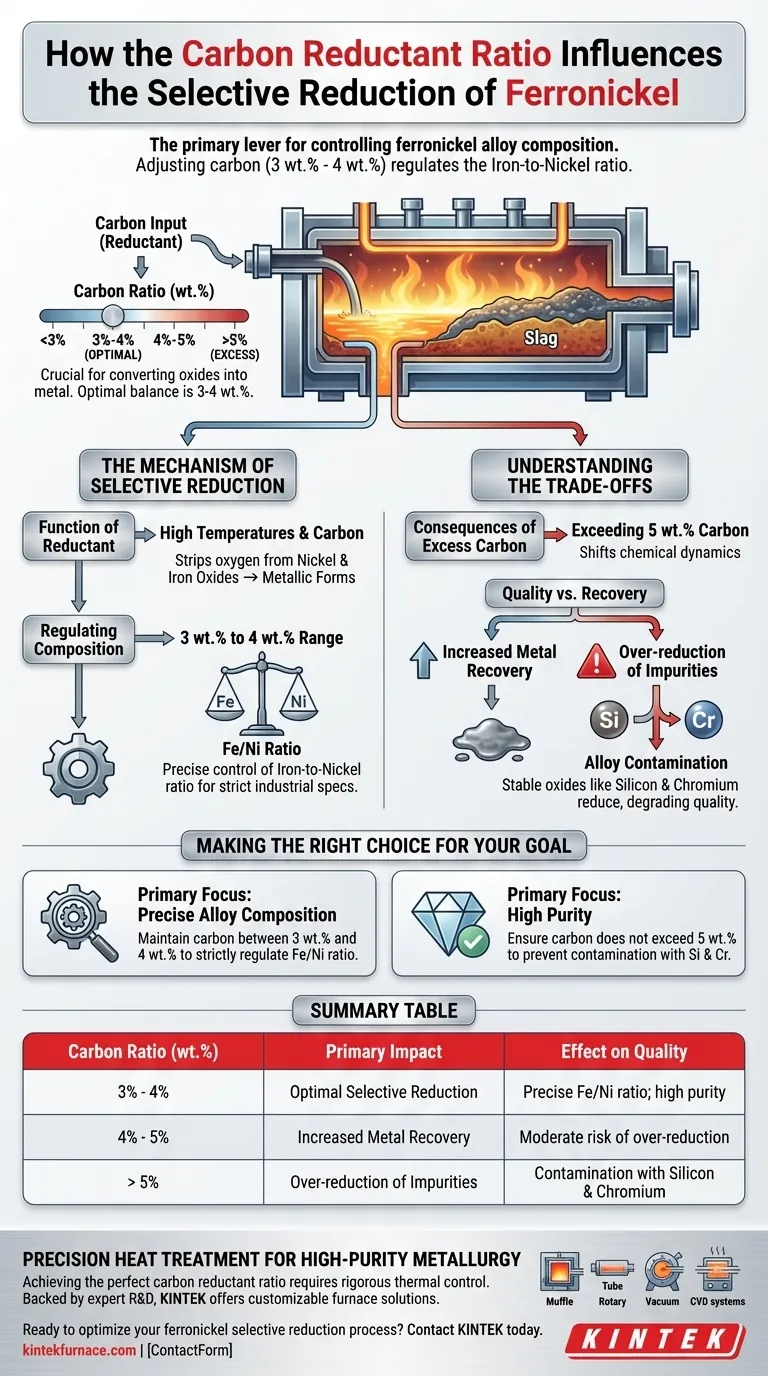
How does the carbon reductant ratio influence the selective reduction of ferronickel? Mastering Alloy Purity Visual Guide

References

  1. Erdenebold Urtnasan, Jei‐Pil Wang. Relationship Between Thermodynamic Modeling and Experimental Process for Optimization Ferro-Nickel Smelting. DOI: 10.3390/min15020101

This article is also based on technical information from Kintek Furnace Knowledge Base .

Related Products

People Also Ask

Related Products

Laboratory Quartz Tube Furnace RTP Heating Tubular Furnace

Laboratory Quartz Tube Furnace RTP Heating Tubular Furnace

KINTEK's RTP Rapid Heating Tube Furnace delivers precise temperature control, rapid heating up to 100°C/sec, and versatile atmosphere options for advanced lab applications.

Vertical Laboratory Quartz Tube Furnace Tubular Furnace

Vertical Laboratory Quartz Tube Furnace Tubular Furnace

Precision KINTEK Vertical Tube Furnace: 1800℃ heating, PID control, customizable for labs. Ideal for CVD, crystal growth & materials testing.

Laboratory Vacuum Tilt Rotary Tube Furnace Rotating Tube Furnace

Laboratory Vacuum Tilt Rotary Tube Furnace Rotating Tube Furnace

KINTEK Laboratory Rotary Furnace: Precision heating for calcination, drying, sintering. Customizable solutions with vacuum & controlled atmosphere. Enhance research now!

1400℃ Controlled Inert Nitrogen Atmosphere Furnace

1400℃ Controlled Inert Nitrogen Atmosphere Furnace

KT-14A Controlled Atmosphere Furnace for labs & industry. 1400°C max temp, vacuum sealing, inert gas control. Customizable solutions available.

Custom Made Versatile CVD Tube Furnace Chemical Vapor Deposition CVD Equipment Machine

Custom Made Versatile CVD Tube Furnace Chemical Vapor Deposition CVD Equipment Machine

KINTEK's CVD Tube Furnace offers precision temperature control up to 1600°C, ideal for thin film deposition. Customizable for research and industrial needs.

1700℃ High Temperature Muffle Oven Furnace for Laboratory

1700℃ High Temperature Muffle Oven Furnace for Laboratory

KT-17M Muffle Furnace: High-precision 1700°C lab furnace with PID control, energy efficiency, and customizable sizes for industrial & research applications.

Split Chamber CVD Tube Furnace with Vacuum Station CVD Machine

Split Chamber CVD Tube Furnace with Vacuum Station CVD Machine

Split Chamber CVD Tube Furnace with Vacuum Station - High precision 1200°C lab furnace for advanced materials research. Customizable solutions available.

1400℃ Muffle Oven Furnace for Laboratory

1400℃ Muffle Oven Furnace for Laboratory

KT-14M Muffle Furnace: Precision 1400°C heating with SiC elements, PID control, and energy-efficient design. Ideal for labs.

1700℃ Controlled Inert Nitrogen Atmosphere Furnace

1700℃ Controlled Inert Nitrogen Atmosphere Furnace

KT-17A Controlled Atmosphere Furnace: Precise 1700°C heating with vacuum & gas control. Ideal for sintering, research & material processing. Explore now!

Laboratory Muffle Oven Furnace with Bottom Lifting

Laboratory Muffle Oven Furnace with Bottom Lifting

Boost lab efficiency with KT-BL Bottom Lifting Furnace: precise 1600℃ control, superior uniformity, and enhanced productivity for material science and R&D.

Vacuum Sealed Continuous Working Rotary Tube Furnace Rotating Tube Furnace

Vacuum Sealed Continuous Working Rotary Tube Furnace Rotating Tube Furnace

Precision rotary tube furnace for continuous vacuum processing. Ideal for calcination, sintering, and heat treatment. Customizable up to 1600℃.

9MPa Air Pressure Vacuum Heat Treat and Sintering Furnace

9MPa Air Pressure Vacuum Heat Treat and Sintering Furnace

Achieve superior ceramic densification with KINTEK's advanced air pressure sintering furnace. High-pressure up to 9MPa, precise 2200℃ control.

Mesh Belt Controlled Atmosphere Furnace Inert Nitrogen Atmosphere Furnace

Mesh Belt Controlled Atmosphere Furnace Inert Nitrogen Atmosphere Furnace

KINTEK Mesh Belt Furnace: High-performance controlled atmosphere furnace for sintering, hardening & heat treatment. Customizable, energy-efficient, precise temperature control. Get a quote now!

1700℃ High Temperature Laboratory Tube Furnace with Quartz or Alumina Tube

1700℃ High Temperature Laboratory Tube Furnace with Quartz or Alumina Tube

KINTEK's Tube Furnace with Alumina Tube: Precision heating up to 1700°C for material synthesis, CVD, and sintering. Compact, customizable, and vacuum-ready. Explore now!

High Pressure Laboratory Vacuum Tube Furnace Quartz Tubular Furnace

High Pressure Laboratory Vacuum Tube Furnace Quartz Tubular Furnace

KINTEK High Pressure Tube Furnace: Precision heating up to 1100°C with 15Mpa pressure control. Ideal for sintering, crystal growth, and lab research. Customizable solutions available.

Small Vacuum Heat Treat and Tungsten Wire Sintering Furnace

Small Vacuum Heat Treat and Tungsten Wire Sintering Furnace

Compact vacuum tungsten wire sintering furnace for labs. Precise, mobile design with superior vacuum integrity. Ideal for advanced material research. Contact us!

Vacuum Dental Porcelain Sintering Furnace for Dental Laboratories

Vacuum Dental Porcelain Sintering Furnace for Dental Laboratories

KinTek Vacuum Porcelain Furnace: Precision dental lab equipment for high-quality ceramic restorations. Advanced firing control & user-friendly operation.

2200 ℃ Tungsten Vacuum Heat Treat and Sintering Furnace

2200 ℃ Tungsten Vacuum Heat Treat and Sintering Furnace

2200°C Tungsten Vacuum Furnace for high-temperature materials processing. Precise control, superior vacuum, customizable solutions. Ideal for research & industrial applications.

Chairside Dental Porcelain Zirconia Sintering Furnace with Transformer for Ceramic Restorations

Chairside Dental Porcelain Zirconia Sintering Furnace with Transformer for Ceramic Restorations

Dental Porcelain Speedy Sintering Furnace: Fast 9-minute zirconia sintering, 1530°C precision, SiC heaters for dental labs. Boost productivity today!

Multi Heating Zones CVD Tube Furnace Machine for Chemical Vapor Deposition Equipment

Multi Heating Zones CVD Tube Furnace Machine for Chemical Vapor Deposition Equipment

KINTEK's Multi-Zone CVD Tube Furnaces offer precision temperature control for advanced thin film deposition. Ideal for research and production, customizable for your lab needs.


Leave Your Message
















