The primary advantage of using an oriented single-crystal seed in the growth of Zinc Germanium Phosphide (ZnGeP2) is the ability to strictly dictate the crystallographic structure of the final material. By utilizing a seed with a specific orientation, such as (100), you effectively predetermine the growth axis rather than leaving it to chance. This technique is critical for suppressing the chaotic nature of spontaneous nucleation, ensuring the production of high-quality crystals with minimized defects.
By acting as a structural template, oriented seeds eliminate the randomness of spontaneous growth. This ensures a reduction in dislocations and parasitic crystallization, delivering the consistent physical properties required for high-performance non-linear optical applications.

Precise Control Over Crystal Architecture
Predetermining the Growth Axis
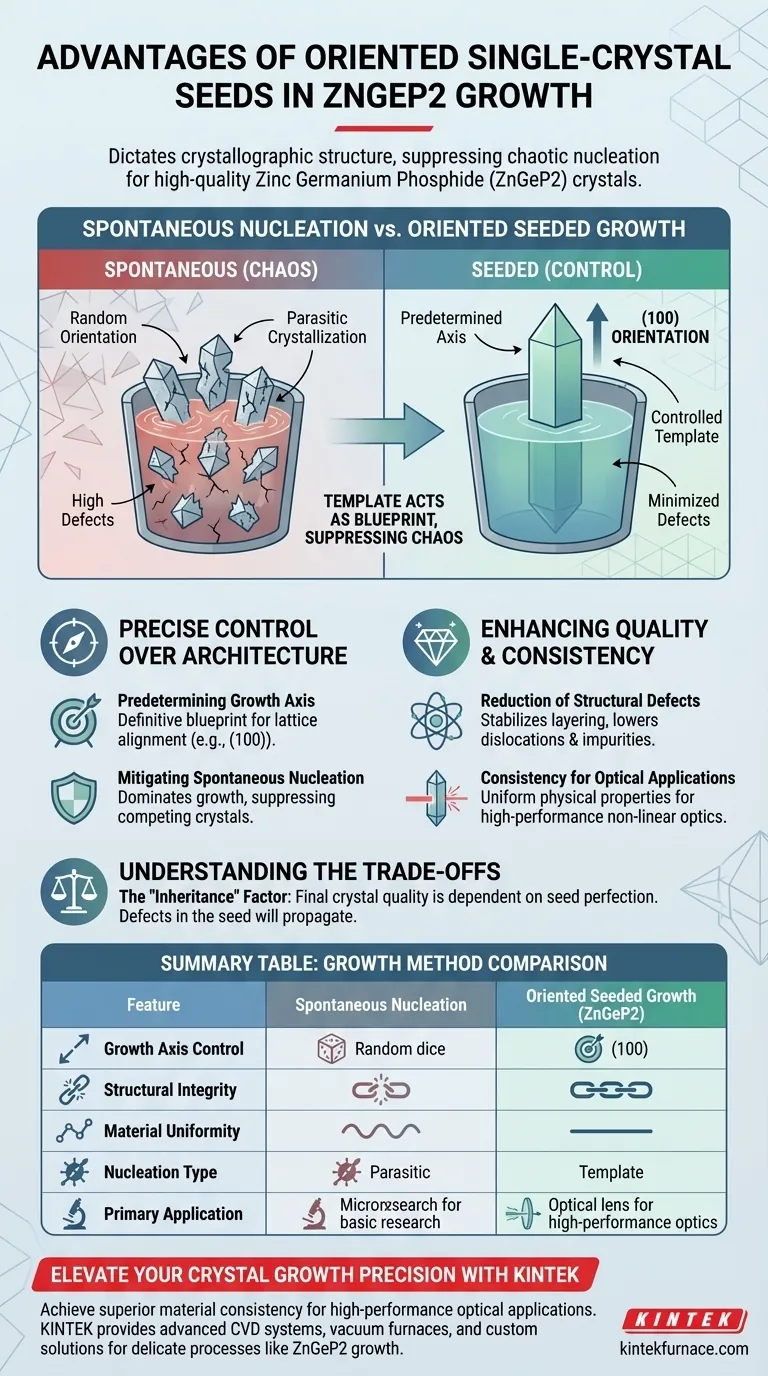
In unseeded growth, the orientation of a crystal is often random and unpredictable. Using a seed acts as a definitive blueprint for the developing material.
By introducing a seed with a specific orientation, typically (100), the growing crystal is forced to align with that specific lattice structure. This allows engineers to dictate the geometry and optical axes of the crystal from the very start of the process.
Mitigating Spontaneous Nucleation
Spontaneous nucleation occurs when crystals form randomly within the melt without a guiding structure. This often leads to parasitic crystallization, where multiple small, competing crystals grow instead of one large, unified mass.
An oriented seed provides a lower energy surface for growth to begin. This dominates the process, effectively suppressing spontaneous nucleation and ensuring the material grows as a single, cohesive unit.
Enhancing Material Quality and Consistency
Reduction of Structural Defects
The structural integrity of ZnGeP2 is paramount for its end-use performance. Uncontrolled growth often results in dislocations—breaks or misalignments in the crystal lattice.
Seeded growth stabilizes the atomic layering process. This stability significantly lowers the density of dislocations, resulting in a purer internal structure.
Consistency for Optical Applications
ZnGeP2 is primarily valued for its use in non-linear optical applications. These devices require the material to have uniform physical properties throughout its entire volume.
Because the seed ensures a consistent crystallographic orientation, the resulting physical properties remain constant across the crystal. This uniformity is impossible to guarantee with random, spontaneous growth methods.
Understanding the Trade-offs
The "Inheritance" Factor
While seeded growth offers superior control, it introduces a dependency on the quality of the seed itself. The growth process is essentially a copying mechanism.
If the seed contains defects or structural inaccuracies, these imperfections will propagate into the new crystal. Therefore, the advantage of this method is strictly limited by the quality of the initial seed material used.
Making the Right Choice for Your Goal
To maximize the yield and utility of Zinc Germanium Phosphide crystals, align your growth strategy with your specific requirements.
- If your primary focus is High-Fidelity Optical Output: Prioritize oriented seeding to guarantee the consistent physical properties required for non-linear optical devices.
- If your primary focus is Defect Minimization: Use seeded growth to prevent parasitic crystallization and significantly reduce lattice dislocations.
By moving from spontaneous nucleation to seeded growth, you transition from generating random samples to engineering precision optical components.
Summary Table:
| Feature | Spontaneous Nucleation | Oriented Seeded Growth (ZnGeP2) |
|---|---|---|
| Growth Axis Control | Random / Unpredictable | Predetermined (e.g., (100) orientation) |
| Structural Integrity | High risk of dislocations | Minimized defects and dislocations |
| Material Uniformity | Low / Inconsistent | High consistency for optical paths |
| Nucleation Type | Parasitic crystallization | Controlled template growth |
| Primary Application | Basic research samples | High-performance non-linear optics |
Elevate Your Crystal Growth Precision with KINTEK
Are you looking to achieve superior material consistency in your high-performance optical applications? At KINTEK, we understand that precision is the foundation of innovation. Backed by expert R&D and world-class manufacturing, we provide advanced CVD systems, vacuum furnaces, and customizable high-temperature lab solutions specifically designed to support delicate processes like the growth of Zinc Germanium Phosphide (ZnGeP2).
Whether you need to maintain strict thermal gradients for seeded growth or require a bespoke furnace for unique material synthesis, our team is ready to deliver the reliability your research demands. Contact KINTEK today to discuss your specific requirements and discover how our tailored heating solutions can optimize your laboratory’s output.
Visual Guide
References
- Alexey Lysenko, Alexey Olshukov. Band-like Inhomogeneity in Bulk ZnGeP2 Crystals, and Composition and Influence on Optical Properties. DOI: 10.3390/cryst15040382
This article is also based on technical information from Kintek Furnace Knowledge Base .
Related Products
- Multi Heating Zones CVD Tube Furnace Machine for Chemical Vapor Deposition Equipment
- MPCVD Machine System Reactor Bell-jar Resonator for Lab and Diamond Growth
- Multi Zone Laboratory Quartz Tube Furnace Tubular Furnace
- Cylindrical Resonator MPCVD Machine System for Lab Diamond Growth
- Vertical Laboratory Quartz Tube Furnace Tubular Furnace
People Also Ask
- What is the function of a multi-zone tube furnace in CVD synthesis? Master 2D In2Se3 Nanosheet Precision
- Why are multi zone tube furnaces particularly useful for nanomaterial research? Unlock Precise Thermal Control for Advanced Synthesis
- What role do multi zone tube furnaces play in new energy research? Unlock Precise Thermal Control for Innovation
- What environmental protection applications utilize multi zone tube furnaces? Unlock Precision in Waste Treatment and Green Tech
- What temperature-related capabilities make multi zone tube furnaces valuable for research? Unlock Precision Thermal Control