
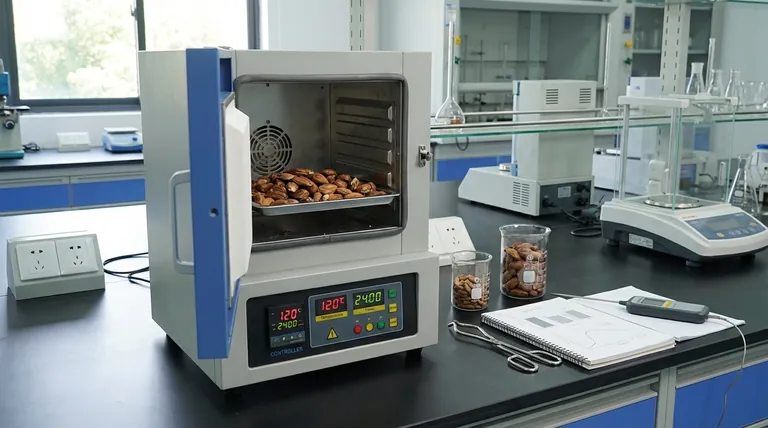
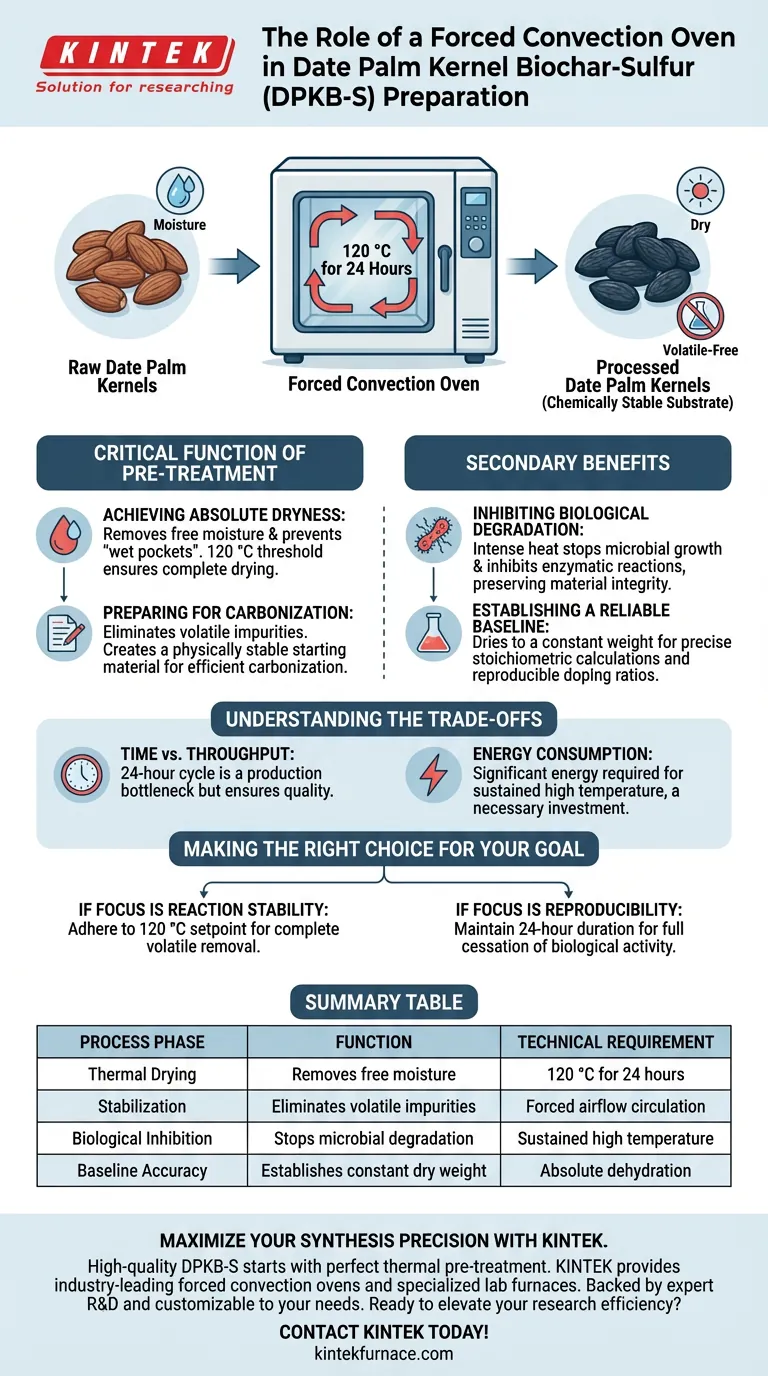
In the synthesis of Date Palm Kernel Biochar-Sulfur (DPKB-S), the forced convection oven acts as the foundational pre-treatment instrument. Its specific role is to subject washed date palm kernel raw materials to a sustained temperature of 120 °C for 24 hours. This rigorous thermal cycle is engineered to completely strip the biomass of moisture and volatile impurities, creating the necessary conditions for subsequent chemical processing.
The forced convection oven transforms raw, variable biomass into a chemically stable substrate. By eliminating free moisture and volatile compounds, it ensures the material is primed for effective chemical dehydration and high-quality carbonization.
The Critical Function of Pre-Treatment
Achieving Absolute Dryness
The primary objective of this phase is the removal of free moisture from the plant tissues. While standard plant analysis often utilizes lower temperatures (e.g., 60°C or 105°C), the preparation of DPKB-S requires a more aggressive threshold of 120 °C.
The forced convection mechanism ensures that heated air circulates evenly around the kernels. This continuous airflow guarantees that every part of the biomass reaches the target temperature, preventing "wet pockets" that could disrupt later stages.
Preparing for Carbonization
The oven does not merely dry the material; it stabilizes it. By removing water and volatile impurities early, the process ensures that the subsequent chemical dehydration and carbonization steps react only with the biomass structure itself.
If moisture were left in the kernels during carbonization, it would consume energy to evaporate, causing temperature fluctuations. This pre-treatment creates a physically stable starting material, ensuring the chemical reactions that follow are consistent and efficient.
Secondary Benefits of Thermal Processing
Inhibiting Biological Degradation
Raw plant materials are biologically active. The intense heat of the forced convection oven effectively stops microbial growth and inhibits enzymatic reactions.
Without this inhibition, the active components of the date palm kernels could degrade before synthesis is complete. This step preserves the structural integrity of the precursor material.
Establishing a Reliable Baseline
To synthesize biochar with precise doping ratios (like sulfur), you must know exactly how much dry matter you are starting with.
Moisture fluctuations can introduce significant experimental errors. By drying the material to a constant weight, the oven establishes a stable baseline weight, allowing for precise stoichiometric calculations in the DPKB-S synthesis.
Understanding the Trade-offs
Time vs. Throughput
The 24-hour drying cycle represents a significant bottleneck in production speed. While it ensures quality, it limits the throughput of the synthesis process compared to rapid-drying techniques like flash drying.
Energy Consumption
Maintaing a forced convection oven at 120 °C for a full day requires substantial energy.
This high energy cost is a necessary investment to prevent the failure of downstream processes. However, in large-scale production, this step is often the primary target for efficiency optimization.
Making the Right Choice for Your Goal
To ensure the successful preparation of DPKB-S, apply the following principles:
- If your primary focus is Reaction Stability: Strictly adhere to the 120 °C temperature setpoint to ensure all volatile impurities that could interfere with carbonization are removed.
- If your primary focus is Reproducibility: Do not shorten the 24-hour duration, as this guarantees the complete cessation of enzymatic activity and a consistent dry mass.
The forced convection oven is not just a drying tool; it is the gatekeeper of quality for the entire biochar synthesis workflow.
Summary Table:
| Process Phase | Function in DPKB-S Preparation | Technical Requirement |
|---|---|---|
| Thermal Drying | Removes free moisture and prevents "wet pockets" | 120 °C for 24 hours |
| Stabilization | Eliminates volatile impurities for consistent carbonization | Forced airflow circulation |
| Biological Inhibition | Stops microbial/enzymatic degradation of plant tissue | Sustained high temperature |
| Baseline Accuracy | Establishes constant dry weight for precise sulfur doping | Absolute dehydration |
Maximize Your Synthesis Precision with KINTEK
High-quality Date Palm Kernel Biochar-Sulfur starts with perfect thermal pre-treatment. KINTEK provides industry-leading forced convection ovens and specialized lab furnaces designed to maintain the rigorous temperature stability required for biomass processing.
Backed by expert R&D and manufacturing, we offer a comprehensive range of Muffle, Tube, Rotary, Vacuum, and CVD systems. Whether you are working on biochar research or advanced material carbonization, our equipment is fully customizable to meet your unique laboratory needs.
Ready to elevate your research efficiency? Contact KINTEK today to find the perfect thermal solution for your workflow!
Visual Guide
References
- Marwa R. Elkatory, Ahmed El Nemr. Fabrication of date palm kernel biochar-sulfur (DPKB-S) for super adsorption of methylene blue dye from water. DOI: 10.1038/s41598-024-56939-w
This article is also based on technical information from Kintek Furnace Knowledge Base .
Related Products
- High Temperature Muffle Oven Furnace for Laboratory Debinding and Pre Sintering
- Laboratory Muffle Oven Furnace with Bottom Lifting
- 1700℃ High Temperature Muffle Oven Furnace for Laboratory
- 1200℃ Muffle Oven Furnace for Laboratory
- 1400℃ Muffle Oven Furnace for Laboratory
People Also Ask
- What thermal phenomena occur during polymer binder burnout in ceramic green bodies? Lab Furnace Guide
- Why is controlled heat treatment in a muffle furnace necessary for calcined clay? Achieve Optimal Pozzolanic Activity
- What role does a high-temperature muffle furnace play in STFO synthesis? Achieve Pure Perovskite Results
- How does a high-temperature muffle furnace facilitate the formation of LaNbxAl1−xO3+δ perovskite structures? Key Roles
- What role does a high-temperature muffle furnace play in the multi-stage synthesis of Li0.5MnFe1.5O4? Key to Pure Spinel





