
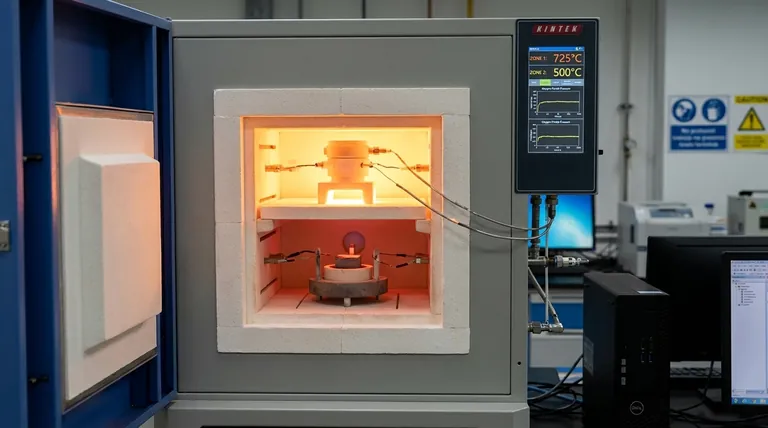
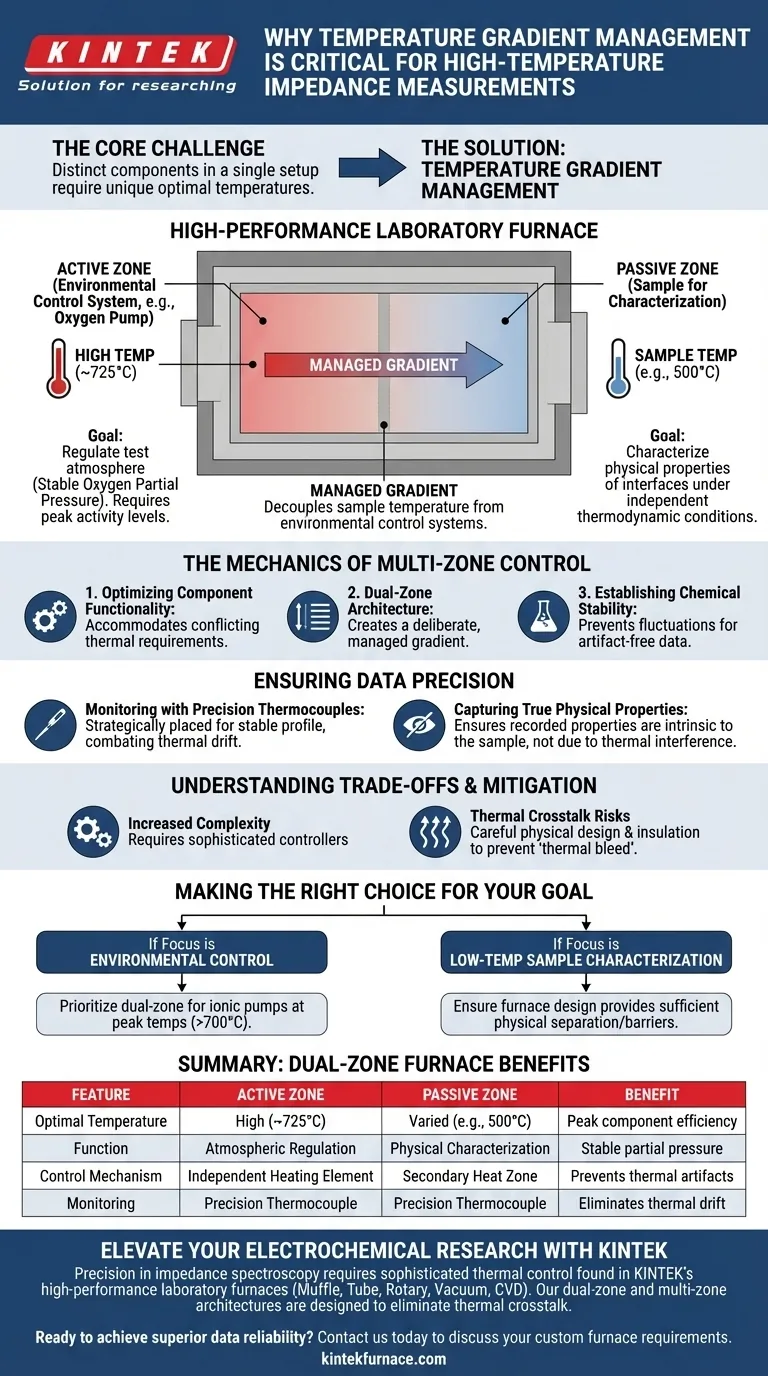
Temperature gradient management is strictly necessary because it permits distinct components within a single experimental setup to operate at their unique, optimal temperatures simultaneously. In high-temperature impedance measurements, this capability allows environmental control systems—such as oxygen pumps—to function at high efficiency without thermally compromising the sample being tested at a different specific temperature.
By decoupling the temperature of the sample from the temperature of the environmental control systems, researchers can maintain a stable chemical atmosphere while accurately characterizing the physical properties of interfaces under independent thermodynamic conditions.
The Mechanics of Multi-Zone Control
Optimizing Component Functionality
Complex impedance setups often require active components, such as oxygen pumps, to regulate the test atmosphere.
These components frequently require high temperatures to achieve necessary activity levels for ion transport, often around 725 °C.
However, the sample material itself may require testing at a significantly lower temperature, such as 500 °C.
The Role of Dual-Zone Architecture
To accommodate these conflicting thermal requirements, high-performance furnaces utilize dual-zone temperature control.
This architecture creates a deliberate, managed gradient within the furnace chamber.
It enables the "active" region to remain hot enough for environmental regulation while the "passive" sample region stays at the target test temperature.
Establishing Chemical Stability
A primary goal of this thermal management is ensuring a stable oxygen partial pressure environment.
By keeping the oxygen pump in its high-activity zone, the system can maintain precise atmospheric conditions regardless of the sample's temperature.
This stability is critical for preventing chemical fluctuations that could introduce artifacts into the impedance data.
Ensuring Data Precision
Monitoring with Precision Thermocouples
Implementing a temperature gradient requires rigorous monitoring to ensure the gradient profile is stable and known.
Precision thermocouples are placed strategically to monitor both the high-heat active zone and the sample zone.
This feedback loop allows the furnace controllers to combat thermal drift and lock in the desired gradient.
Capturing True Physical Properties
Impedance spectroscopy is highly sensitive to the thermodynamic state of the material interfaces.
If the sample temperature fluctuates due to proximity to the oxygen pump, the thermodynamic conditions change, skewing the data.
Gradient management ensures the physical properties recorded are intrinsic to the sample at the intended test temperature, not a result of thermal interference.
Understanding the Trade-offs
Increased System Complexity
While necessary for high-fidelity data, managing temperature gradients introduces significant complexity to the equipment setup.
It requires multiple independent heating elements and sophisticated controllers rather than a single set-point thermostat.
Thermal Crosstalk Risks
Even with dual-zone control, heat naturally migrates from high-temperature zones to lower ones.
Improper spacing or insulation between the oxygen pump and the sample can lead to "thermal bleed," where the sample is inadvertently heated above its set point.
This requires careful physical design of the furnace to maintain the integrity of the gradient.
Making the Right Choice for Your Goal
To maximize the accuracy of your impedance measurements, you must align your furnace capabilities with your experimental constraints.
- If your primary focus is environmental control: Prioritize a dual-zone system that allows ionic pumps to operate at peak temperatures (e.g., >700 °C) to ensure a stable oxygen partial pressure.
- If your primary focus is low-temperature sample characterization: Ensure your furnace design provides sufficient physical separation or thermal barriers to prevent heat from the environmental control zone from affecting the sample.
Precision in thermal management is the defining factor that transforms a standard furnace into a high-performance tool for reliable electrochemical analysis.
Summary Table:
| Feature | Active Zone (Oxygen Pump) | Passive Zone (Sample) | Benefit |
|---|---|---|---|
| Optimal Temperature | High (~725°C) | Varied (e.g., 500°C) | Peak component efficiency |
| Function | Atmospheric Regulation | Physical Characterization | Stable partial pressure |
| Control Mechanism | Independent Heating Element | Secondary Heat Zone | Prevents thermal artifacts |
| Monitoring | Precision Thermocouple | Precision Thermocouple | Eliminates thermal drift |
Elevate Your Electrochemical Research with KINTEK
Precision in impedance spectroscopy requires more than just heat; it requires the sophisticated thermal control found in KINTEK’s high-performance laboratory furnaces.
Backed by expert R&D and manufacturing, KINTEK offers a wide range of Muffle, Tube, Rotary, Vacuum, and CVD systems, all customizable for your unique research needs. Our dual-zone and multi-zone furnace architectures are designed to eliminate thermal crosstalk, ensuring your samples remain at the exact target temperature while environmental control systems operate at peak efficiency.
Ready to achieve superior data reliability? Contact us today to discuss your custom furnace requirements.
Visual Guide
References
- Claudia Steinbach, Jürgen Fleig. The Oxygen Partial Pressure Dependence of Space Charges at SrTiO<sub>3</sub>|Mixed Ionic Electronic Conducting Oxide Heterojunctions. DOI: 10.1002/smtd.202500728
This article is also based on technical information from Kintek Furnace Knowledge Base .
Related Products
- 1700℃ High Temperature Muffle Oven Furnace for Laboratory
- 1800℃ High Temperature Muffle Oven Furnace for Laboratory
- 1400℃ High Temperature Laboratory Tube Furnace with Alumina Tube
- 1700℃ High Temperature Laboratory Tube Furnace with Alumina Tube
- 1200℃ Muffle Oven Furnace for Laboratory
People Also Ask
- What is the primary function of a high-temperature laboratory muffle furnace in chemical synthesis? Achieve Precision.
- How does a high-temperature laboratory muffle furnace affect material properties? Transform Anodic Oxide Films Fast
- What role does a muffle furnace play in BCZY712 electrolyte powder production? Achieve Perfect Phase Purity
- What role does a muffle furnace play in sintering photocathodes? Enhance Electrode Conductivity & Catalytic Activity
- What is the role of a high-temperature muffle furnace in guava leaf carbonization? Master Precise Pyrolysis Control



















