
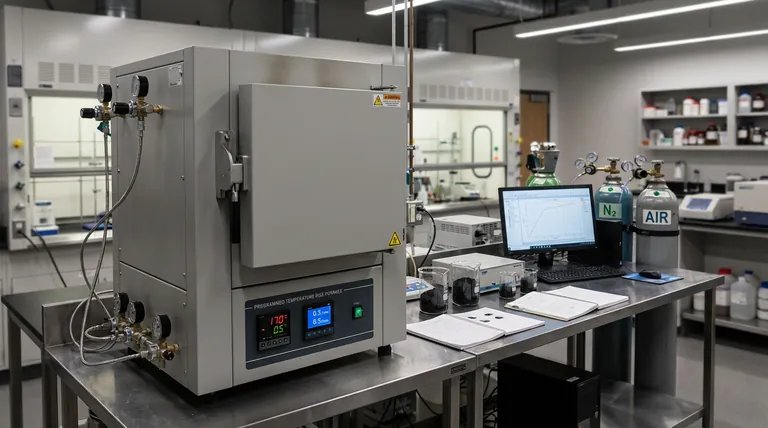
A programmed temperature rise experimental system functions as a precise laboratory tool designed to simulate and arrest specific stages of coal oxidation. Its primary purpose is to apply exact heating rates under controlled atmospheric conditions, allowing researchers to study the chemical evolution of coal samples before they reach full combustion.
Core Insight: By strictly controlling the heating profile and enabling rapid cooling, this system allows researchers to "freeze" the coal's chemical state at critical moments. This capability is essential for isolating and analyzing the functional group changes that drive spontaneous combustion in environments like coal mine goafs.
Simulating Real-World Environments
Replicating Goaf Conditions
The system is engineered to simulate the specific environmental atmospheres found in coal mine goafs (waste areas). By mimicking these conditions, researchers can observe how coal behaves in its natural, high-risk setting.
Controlled Heating Rates
To ensure accuracy, the system applies highly specific heating rates, such as 0.5°C/min. This slow, controlled rise in temperature allows for a detailed observation of the oxidation process as it unfolds over time.
Precision Control of Oxidation Stages
Targeting Specific Temperatures
The system allows the oxidation process to be stopped at exact, pre-determined temperatures. These target temperatures typically range from 40°C to 170°C, covering the critical pre-oxidation window.
The Rapid Cooling Mechanism
Once the coal reaches the target temperature, the system triggers a rapid switch to a nitrogen cooling environment. This immediate introduction of inert gas halts the oxidation reaction instantly.
Preserving Physicochemical States
By stopping the reaction abruptly, the system preserves the coal's physicochemical state at that specific moment. This prevents the sample from progressing to a later stage of combustion, ensuring the data reflects the exact temperature point being studied.
Analytical Capabilities
Capturing Functional Group Changes
The primary scientific output of this system is the isolation of functional groups within the coal structure. Because the reaction is frozen in time, researchers can analyze exactly which chemical bonds are breaking or forming.
Understanding Pre-Oxidation Behavior
This data provides a snapshot of the coal's "lifecycle" during the early stages of heating. It helps define the specific chemical pathways that lead from stable coal to spontaneous combustion.
Understanding the Trade-offs
Simulation vs. Reality
While precise, laboratory simulations cannot perfectly replicate the complex, large-scale airflow dynamics of an actual mine. The data represents a controlled ideal rather than the chaotic reality of underground ventilation.
Sensitivity to Cooling Speed
The accuracy of the data relies entirely on the speed of the nitrogen switch. Any delay in the cooling phase allows the oxidation to continue, potentially corrupting the analysis of the functional groups for that specific temperature point.
Making the Right Choice for Your Goal
When designing your experimental framework, consider how you utilize the system's control features to match your specific research objectives.
- If your primary focus is Mechanism Analysis: Prioritize the rapid nitrogen cooling phase to ensure the chemical structure is perfectly preserved for functional group testing.
- If your primary focus is Safety Simulation: Prioritize the heating rate accuracy (e.g., 0.5°C/min) to ensure the thermal stress applied to the coal matches the slow heat accumulation found in mine goafs.
Success in pre-oxidation study relies not just on heating the coal, but on the precision with which you can stop the process.
Summary Table:
| Feature | Function in Pre-Oxidation Study | Key Benefit |
|---|---|---|
| Controlled Heating | Applies precise rates (e.g., 0.5°C/min) | Replicates real-world thermal stress in mines |
| Atmosphere Simulation | Mimics goaf environmental conditions | Ensures high-fidelity experimental data |
| Rapid N₂ Cooling | Instantly halts oxidation via inert gas | "Freezes" the coal's chemical state for analysis |
| Targeted Stopping | Arrests reaction at 40°C–170°C | Isolates specific functional group changes |
Elevate Your Geological & Material Research with KINTEK
Precise temperature control is the backbone of reliable pre-oxidation studies and spontaneous combustion analysis. KINTEK provides industry-leading laboratory solutions, including Muffle, Tube, Rotary, Vacuum, and CVD systems, all backed by expert R&D and precision manufacturing. Whether you are simulating coal mine goaf conditions or analyzing complex functional group changes, our high-temperature furnaces are fully customizable to meet your unique experimental parameters.
Ready to achieve superior thermal precision? Contact our technical experts today to find the perfect system for your lab.
References
- Baoshan Jia, Xian Wu. Effects of pre-oxidation temperature and air volume on oxidation thermogravimetric and functional group change of lignite. DOI: 10.1371/journal.pone.0316705
This article is also based on technical information from Kintek Furnace Knowledge Base .
Related Products
People Also Ask
- What thermal phenomena occur during polymer binder burnout in ceramic green bodies? Lab Furnace Guide
- Why is controlled heat treatment in a muffle furnace necessary for calcined clay? Achieve Optimal Pozzolanic Activity
- What role does a high-temperature muffle furnace play in STFO synthesis? Achieve Pure Perovskite Results
- How does a high-temperature muffle furnace facilitate the formation of LaNbxAl1−xO3+δ perovskite structures? Key Roles
- What role does a high-temperature muffle furnace play in the multi-stage synthesis of Li0.5MnFe1.5O4? Key to Pure Spinel
