
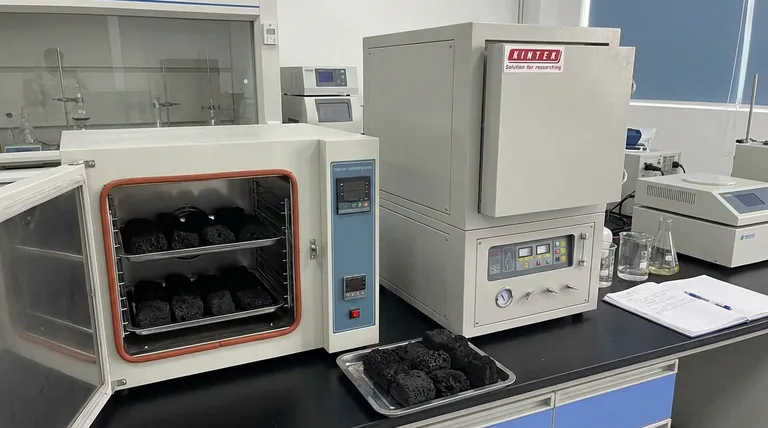
Precision thermal control is the first line of defense against structural failure in activated carbon production. A constant temperature drying oven is necessary to completely remove both free and bound water from raw materials or impregnated samples—typically at temperatures such as 353 K (80°C) or 383 K (110°C)—before they are subjected to extreme heat. Without this step, residual moisture turns into a destructive force during the carbonization phase.
The primary role of the drying oven is to stabilize the material prior to high-temperature processing. By ensuring the complete removal of moisture and solvents, it prevents the rapid vaporization that leads to carbon skeleton collapse and ensures the uniform distribution of chemical activators within the pore structure.
Preserving the Carbon Skeleton
The preparation of porous activated carbon involves transitioning materials from ambient conditions to extremely high temperatures. The drying oven bridges this gap to protect the physical structure.
Preventing Structural Collapse
The most critical function of the oven is protecting the integrity of the porous structure. If raw materials enter the high-temperature carbonization stage while wet, the remaining water vaporizes instantly.
This rapid expansion creates internal pressure spikes capable of shattering the carbon skeleton. Controlled drying eliminates this risk, ensuring the framework remains intact for pore formation.
Avoiding Pore Blockage
In composite materials or impregnated samples, moisture evaporation must be gradual. The drying oven provides a stable thermal field that prevents nanostructures from agglomerating.
If evaporation occurs too aggressively, particles can clump together. This results in a loss of the "loose powder state" and blocks the very pores you are trying to create, reducing the final surface area.
Minimizing Premature Oxidation
For materials that have already been washed, the oven removes residual moisture—typically at 105°C—without subjecting the material to excessive heat.
This controlled environment ensures that water is removed from the pores without triggering the premature oxidation of surface functional groups, which are vital for the material's adsorption capabilities.
Optimizing Chemical Activation
When preparing activated carbon loaded with agents like potassium hydroxide (KOH) or metal precursors, the drying phase dictates how these chemicals interact with the carbon matrix.
Ensuring Uniform Distribution
When drying impregnated samples, the goal is to evaporate the solvent while leaving the active component behind. A constant temperature (often around 85°C for KOH or CuO) ensures this happens smoothly.
This stability allows active components to distribute uniformly at a molecular level across the surface and within the pores, rather than pooling in specific areas.
Preventing Solute Segregation
If drying is uneven or fluctuating, "solute segregation" can occur. This happens when dissolved ions migrate with the evaporating solvent to the outer surface of the particle.
By strictly controlling the temperature and airflow, the oven guides the in-situ precipitation of these ions deep within the porous structure, ensuring high dispersion of active centers rather than surface crusting.
Ensuring Process Stability and Accuracy
Beyond the material quality, the drying oven is essential for the reliability of the manufacturing process and experimental data.
Preventing Pressure Fluctuations
During pre-carbonization, water evaporation can cause significant pressure fluctuations within the reactor.
Thorough dehydration of raw materials (such as sugarcane bagasse) mitigates this risk, ensuring a stable environment for the chemical reactions involved in pyrolysis.
Enabling Accurate Stoichiometry
Precise chemical impregnation relies on accurate weight measurements. If the raw material contains an unknown amount of adsorbed water, concentration calculations for reagents will be incorrect.
Drying to a constant weight establishes a reliable baseline, ensuring the ratio of carbon to chemical activator is exactly as intended.
Common Pitfalls to Avoid
While the drying oven is a standard tool, its misuse can lead to suboptimal results. It is important to recognize the trade-offs involved in this step.
The Risk of "Over-Drying" While removing water is essential, excessively high temperatures or prolonged drying times can degrade sensitive biomass precursors or volatile components before carbonization even begins.
The Cost of Time Achieving a constant weight is a slow process compared to flash drying methods. However, prioritizing speed over the stability of the thermal environment almost always results in inferior pore development and lower mechanical strength.
Making the Right Choice for Your Goal
The specific settings you use for your constant temperature oven should be dictated by the specific stage of your preparation process.
- If your primary focus is Structural Integrity: Prioritize removing bound water at temperatures near 105-110°C to prevent "popcorn" style fragmentation during pyrolysis.
- If your primary focus is Chemical Doping/Impregnation: Prioritize lower, gentler temperatures (e.g., 60-85°C) to prevent solute migration and ensure metal ions are dispersed deep within the pores.
- If your primary focus is Experimental Accuracy: Ensure samples are dried for at least 12 hours or until weight stabilizes to prevent endothermic moisture effects from skewing thermal data.
Ultimately, the constant temperature drying oven is not merely a dehydration tool, but a precision instrument that defines the architectural limits of your final carbon material.
Summary Table:
| Process Objective | Temperature Range | Key Benefit |
|---|---|---|
| Structural Integrity | 105°C - 110°C | Prevents rapid vaporization & carbon skeleton collapse |
| Chemical Impregnation | 60°C - 85°C | Ensures uniform activator distribution & prevents segregation |
| Moisture Removal | Constant Weight | Enables accurate stoichiometry & process stability |
| Quality Control | Controlled Airflow | Protects surface functional groups from premature oxidation |
Maximize Your Material Performance with KINTEK
Precise thermal control is the foundation of high-quality porous materials. KINTEK provides industry-leading drying solutions and high-temperature systems tailored for advanced carbon research. Backed by expert R&D and manufacturing, we offer a comprehensive range of Muffle, Tube, Rotary, Vacuum, and CVD systems, all fully customizable to meet your unique laboratory needs.
Don't let residual moisture compromise your carbon skeleton. Contact us today to discover how our precision lab furnaces can enhance your research outcomes and ensure perfect pore formation every time.
References
- Yassine Jari, Bouchaib Gourich. Porous activated carbons derived from waste Moroccan pine cones for high-performance adsorption of bisphenol A from water. DOI: 10.1016/j.heliyon.2024.e29645
This article is also based on technical information from Kintek Furnace Knowledge Base .
Related Products
- 1700℃ High Temperature Muffle Oven Furnace for Laboratory
- 1800℃ High Temperature Muffle Oven Furnace for Laboratory
- 1400℃ Muffle Oven Furnace for Laboratory
- High Temperature Muffle Oven Furnace for Laboratory Debinding and Pre Sintering
- 1200℃ Muffle Oven Furnace for Laboratory
People Also Ask
- What is the primary function of a high-temperature laboratory muffle furnace in chemical synthesis? Achieve Precision.
- How does a high-temperature laboratory muffle furnace affect material properties? Transform Anodic Oxide Films Fast
- What role does a muffle furnace play in BCZY712 electrolyte powder production? Achieve Perfect Phase Purity
- What is the role of a high-temperature muffle furnace in guava leaf carbonization? Master Precise Pyrolysis Control
- How does a muffle furnace impact Ni/MgAl2O4 catalysts? Optimize Stability and Catalytic Performance





