Knowledge How does an oil circulation heating and cooling system affect HPDC? Optimize Your Die Casting Thermal Control
Author avatar

Tech Team · Kintek Furnace

Updated 2 days ago

How does an oil circulation heating and cooling system affect HPDC? Optimize Your Die Casting Thermal Control


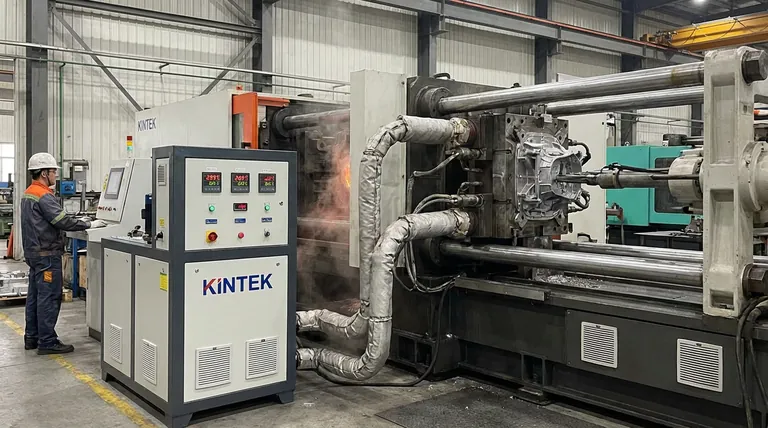
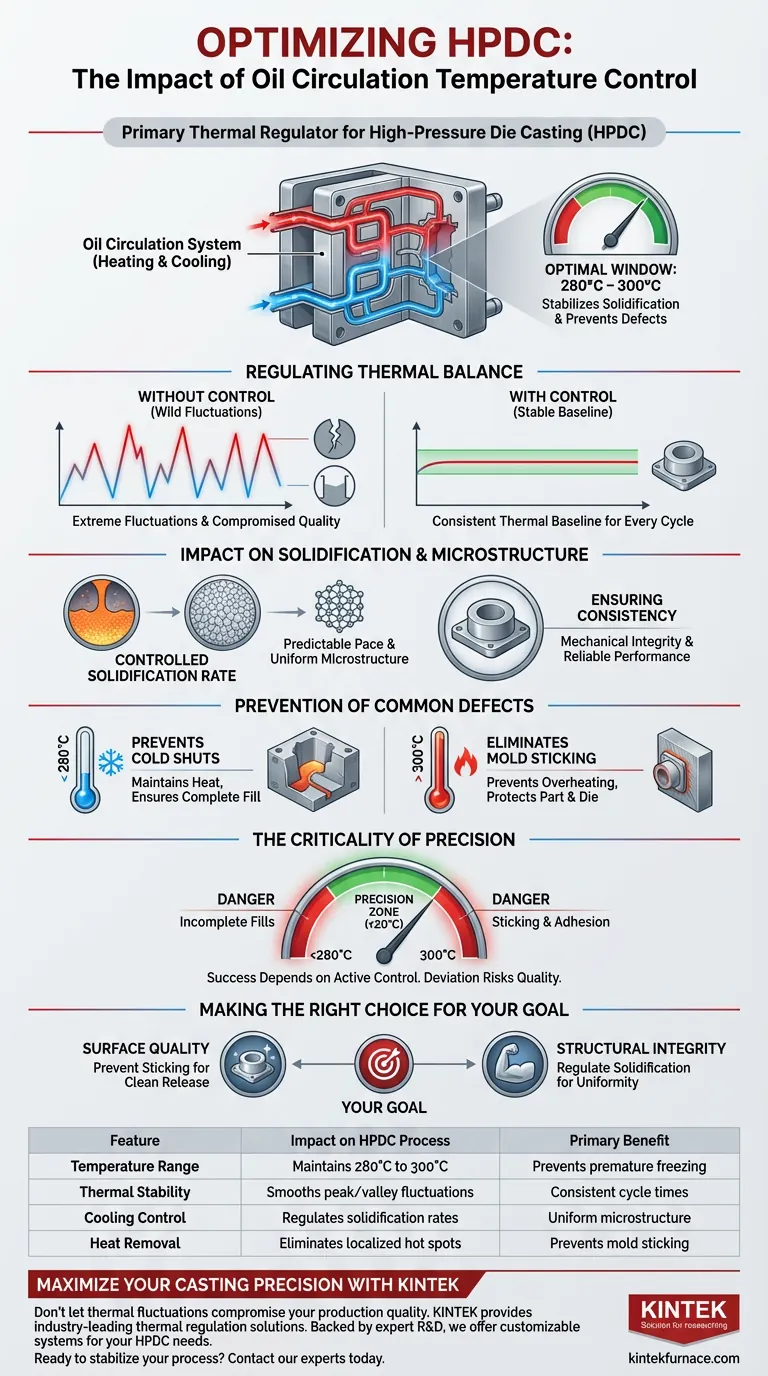
An oil circulation heating and cooling temperature control system acts as the primary thermal regulator for the high-pressure die casting (HPDC) process. Its function is to actively maintain the mold temperature within a precise, optimal window—typically between 280°C and 300°C—to stabilize the solidification of the liquid alloy and prevent temperature-related defects.

By stabilizing the thermal balance of the mold, this system eliminates the extreme temperature fluctuations that compromise part quality. It ensures the mold is neither too cold, which causes premature freezing, nor too hot, which leads to adhesion issues.
How does an oil circulation heating and cooling system affect HPDC? Optimize Your Die Casting Thermal Control

Regulating Thermal Balance

To understand the impact of an oil circulation system, you must look at how it manages the thermal energy within the mold tool.

Establishing the Optimal Window

The system is designed to lock the mold temperature into a specific range, usually 280°C to 300°C.

Stabilizing the Process

Without active control, a mold's temperature fluctuates wildly as hot metal is injected and the part is ejected. This system smooths out these peaks and valleys, creating a consistent thermal baseline for every cycle.

Impact on Solidification and Microstructure

The way the liquid alloy freezes determines the mechanical properties of the final part.

Controlling Solidification Rates

The system regulates the solidification rate of the liquid alloy within the cavity. By preventing the mold from acting as an uncontrolled heat sink, it allows the metal to cool at a predictable pace.

Ensuring Microstructural Consistency

Consistent cooling leads to a consistent internal structure. The system ensures a uniform distribution of microstructural components, which is essential for the mechanical integrity of the casting.

Prevention of Common Defects

The primary value of the system lies in its ability to mitigate specific defects caused by thermal mismanagement.

Preventing Cold Shuts

If a mold is too cold, the metal may freeze before it completely fills the cavity. By maintaining heat, the system prevents these cold shuts and ensures complete fill.

eliminating Mold Sticking

Conversely, if a mold overheats or develops hot spots, the alloy may adhere to the tool surface. The cooling capability of the system prevents this mold sticking, protecting both the part surface and the die itself.

The Criticality of Precision (Trade-offs)

While an oil circulation system is a powerful tool, its effectiveness relies entirely on the precision of its settings.

The Consequence of Deviation

The system operates within a relatively narrow margin (20°C variance). Falling below 280°C risks incomplete fills, while exceeding 300°C invites sticking.

Dependency on Thermal Balance

The process becomes highly dependent on this active control. Any failure in the circulation system immediately disrupts the thermal balance, reintroducing the temperature gradients that cause defects.

Making the Right Choice for Your Goal

The implementation of this system should be driven by the specific quality metrics you are trying to improve.

  • If your primary focus is Surface Quality: The system is essential for preventing mold sticking, ensuring the casting releases cleanly without surface damage.
  • If your primary focus is Structural Integrity: The precise temperature control regulates solidification, preventing cold shuts and ensuring a uniform microstructure across the part.

Success in HPDC relies on treating temperature as a controlled variable, not a random outcome.

Summary Table:

Feature Impact on HPDC Process Primary Benefit
Temperature Range Maintains 280°C to 300°C Prevents premature freezing
Thermal Stability Smooths peak/valley fluctuations Consistent cycle times
Cooling Control Regulates solidification rates Uniform microstructure
Heat Removal Eliminates localized hot spots Prevents mold sticking

Maximize Your Casting Precision with KINTEK

Don't let thermal fluctuations compromise your production quality. KINTEK provides industry-leading thermal regulation solutions designed for high-performance environments. Backed by expert R&D and manufacturing, we offer customizable Muffle, Tube, Rotary, Vacuum, and CVD systems, alongside specialized lab high-temp furnaces tailored to your unique HPDC and material research needs.

Ready to stabilize your process? Contact our experts today to discover how our precision heating and cooling systems can enhance your lab or foundry's efficiency.

Visual Guide
How does an oil circulation heating and cooling system affect HPDC? Optimize Your Die Casting Thermal Control Visual Guide

References

  1. Guan Sheng, Yong Zhu. Microstructure and Mechanical Properties of High-Pressure Die-Casting Mg–Al–RE Alloys with Minor Ca Addition. DOI: 10.3390/ma18020231

This article is also based on technical information from Kintek Furnace Knowledge Base .

Related Products

People Also Ask

Related Products

Vacuum Heat Treat Sintering Furnace Molybdenum Wire Vacuum Sintering Furnace

Vacuum Heat Treat Sintering Furnace Molybdenum Wire Vacuum Sintering Furnace

KINTEK's Vacuum Molybdenum Wire Sintering Furnace excels in high-temperature, high-vacuum processes for sintering, annealing, and material research. Achieve precise 1700°C heating with uniform results. Custom solutions available.

1200℃ Split Tube Furnace Laboratory Quartz Tube Furnace with Quartz Tube

1200℃ Split Tube Furnace Laboratory Quartz Tube Furnace with Quartz Tube

Discover KINTEK's 1200℃ Split Tube Furnace with quartz tube for precise high-temperature lab applications. Customizable, durable, and efficient. Get yours now!

Laboratory Muffle Oven Furnace with Bottom Lifting

Laboratory Muffle Oven Furnace with Bottom Lifting

Boost lab efficiency with KT-BL Bottom Lifting Furnace: precise 1600℃ control, superior uniformity, and enhanced productivity for material science and R&D.

High Temperature Muffle Oven Furnace for Laboratory Debinding and Pre Sintering

High Temperature Muffle Oven Furnace for Laboratory Debinding and Pre Sintering

KT-MD Debinding & Pre-Sintering Furnace for ceramics - precise temperature control, energy-efficient design, customizable sizes. Boost your lab efficiency today!

1700℃ High Temperature Muffle Oven Furnace for Laboratory

1700℃ High Temperature Muffle Oven Furnace for Laboratory

KT-17M Muffle Furnace: High-precision 1700°C lab furnace with PID control, energy efficiency, and customizable sizes for industrial & research applications.

1400℃ Muffle Oven Furnace for Laboratory

1400℃ Muffle Oven Furnace for Laboratory

KT-14M Muffle Furnace: Precision 1400°C heating with SiC elements, PID control, and energy-efficient design. Ideal for labs.

1700℃ Controlled Inert Nitrogen Atmosphere Furnace

1700℃ Controlled Inert Nitrogen Atmosphere Furnace

KT-17A Controlled Atmosphere Furnace: Precise 1700°C heating with vacuum & gas control. Ideal for sintering, research & material processing. Explore now!

Multi Heating Zones CVD Tube Furnace Machine for Chemical Vapor Deposition Equipment

Multi Heating Zones CVD Tube Furnace Machine for Chemical Vapor Deposition Equipment

KINTEK's Multi-Zone CVD Tube Furnaces offer precision temperature control for advanced thin film deposition. Ideal for research and production, customizable for your lab needs.

1400℃ Controlled Inert Nitrogen Atmosphere Furnace

1400℃ Controlled Inert Nitrogen Atmosphere Furnace

KT-14A Controlled Atmosphere Furnace for labs & industry. 1400°C max temp, vacuum sealing, inert gas control. Customizable solutions available.

Vacuum Heat Treat Sintering and Brazing Furnace

Vacuum Heat Treat Sintering and Brazing Furnace

KINTEK Vacuum Brazing Furnaces deliver precision, clean joints with superior temperature control. Customizable for diverse metals, ideal for aerospace, medical, and thermal applications. Get a quote!

1400℃ High Temperature Laboratory Tube Furnace with Quartz and Alumina Tube

1400℃ High Temperature Laboratory Tube Furnace with Quartz and Alumina Tube

KINTEK's Tube Furnace with Alumina Tube: Precision high-temperature processing up to 2000°C for labs. Ideal for material synthesis, CVD, and sintering. Customizable options available.

1200℃ Controlled Inert Nitrogen Atmosphere Furnace

1200℃ Controlled Inert Nitrogen Atmosphere Furnace

KINTEK 1200℃ Controlled Atmosphere Furnace: Precision heating with gas control for labs. Ideal for sintering, annealing, and material research. Customizable sizes available.

Vacuum Heat Treat Furnace with Ceramic Fiber Liner

Vacuum Heat Treat Furnace with Ceramic Fiber Liner

KINTEK's Vacuum Furnace with Ceramic Fiber Lining offers precise high-temperature processing up to 1700°C, ensuring uniform heat distribution and energy efficiency. Ideal for labs and production.

Silicon Carbide SiC Thermal Heating Elements for Electric Furnace

Silicon Carbide SiC Thermal Heating Elements for Electric Furnace

High-performance SiC heating elements for labs, offering 600-1600°C precision, energy efficiency, and long lifespan. Customizable solutions available.

600T Vacuum Induction Hot Press Vacuum Heat Treat and Sintering Furnace

600T Vacuum Induction Hot Press Vacuum Heat Treat and Sintering Furnace

600T Vacuum Induction Hot Press Furnace for precise sintering. Advanced 600T pressure, 2200°C heating, vacuum/atmosphere control. Ideal for research & production.

Vacuum Hot Press Furnace Machine for Lamination and Heating

Vacuum Hot Press Furnace Machine for Lamination and Heating

KINTEK Vacuum Lamination Press: Precision bonding for wafer, thin-film & LCP applications. 500°C max temp, 20-ton pressure, CE certified. Custom solutions available.

Controlled Inert Nitrogen Hydrogen Atmosphere Furnace

Controlled Inert Nitrogen Hydrogen Atmosphere Furnace

Discover KINTEK's Hydrogen Atmosphere Furnace for precise sintering & annealing in controlled environments. Up to 1600°C, safety features, customizable.

Molybdenum Disilicide MoSi2 Thermal Heating Elements for Electric Furnace

Molybdenum Disilicide MoSi2 Thermal Heating Elements for Electric Furnace

High-performance MoSi2 heating elements for labs, reaching 1800°C with superior oxidation resistance. Customizable, durable, and reliable for high-temperature applications.

1800℃ High Temperature Muffle Oven Furnace for Laboratory

1800℃ High Temperature Muffle Oven Furnace for Laboratory

KINTEK Muffle Furnaces: Precision 1800°C heating for labs. Energy-efficient, customizable, with PID control. Ideal for sintering, annealing, and research.

Electric Rotary Kiln Small Rotary Furnace Biomass Pyrolysis Plant Rotating Furnace

Electric Rotary Kiln Small Rotary Furnace Biomass Pyrolysis Plant Rotating Furnace

KINTEK's Rotary Biomass Pyrolysis Furnace converts biomass to biochar, bio-oil, and syngas efficiently. Customizable for research or production. Get your solution now!


Leave Your Message


