
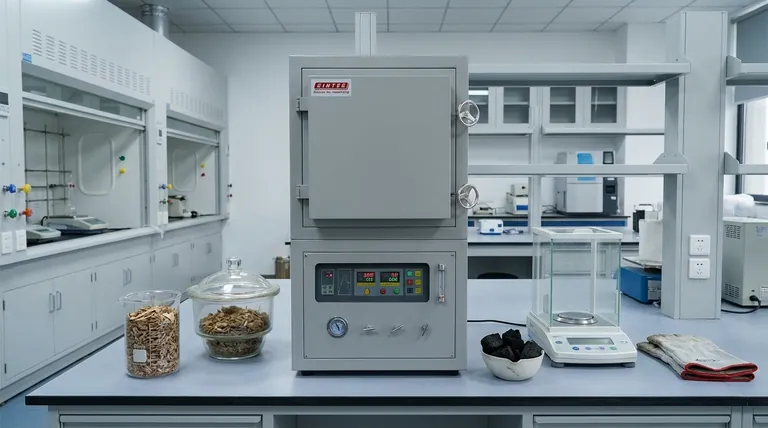
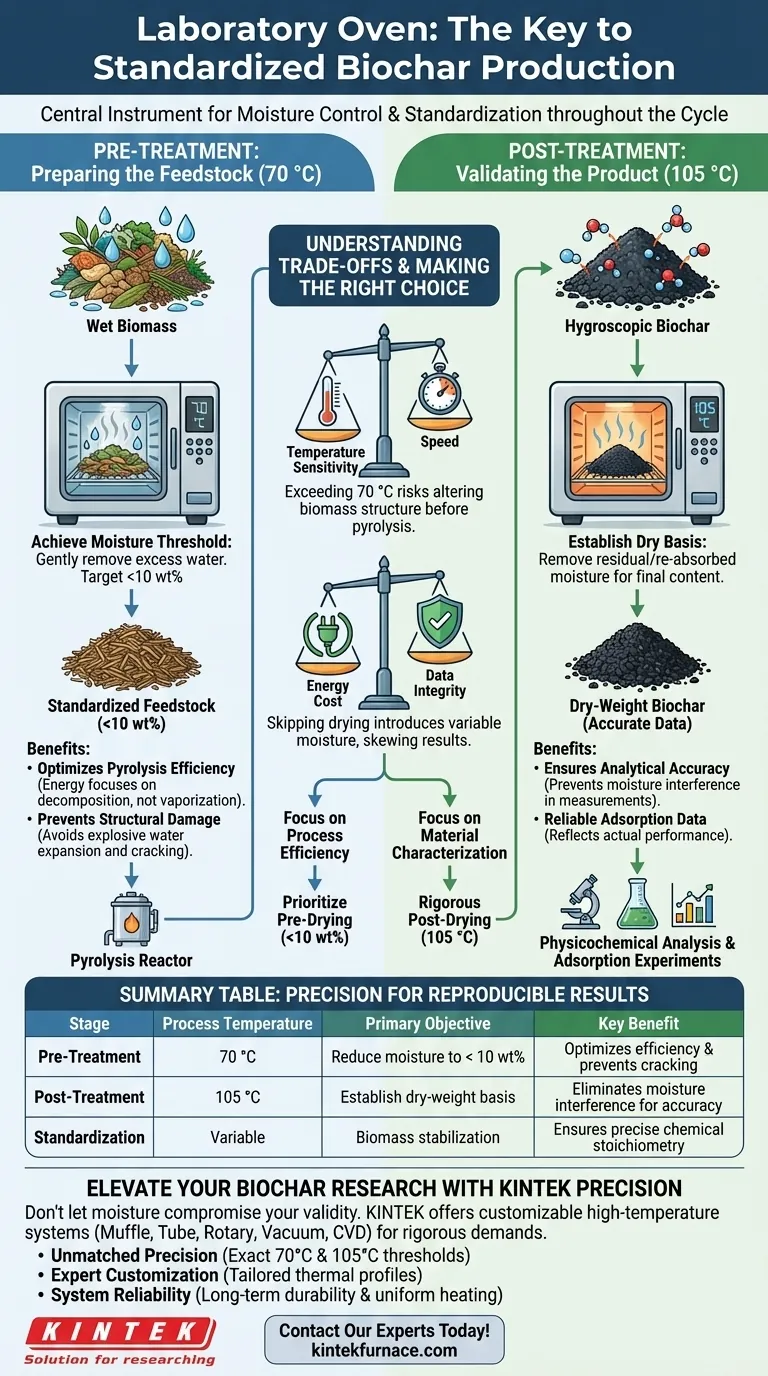
A laboratory oven acts as the central instrument for moisture control and standardization throughout the biochar production cycle. In the pre-treatment phase, it reduces biomass moisture (typically at 70 °C) to below 10 wt% to optimize pyrolysis efficiency, while in the post-treatment phase, it dries the finished biochar (at 105 °C) to eliminate moisture interference during physicochemical analysis and adsorption experiments.
The laboratory oven transforms variable biomass into a standardized feedstock and ensures that final biochar characterization is based on accurate, dry-weight data rather than fluctuating moisture content.
Pre-Treatment: Preparing the Feedstock
Achieving the Moisture Threshold
The primary role of the oven prior to pyrolysis is to stabilize the biomass. By heating the material at 70 °C, the oven gently removes excess water without triggering premature thermal degradation.
The target is to reduce the moisture content to below 10 wt%. This specific threshold is critical for establishing a consistent baseline before the material enters the reactor.
Improving Pyrolysis Efficiency
Wet biomass is inefficient to process. If the feedstock contains excess water, the pyrolysis reactor must expend significant energy vaporizing that water before carbonization can occur.
Pre-drying the material ensures that the energy applied during pyrolysis is directed immediately toward the thermal decomposition of the organic matter, rather than phase-changing water.
Preventing Structural Damage
Rapid vaporization of internal moisture during high-temperature pyrolysis can be destructive. If water remains in the pores, it expands explosively when heated.
By removing surface and physically adsorbed water in the oven first, you prevent material cracking. This preserves the structural integrity of the biochar and allows for better control over chemical stoichiometry.
Post-Treatment: Validating the Product
Establishing the Dry Basis
Once biochar is produced, it must be characterized. However, biochar is hygroscopic and can re-absorb moisture from the air.
The laboratory oven is used to heat the produced biochar to 105 °C. This removes any residual or re-absorbed moisture, allowing researchers to determine the material's true final moisture content.
Ensuring Analytical Accuracy
Moisture is a major contaminant in data collection. If biochar is not perfectly dry, water molecules will occupy pore sites and add mass.
This interference skews results in component analysis and adsorption experiments. Oven drying ensures that measurements of surface area, porosity, and contaminant removal capacity reflect the biochar's actual performance, not the water it holds.
Understanding the Trade-offs
Temperature Sensitivity vs. Speed
There is often a temptation to increase oven temperatures to speed up drying. However, exceeding recommended temperatures (like the 70 °C pre-treatment standard) risks altering the chemical structure of the biomass before pyrolysis begins.
Energy Cost vs. Data Integrity
Running laboratory ovens for extended periods consumes energy. However, skipping or shortening these drying cycles introduces a variable—moisture—that makes experimental data unreproducible. The energy cost of the oven is the price of scientific validity.
Making the Right Choice for Your Goal
To ensure your biochar production yields reliable data and high-quality material, apply the oven protocols based on your specific objective:
- If your primary focus is Process Efficiency: Prioritize pre-drying feedstock to <10 wt% to minimize energy waste and prevent physical cracking inside the reactor.
- If your primary focus is Material Characterization: rigorous post-drying at 105 °C is mandatory to ensure adsorption data and physicochemical indicators are not skewed by moisture weight.
Precision in thermal pre- and post-treatment is the defining factor between rough estimation and reproducible scientific results.
Summary Table:
| Stage | Process Temperature | Primary Objective | Key Benefit |
|---|---|---|---|
| Pre-Treatment | 70 °C | Reduce moisture to < 10 wt% | Optimizes pyrolysis efficiency & prevents structural cracking |
| Post-Treatment | 105 °C | Establish dry-weight basis | Eliminates moisture interference for accurate adsorption data |
| Standardization | Variable | Biomass stabilization | Ensures reproducible results and precise chemical stoichiometry |
Elevate Your Biochar Research with KINTEK Precision
Don't let moisture interference compromise your experimental validity. Backed by expert R&D and world-class manufacturing, KINTEK offers a comprehensive range of laboratory ovens and high-temperature systems—including Muffle, Tube, Rotary, Vacuum, and CVD systems—all fully customizable to meet the rigorous demands of your biochar research and production.
Our value to you:
- Unmatched Precision: Achieve the exact moisture thresholds (70°C and 105°C) required for standardized feedstock and accurate characterization.
- Expert Customization: Tailor thermal profiles to your specific biomass types and research goals.
- System Reliability: Ensure long-term durability and uniform heating for reproducible scientific results.
Ready to optimize your thermal processing? Contact our experts today to find your perfect heating solution!
Visual Guide
References
- S. S. Ibrahim, Badr A. Mohamed. Catalyzed biochar from date palm waste for ammonium removal: potential application in poultry farms for ammonia mitigation. DOI: 10.1007/s43621-025-00817-6
This article is also based on technical information from Kintek Furnace Knowledge Base .
Related Products
- Laboratory Muffle Oven Furnace with Bottom Lifting
- 1200℃ Muffle Oven Furnace for Laboratory
- 1400℃ Muffle Oven Furnace for Laboratory
- 1800℃ High Temperature Muffle Oven Furnace for Laboratory
- 1700℃ High Temperature Muffle Oven Furnace for Laboratory
People Also Ask
- Why is a high-temperature muffle furnace required for FeOx-MOx/TiO2? Engineering High-Performance Nanocomposites
- Why is a high-temperature laboratory muffle furnace essential for the alkali fusion process in zeolite synthesis?
- What is the importance of the calcination process? Master High-Purity Calcium Phosphate Nanopowder Production
- What function does a muffle furnace perform in Ba0.75Ca0.25TiO3 calcination? Ensure Phase Purity & Synthesis
- What are the primary functions of a high-temperature laboratory muffle furnace in the preparation of biosorbent materials?



















