
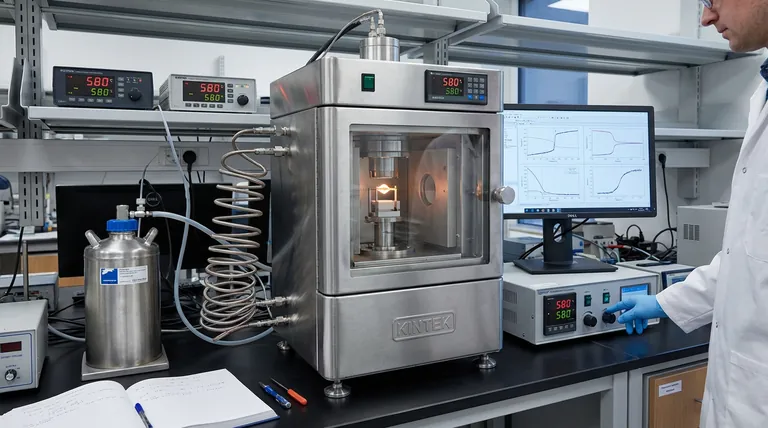
A laboratory cryofurnace functions as a high-precision environmental control center. Specifically for Co3O2BO3 single-crystal experiments, it acts as a stable sample holder capable of heating the material to temperatures exceeding 580 K. Its primary operational goal is to provide the exact thermal stability required to monitor phase transitions continuously.
The cryofurnace is not simply a heating device; it provides the granular control necessary to observe the subtle evolution of long-range spin-state ordered phases. This precision is the defining factor that allows researchers to map critical transition points accurately.
The Role of Environmental Control
Serving as a Stable Sample Holder
The fundamental function of the cryofurnace is to physically secure the Co3O2BO3 single crystal. By acting as a robust sample holder, it isolates the material to ensure that external variables do not corrupt experimental data.
Achieving Specific Thermal Thresholds
To trigger the necessary phase changes in Co3O2BO3, the equipment must reach specific thermal heights. The cryofurnace is engineered to drive the sample environment to temperatures exceeding 580 K. This capability ensures that the full range of relevant high-temperature behaviors can be induced and studied.
The Necessity of Precision for Phase Transitions
Facilitating Continuous Monitoring
Phase transitions are rarely instantaneous events; they are processes that evolve. The cryofurnace enables continuous monitoring, allowing researchers to capture data without interruption as the temperature changes.
Enabling Fine-Tuned Observation
The reference highlights the need for "fine monitoring." The cryofurnace’s control systems are tight enough to allow researchers to see minute changes, rather than just the start and end states of a transition.
Tracking Long-Range Spin-States
The specific phenomenon being studied is the evolution of long-range spin-state ordered phases. These magnetic states are highly sensitive to thermal fluctuations. The cryofurnace ensures the environment remains stable enough to preserve the integrity of these spin states as they pass through critical points.
Understanding the Trade-offs
Precision vs. Speed
While the cryofurnace allows for temperatures over 580 K, the priority is control over rapid throughput. To maintain the stability required for "fine monitoring" of spin-state phases, temperature ramping must often be deliberate and slow. Prioritizing speed could compromise the resolution needed to detect subtle phase evolutions.
Complexity of Setup
Using a device designed for such specific environmental control adds complexity to the experimental setup. It requires careful calibration to ensure the sample holder itself does not introduce thermal gradients that could skew the data regarding the Co3O2BO3 crystal.
Making the Right Choice for Your Goal
When configuring your experiment for Co3O2BO3, consider your specific analytical needs:
- If your primary focus is mapping the full transition: Ensure your apparatus is calibrated to remain stable well beyond the 580 K threshold to avoid signal noise at peak temperatures.
- If your primary focus is spin-state dynamics: prioritize the "fine monitoring" capabilities of the control loop over rapid heating rates to capture the granular evolution of the ordered phases.
Success in these experiments relies on treating temperature not just as a variable to increase, but as a precise environment to be shaped.
Summary Table:
| Feature | Function in Co3O2BO3 Experiments |
|---|---|
| Temperature Range | Reaches and stabilizes temperatures exceeding 580 K |
| Thermal Stability | Enables fine monitoring of long-range spin-state ordered phases |
| Sample Management | Acts as a stable holder to eliminate external experimental variables |
| Data Integrity | Facilitates continuous monitoring of evolving phase transitions |
| Control Mechanism | Prioritizes granular thermal precision over rapid heating speed |
Elevate Your Research Precision with KINTEK
Unlock the full potential of your materials science research with KINTEK’s high-precision thermal solutions. Whether you are mapping complex phase transitions in Co3O2BO3 or studying delicate spin-state dynamics, our systems provide the stability and control your data demands.
Backed by expert R&D and world-class manufacturing, KINTEK offers a comprehensive range of Muffle, Tube, Rotary, Vacuum, and CVD systems, along with specialized lab high-temp furnaces. All our equipment is fully customizable to meet the unique environmental needs of your most sensitive experiments.
Ready to achieve superior thermal control? Contact us today to discuss your custom furnace needs!
Visual Guide

References
- E. Granado, D. C. Freitas. Spin-state ordering and intermediate states in the mixed-valence cobalt oxyborate <mml:math xmlns:mml="http://www.w3.org/1998/Math/MathML"><mml:mrow><mml:msub><mml:mi>Co</mml:mi><mml:mn>3</mml:mn></mml:msub><mml:msub><mml:mi mathvariant="normal">O</mml:mi. DOI: 10.1103/physrevb.109.094115
This article is also based on technical information from Kintek Furnace Knowledge Base .
Related Products
- 1200℃ Muffle Oven Furnace for Laboratory
- Laboratory Muffle Oven Furnace with Bottom Lifting
- 1400℃ Muffle Oven Furnace for Laboratory
- 1800℃ High Temperature Muffle Oven Furnace for Laboratory
- High Temperature Muffle Oven Furnace for Laboratory Debinding and Pre Sintering
People Also Ask
- How does a high-temperature laboratory muffle furnace affect material properties? Transform Anodic Oxide Films Fast
- What is the primary function of a high-temperature laboratory muffle furnace in chemical synthesis? Achieve Precision.
- How is a laboratory muffle furnace used in 3D-printed PP-CF cross-linking? Achieve Thermal Stability at 150 °C
- What functions does a laboratory muffle furnace perform for AISI 1025 steel post-processing? Precision Thermal Control
- What is the role of a laboratory high-temperature muffle furnace in iron analysis? Key to Precise Sample Mineralization



















