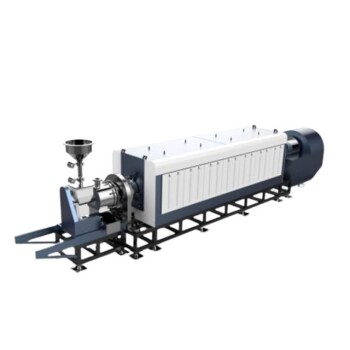
The maintenance of a constant carbon dioxide (CO2) flow is critical to the success of biochar pyrolysis for two immediate reasons: it prevents the biomass from burning by displacing oxygen, and it physically transports volatile byproducts away from the sample. Without this continuous flow, the experiment would likely result in ash or a product with clogged, ineffective pores.
By displacing oxygen, a constant CO2 flow ensures true pyrolysis (thermal decomposition) rather than combustion. Simultaneously, the flow acts as a mechanical transport mechanism, continuously clearing volatile compounds to develop the critical pore structure needed for high-quality biochar.
The Dual Function of Gas Flow
Creating an Inert Environment
The primary function of introducing CO2 is to establish an inert gas environment within the muffle furnace.
At the high temperatures required for pyrolysis, biomass is highly susceptible to combustion and oxidation. If oxygen were present, the material would simply burn to ash. The CO2 flow displaces atmospheric oxygen, protecting the raw material and ensuring that the mass loss is due to thermal decomposition, not burning.
Enhancing Pore Development
Beyond protection, the gas flow plays an active role in shaping the physical properties of the biochar.
During pyrolysis, biomass releases tars and gases known as volatile components. A specific CO2 flow rate is required to sweep these volatiles away from the solid material. This removal is essential for the successful development of the biochar's pore structure, preventing re-deposition that could block the pores.
Optimization and Process Control
The Influence of Heating Rate
While gas flow manages the environment, the heating rate drives the reaction mechanics.
Controlling the temperature increase (e.g., at 15 °C/min) directly influences internal heat transfer within the biomass. It determines the speed at which volatile substances are generated and released.
Customizing Adsorption Properties
The interaction between gas flow and heating rate allows for the customization of the final product.
By precisely managing these variables, researchers can optimize the biochar yield and tune the microscopic pore network. This allows for the adjustment of the micropore-to-mesopore ratio, tailoring the biochar's adsorption performance to target specific pollutants.
Understanding the Trade-offs
Balancing Volatile Removal
There is a delicate balance required when setting the flow rate.
If the flow is insufficient, volatile components may linger and re-condense, effectively clogging the pores you are trying to create. However, an erratic or poorly controlled flow could lead to inconsistent atmospheric conditions within the furnace.
Heating Rate Precision
Heating rate affects the structural integrity of the char.
Rapid heating might release volatiles too quickly, potentially damaging the pore structure. Conversely, a rate that is too slow alters the internal heat transfer dynamics, which may lead to suboptimal yields or a pore structure that is not suited for the intended application.
Making the Right Choice for Your Goal
To achieve the best results in biochar production, you must align your furnace settings with your specific objectives:
- If your primary focus is maximizing yield: Ensure the CO2 flow is constant enough to prevent oxidation, while selecting a heating rate that promotes efficient carbonization without excessive volatilization.
- If your primary focus is pollutant adsorption: Coordinate the gas flow with a precise heating rate to engineer a specific micropore-to-mesopore ratio suited for the target contaminant.
Mastering the interplay between CO2 flow and heating rate is the key to transitioning from simply burning biomass to engineering high-performance materials.
Summary Table:
| Factor | Role in Pyrolysis | Impact on Final Biochar |
|---|---|---|
| CO2 Gas Flow | Displaces Oxygen & Removes Volatiles | Prevents ash formation; creates open pore structures. |
| Heating Rate | Manages Internal Heat Transfer | Determines the speed of volatile release and yield quality. |
| Inert Environment | Prevents Oxidation | Ensures thermal decomposition instead of combustion. |
| Volatile Removal | Prevents Re-deposition | Maintains microscopic pore network for adsorption performance. |
Elevate Your Biochar Research with KINTEK Precision
Achieving the perfect pore structure in biochar requires more than just heat—it requires absolute control over atmospheric conditions and thermal gradients. KINTEK provides industry-leading Muffle, Tube, and Vacuum furnace systems specifically designed to handle precise gas flow and heating rate requirements for advanced pyrolysis experiments.
Why partner with KINTEK?
- Customizable Solutions: Tailor gas inlet systems and heating programs to your unique R&D needs.
- Expert Engineering: Backed by robust manufacturing and R&D for lab-scale and industrial applications.
- Consistent Results: Ensure uniform heating and reliable inert environments every time.
Ready to engineer high-performance materials? Contact KINTEK today to discuss your project!
References
- Mohammad Umair Jamal, Lidija Šiller. Scottish softwood biochar for water remediation targeting selected persistent organic pollutants. DOI: 10.1177/02636174241256854
This article is also based on technical information from Kintek Furnace Knowledge Base .
Related Products
- 1400℃ Muffle Oven Furnace for Laboratory
- 1200℃ Muffle Oven Furnace for Laboratory
- High Temperature Muffle Oven Furnace for Laboratory Debinding and Pre Sintering
- 1700℃ High Temperature Muffle Oven Furnace for Laboratory
- 1800℃ High Temperature Muffle Oven Furnace for Laboratory
People Also Ask
- How does a high-temperature laboratory muffle furnace affect material properties? Transform Anodic Oxide Films Fast
- What is the primary function of a high-temperature laboratory muffle furnace in chemical synthesis? Achieve Precision.
- What function does a muffle furnace perform in perovskite formation? Optimize Your Thermal Synthesis
- How does a laboratory high-temperature muffle furnace facilitate the homogenization of borosilicate glass samples? Expert Insights
- What is the function of a muffle furnace in MOF-derived zirconia conversion? Optimize Phase & Pore Engineering