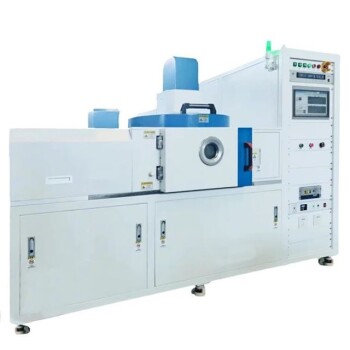
Spark Plasma Sintering (SPS) fundamentally outperforms traditional muffle furnaces for fine-grained ceramics by utilizing simultaneous pressure and pulsed direct current to drive rapid densification. While a muffle furnace relies on slow, external radiative heating, an SPS system generates heat internally within the powder, reducing sintering times from hours to mere minutes. This speed effectively inhibits grain growth, allowing you to achieve near-theoretical density while preserving nano- or sub-micron structures.
The Core Insight In traditional sintering, keeping grains small often means sacrificing density, as the time required to eliminate porosity allows grains to coarsen. SPS solves this paradox by using high pressure and extreme heating rates to force densification instantly, bypassing the temperature windows where unwanted grain growth occurs.
The Mechanics of Rapid Densification
Direct Pulsed Current Heating
Unlike a muffle furnace that heats a sample from the outside in, an SPS system sends a pulsed electric current directly through the mold and the powder particles.
This generates internal heat via the Joule effect and plasma activation between particles. The result is a thermal efficiency that muffle furnaces cannot match, enabling heating rates of hundreds of degrees per minute.
Simultaneous Pressure Application
SPS is not just a heating process; it is a thermo-mechanical process. The system applies synchronized pressure during the heating cycle.
This mechanical force physically aids in closing pores and rearranging particles. By mechanically assisting densification, the material can reach full density at lower temperatures or faster rates than would be possible with heat alone.
Preserving Microstructure Integrity
Bypassing Grain Coarsening Zones
Grain growth is time- and temperature-dependent. In the slow ramp-up of a muffle furnace, materials spend significant time in intermediate temperature zones where grains grow (coarsen) but densification hasn't finished.
The high heating rates of SPS allow the material to quickly bypass these low-to-intermediate temperature ranges. The material reaches its sintering temperature before the grains have time to coarsen significantly.
Short Holding Times
Once the target temperature is reached, the holding time in an SPS system is extremely short compared to traditional methods.
Because the process is so efficient, atomic diffusion is accelerated just enough to bond the particles without allowing the extensive diffusion required for grain growth. This "freezes" the fine microstructure in place.
Resulting Material Performance
Enhanced Mechanical Properties
The direct result of retaining a fine-grained (nano or sub-micron) microstructure is a significant improvement in mechanical performance.
Ceramics produced via SPS consistently exhibit higher fracture toughness, hardness, and flexural strength. By eliminating porosity without enlarging the grains, you maximize the inherent theoretical properties of the material, such as Silicon Nitride or Silicon Carbide.
Understanding the Trade-offs
Geometry and Scalability Constraints
While the process advantages are clear, SPS does have limitations regarding the shape of the final product.
Because SPS relies on a die set (typically graphite) to apply pressure, it is generally limited to simple shapes like disks, cylinders, or blocks. A traditional muffle furnace, while slower, can process complex geometries and net-shape parts that cannot be subjected to the uniaxial pressure required by SPS.
Making the Right Choice for Your Goal
If you are deciding between investing in SPS technology or relying on traditional sintering, consider your specific material requirements:
- If your primary focus is Maximum Mechanical Performance: Choose SPS to achieve near-theoretical density with ultra-fine grain structures that improve hardness and toughness.
- If your primary focus is Complex Geometry: Recognize that the pressure requirement of SPS limits shape complexity, making traditional sintering better for intricate parts despite the coarser grains.
SPS is the definitive choice when the goal is to break the link between high density and grain growth, unlocking material properties that traditional thermal cycles simply cannot achieve.
Summary Table:
| Feature | Spark Plasma Sintering (SPS) | Traditional Muffle Furnace |
|---|---|---|
| Heating Mechanism | Internal Joule effect (Pulsed DC) | External radiative heating |
| Heating Rate | Very Fast (up to 1000°C/min) | Slow (typically <20°C/min) |
| Sintering Time | Minutes | Hours |
| Microstructure | Nano- or sub-micron (Fine-grained) | Coarse-grained due to long cycles |
| Pressure | High Uniaxial Pressure | None (Atmospheric/Gas) |
| Shape Capability | Simple geometries (Disks, Cylinders) | Complex net-shapes |
| Material Density | Near-theoretical (>99%) | Often lower for fine grains |
Unlock Superior Material Performance with KINTEK
Are you struggling to balance material density with grain size? Backed by expert R&D and manufacturing, KINTEK offers cutting-edge Spark Plasma Sintering (SPS) systems, Muffle, Tube, Rotary, and Vacuum furnaces, all customizable for your unique research or production needs.
Whether you need to preserve nanostructures or process complex geometries, our high-temperature solutions deliver the precision your lab requires. Contact us today to consult with our specialists and find the perfect sintering technology for your materials.
References
- Sebastián Caicedo‐Dávila, David A. Egger. Disentangling the effects of structure and lone-pair electrons in the lattice dynamics of halide perovskites. DOI: 10.1038/s41467-024-48581-x
This article is also based on technical information from Kintek Furnace Knowledge Base .
Related Products
- Spark Plasma Sintering SPS Furnace
- 915MHz MPCVD Diamond Machine Microwave Plasma Chemical Vapor Deposition System Reactor
- RF PECVD System Radio Frequency Plasma Enhanced Chemical Vapor Deposition
- 9MPa Air Pressure Vacuum Heat Treat and Sintering Furnace
- Vacuum Heat Treat Sintering Furnace with Pressure for Vacuum Sintering
People Also Ask
- How does the heating mechanism of Spark Plasma Sintering (SPS) function? Enhance TiC/SiC Composite Fabrication
- Why is it necessary to maintain a high vacuum environment during the SPS of SiC? Key to High-Density Ceramics
- What are the technical advantages of using an SPS sintering furnace? Elevate Al2O3-TiC Material Performance
- What are the steps in the discharge plasma sintering process? Master Fast, High-Density Material Consolidation
- What are the advantages of spark plasma sintering (SPS) over traditional forging? Precision Microstructural Control