
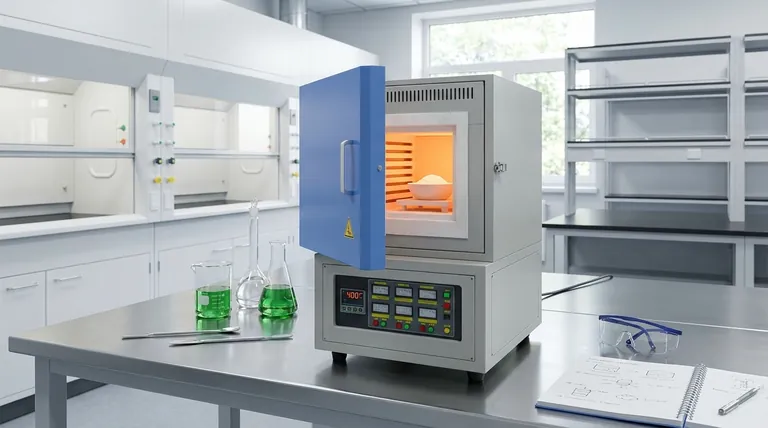
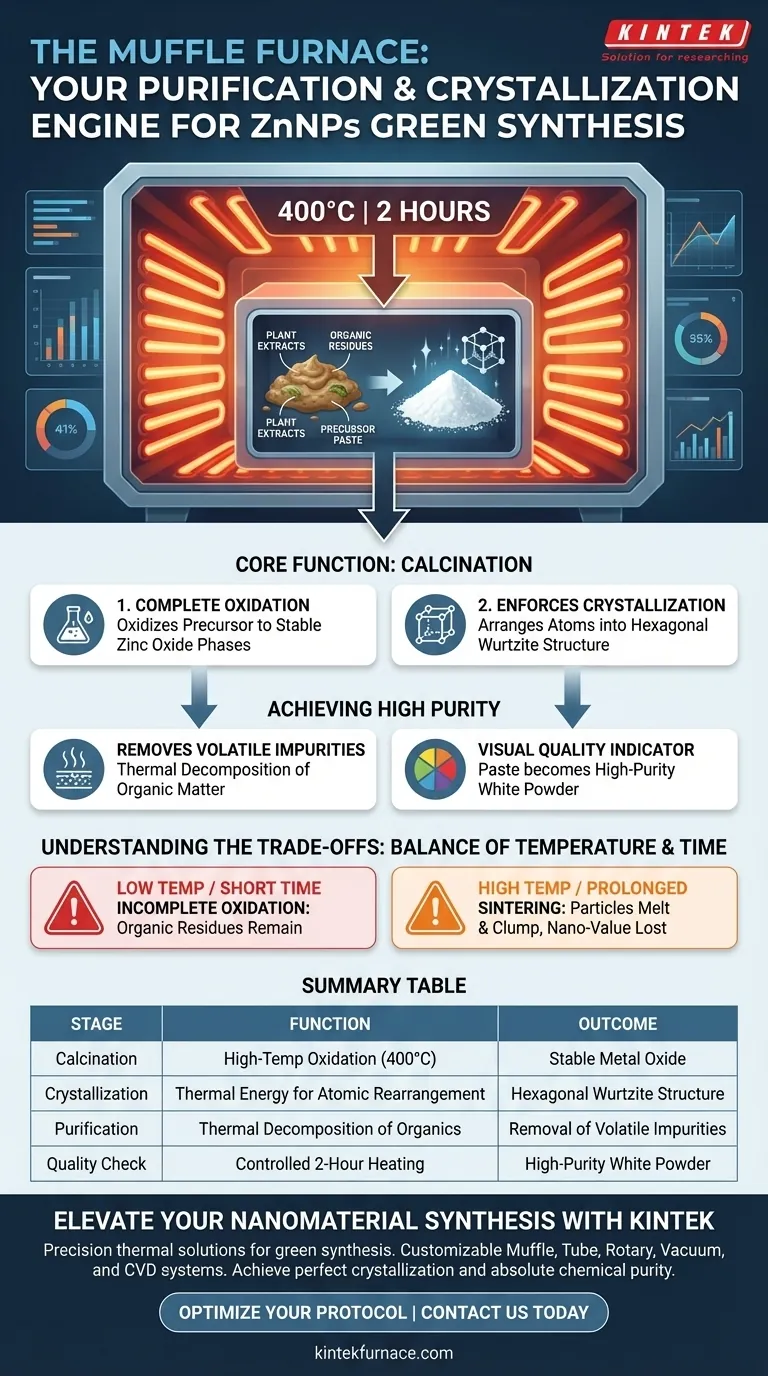
The muffle furnace acts as the definitive purification and crystallization engine in the green synthesis of zinc oxide nanoparticles (ZnNPs). Its primary function is to perform calcination, subjecting the synthesized precursor paste to a sustained temperature of approximately 400°C for two hours. This intense thermal treatment is the specific mechanism that converts the intermediate biological paste into a high-purity, white zinc oxide powder.
Core Takeaway In green synthesis, the initial reaction creates a "dirty" precursor laden with organic residues. The muffle furnace solves this by utilizing high-temperature oxidation to simultaneously burn off volatile impurities and force the zinc and oxygen atoms into a stable, crystalline lattice structure.
The Physiology of Calcination
Driving Complete Oxidation
The synthesis process prior to the furnace yields a precursor paste, not the final oxide. The muffle furnace provides a stable, oxygen-rich environment required to chemically alter this precursor.
By maintaining a temperature of 400°C, the furnace ensures the complete oxidation of the zinc species. This transforms the intermediate compounds into stable metal oxide phases, which is the chemical definition of the final product.
Enforcing Crystallization
Heat is the energy source required for atomic rearrangement. The thermal energy provided by the furnace allows atoms to move and lock into a highly ordered structure.
This process, known as crystallization, ensures the ZnNPs do not remain amorphous (shapeless). Instead, the controlled heat drives the atoms to arrange themselves into a specific crystal lattice, often the hexagonal wurtzite structure. This structural integrity is vital for the material's physical and chemical stability.
Achieving High Purity
Removing Volatile Impurities
Green synthesis relies on biological agents (such as plant extracts) to reduce metal salts. Consequently, the precursor paste is initially contaminated with residual organic matter and biological compounds.
The muffle furnace eliminates these contaminants through thermal decomposition. The high heat effectively vaporizes volatile biological impurities, leaving behind only the inorganic zinc oxide.
The Visual Indicator of Quality
The effectiveness of this purification is visibly apparent in the final product.
Before calcination, the paste may be discolored due to organic residues. After the 2-hour treatment at 400°C, the result is a high-purity white powder. This color change is a primary indicator that the organic matter has been successfully removed and the synthesis is complete.
Understanding the Trade-offs
The Balance of Temperature and Time
While the muffle furnace is a tool of precision, incorrect settings can degrade the nanomaterial.
If the temperature is too low or the duration too short, oxidation will be incomplete, leaving organic impurities that compromise the material's properties.
Conversely, excessive heat or prolonged exposure can lead to sintering. This occurs when individual nanoparticles melt together to form larger clumps, effectively destroying the "nano" characteristics that give the material its unique value.
Making the Right Choice for Your Goal
To maximize the efficacy of the muffle furnace in your synthesis protocol, consider your specific end-goals:
- If your primary focus is Chemical Purity: Ensure the furnace maintains a consistent oxidative atmosphere to fully decompose the specific biological agents used in your green synthesis paste.
- If your primary focus is Structural Integrity: Adhere strictly to the 400°C limit; this provides enough energy for atomic rearrangement into a crystalline phase without inducing aggressive particle agglomeration.
Ultimately, the muffle furnace transforms a chaotic biological mixture into a refined, engineered nanomaterial.
Summary Table:
| Stage of Synthesis | Function of Muffle Furnace | Outcome of Process |
|---|---|---|
| Calcination | High-temperature oxidation (400°C) | Converts precursor paste into stable metal oxide |
| Crystallization | Thermal energy for atomic rearrangement | Formation of hexagonal wurtzite crystal structure |
| Purification | Thermal decomposition of organic matter | Removal of volatile biological impurities |
| Quality Check | Controlled 2-hour heating cycle | Visual transition to high-purity white powder |
Elevate Your Nanomaterial Synthesis with KINTEK
Precision is non-negotiable when converting biological precursors into high-value nanoparticles. KINTEK provides industry-leading thermal solutions designed for the rigors of green synthesis and material science.
Backed by expert R&D and manufacturing, KINTEK offers Muffle, Tube, Rotary, Vacuum, and CVD systems, all fully customizable to meet your specific temperature and atmospheric requirements. Whether you are aiming for perfect crystallization or absolute chemical purity, our lab high-temp furnaces ensure consistent results every time.
Ready to optimize your calcination protocol? Contact us today to find the perfect furnace for your lab.
Visual Guide
References
- Khyati Saini, Naveen Singhal. GREEN SYNTHESIZED ZNO NANOPARTICLES WITH CORDYCEPS MILITARIS FUNGUS EXTRACT FOR THE TREATMENT OF MEMORY IMPAIRMENT IN ALZHIEMER DISEASE. DOI: 10.22159/ijap.2025v17i1.53491
This article is also based on technical information from Kintek Furnace Knowledge Base .
Related Products
- 1400℃ Muffle Oven Furnace for Laboratory
- 1200℃ Muffle Oven Furnace for Laboratory
- Laboratory Muffle Oven Furnace with Bottom Lifting
- High Temperature Muffle Oven Furnace for Laboratory Debinding and Pre Sintering
- 1800℃ High Temperature Muffle Oven Furnace for Laboratory
People Also Ask
- What is the primary function of a high-temperature laboratory muffle furnace in chemical synthesis? Achieve Precision.
- How does a high-temperature laboratory muffle furnace affect material properties? Transform Anodic Oxide Films Fast
- How is a laboratory high-temperature muffle furnace utilized to achieve the specific crystalline structure of LaFeO3 catalysts?
- How is a laboratory high-temperature muffle furnace utilized in g-C3N4 synthesis? Optimize Your Thermal Polycondensation
- What role does a laboratory high-temperature muffle furnace play in the treatment of highly contaminated waste glass?

















