
In jewelry making, a muffle furnace is a specialized oven used for two primary, high-temperature processes: annealing metal to restore its workability and firing metal clay to transform it into a solid, durable piece. It provides a clean, highly controlled heating environment that is difficult to achieve with other methods like a torch.
The true value of a muffle furnace lies not just in its ability to get hot, but in its precision. It offers unparalleled control over temperature, timing, and atmosphere, which is essential for transforming delicate materials and achieving consistent, professional-grade results.
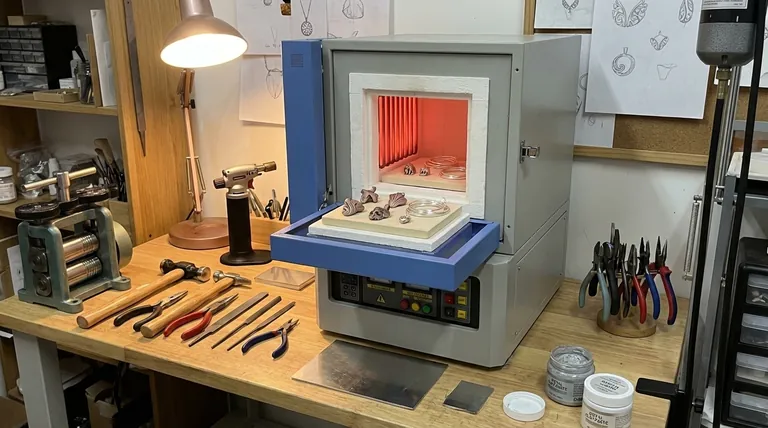
The Core Functions of a Muffle Furnace in Jewelry
A muffle furnace's role extends beyond simple heating. It enables specific metallurgical processes that are fundamental to modern and traditional jewelry techniques.
Firing Metal Clay
Metal clay is a revolutionary material composed of fine metal particles (like silver, gold, or copper), a non-toxic organic binder, and water.
The furnace executes a precise, pre-programmed heating cycle. This cycle first burns away the binder at a lower temperature, then ramps up to a much higher temperature to sinter the metal particles, fusing them into a solid, dense metal object that is nearly identical to one made from traditional cast metal.
Annealing Metals
As you hammer, bend, or shape metal, its internal crystalline structure becomes compressed and stressed. This is known as work-hardening, and it makes the metal brittle and difficult to continue working.
Annealing is the process of heating the metal to a specific temperature and then cooling it to relieve this stress, restoring its softness and ductility. A muffle furnace heats the entire piece evenly without the direct flame contact of a torch, preventing issues like overheating, melting, or excessive surface oxidation (firescale).
Why a Muffle Furnace is the Right Tool
While a simple torch can apply heat, a muffle furnace provides a level of process control that a torch cannot match. This control is what separates amateur results from professional ones.
Unmatched Temperature Precision
Most modern muffle furnaces have digital controllers that allow you to program exact temperature profiles. You can set the rate of heating, the precise target temperature, and the duration of the hold time. This repeatability is critical for successfully sintering metal clay, which has very specific firing schedules.
Uniform, Indirect Heat
The term "muffle" refers to the furnace's inner chamber, which separates the jewelry piece from the actual heating elements. This design ensures the piece is heated by uniform, radiant heat rather than direct, intense contact.
This even heating prevents hot spots, reduces the risk of melting delicate parts, and is essential when annealing complex or large pieces that a torch would heat unevenly.
A Contaminant-Free Environment
The enclosed chamber protects the workpiece from dust, debris, and other workshop contaminants. For processes like enameling, where cleanliness is paramount to prevent discoloration or blemishes in the fused glass, this clean environment is a necessity.
Understanding the Trade-offs
While incredibly useful, a muffle furnace is not the solution for every heating task in a jewelry studio.
Cost and Footprint
A quality muffle furnace is a significant financial investment compared to a handheld torch setup. They also require dedicated, heat-safe bench space.
Slower for Spot-Annealing
If you only need to soften one small area of a larger piece, a torch is much faster and more efficient. A furnace heats the entire chamber and everything inside it, making it less practical for quick, localized tasks.
Not Ideal for Most Soldering
In jewelry, soldering requires applying localized heat to join specific components without melting previous solder joints. A furnace heats the entire piece, which would cause all solder to reflow simultaneously. For this reason, torch soldering remains the industry standard for fabrication.
Making the Right Choice for Your Goal
Deciding whether to invest in a muffle furnace depends entirely on the kind of work you intend to do.
- If your primary focus is working with metal clay: A programmable muffle furnace is not just a benefit; it is essential for achieving reliable, professional results.
- If your primary focus is traditional metal fabrication (sheet and wire): A torch is your primary tool, but a furnace becomes an invaluable asset for batch-annealing components or evenly heating large, complex pieces.
- If your primary focus is advanced techniques like enameling or granulation: A furnace provides the stable, clean, and highly controlled environment necessary for success in these demanding disciplines.
Ultimately, integrating a muffle furnace into your studio is about gaining precise control over heat, unlocking a new level of consistency and creative possibility.
Summary Table:
| Process | Key Benefit | Ideal For |
|---|---|---|
| Firing Metal Clay | Sinters particles into solid metal | Metal clay artists, precise firing cycles |
| Annealing Metals | Restores ductility and softness | Jewelry makers, batch annealing, complex pieces |
| General Heating | Uniform, contaminant-free environment | Enameling, granulation, clean processes |
Unlock Precision in Your Jewelry Studio with KINTEK
Are you striving for flawless results in metal clay firing or annealing? KINTEK's advanced high-temperature furnace solutions, including Muffle, Tube, and Vacuum Furnaces, are designed to meet the unique demands of jewelry makers. With our exceptional R&D and in-house manufacturing, we offer deep customization to ensure your furnace fits your exact experimental needs—whether you're working with delicate metals or require consistent temperature control.
Contact us today to discuss how our tailored furnace systems can elevate your craftsmanship and efficiency!
Visual Guide

Related Products
- 1400℃ Muffle Oven Furnace for Laboratory
- 1700℃ High Temperature Muffle Oven Furnace for Laboratory
- 1800℃ High Temperature Muffle Oven Furnace for Laboratory
- 1200℃ Muffle Oven Furnace for Laboratory
- High Temperature Muffle Oven Furnace for Laboratory Debinding and Pre Sintering
People Also Ask
- How does a high-temperature laboratory muffle furnace affect material properties? Transform Anodic Oxide Films Fast
- What is the primary function of a high-temperature laboratory muffle furnace in chemical synthesis? Achieve Precision.
- How does a laboratory high-temperature muffle furnace contribute to the final formation of Bismuth Oxide nanosheets?
- How is a laboratory high-temperature muffle furnace utilized in g-C3N4 synthesis? Optimize Your Thermal Polycondensation
- How does a laboratory high-temperature muffle furnace facilitate the homogenization of borosilicate glass samples? Expert Insights



















