
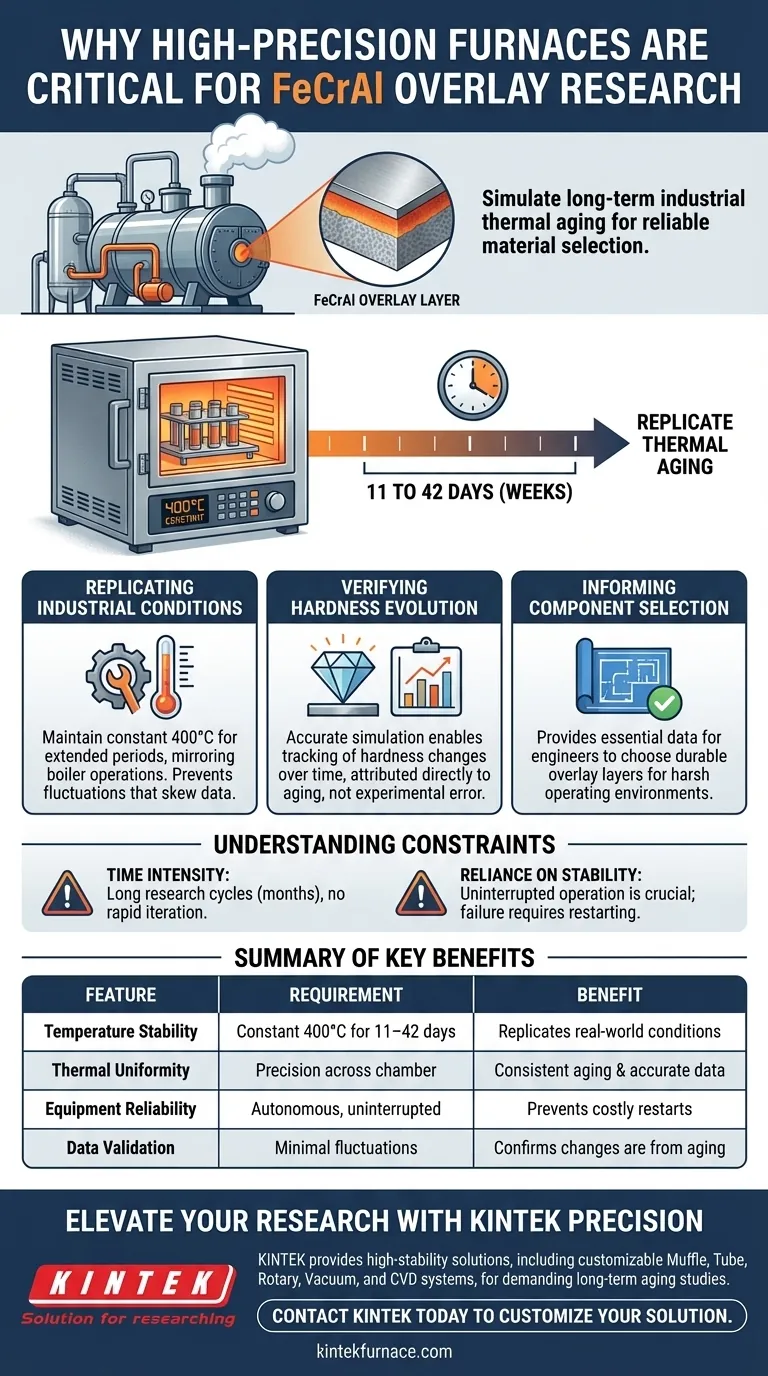
High-precision box experimental furnaces are critical for research on FeCrAl overlay layers because they provide the strictly controlled environment necessary to simulate long-term industrial thermal aging. Specifically, these furnaces are required to maintain a constant temperature, such as 400 degrees Celsius, for extended periods ranging from 11 to 42 days, ensuring accurate verification of hardness evolution trends.
Reliable material selection for industrial boiler components depends on understanding how materials degrade over time. High-precision furnaces enable researchers to replicate these harsh conditions over weeks, providing the essential data needed to predict material performance.
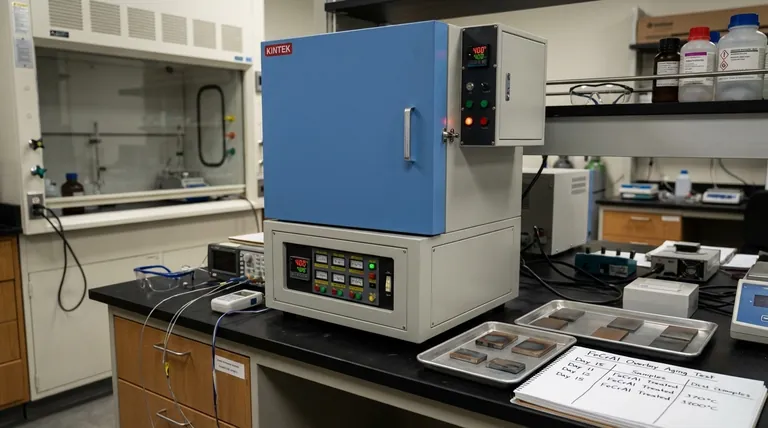
Simulating Industrial Conditions
To understand how FeCrAl overlay layers will perform in the real world, researchers must move beyond short-term testing. They need to replicate the sustained thermal stress found in industrial environments.
The Necessity of Long-Term Stability
Industrial boiler components function continuously for long durations. To simulate this, experimental setups must run for weeks rather than hours.
According to the primary reference, specific testing protocols require maintaining conditions for 11 to 42 days. Only a high-precision furnace can ensure the temperature remains constant throughout this extended timeframe without fluctuations that would skew the data.
Replicating Thermal Aging
Materials behave differently when exposed to heat for long periods, a process known as thermal aging.
To observe the true effects of aging on FeCrAl layers, the environment must be held at a steady 400 degrees Celsius. High-precision box furnaces provide the thermal uniformity required to ensure that the aging process observed in the lab mirrors reality.
Analyzing Material Performance
The ultimate goal of using high-precision equipment is to derive actionable data regarding the material's physical properties.
Verifying Hardness Evolution
A key performance metric for FeCrAl overlay layers is how their hardness evolves under thermal stress.
Fluctuations in temperature can produce inconsistent hardness readings. By ensuring a stable thermal environment, researchers can attribute changes in hardness directly to the material's aging process rather than experimental error.
Informing Component Selection
The data derived from these rigorous tests is not merely academic.
It provides the essential data needed to select the appropriate materials for industrial boiler components. Engineers rely on this verified hardness data to choose overlay layers that will withstand actual operating conditions.
Understanding the Constraints
While high-precision box furnaces are necessary for accurate simulation, researchers must be aware of the inherent challenges in this testing methodology.
The Trade-off of Time Intensity
The primary constraint of this approach is the significant time investment.
Because the simulation requires 11 to 42 days of continuous operation, rapid iteration is impossible. Research cycles are long, meaning that a failure in equipment or setup on day 30 requires restarting a month-long process.
Reliance on Environmental Stability
The validity of the data is entirely dependent on the uninterrupted stability of the furnace.
If the equipment loses precision or experiences power interruptions during the multi-week cycle, the simulation of "constant temperature" is compromised. This necessitates robust equipment that can operate autonomously and reliably for weeks at a time.
Making the Right Choice for Your Goal
To ensure your research into FeCrAl overlay layers yields valid industrial data, align your testing protocols with your specific objectives.
- If your primary focus is verifying material durability: Prioritize equipment capable of maintaining strict thermal stability over cycles lasting at least 42 days to accurately map hardness evolution.
- If your primary focus is industrial application: Use the data derived from these long-term aging simulations to validate material selection for boiler components operating at 400 degrees Celsius.
By investing in high-precision thermal control, you transform raw experimental data into reliable engineering solutions.
Summary Table:
| Feature | Requirement for FeCrAl Research | Benefit to Material Analysis |
|---|---|---|
| Temperature Stability | Constant 400°C for 11–42 days | Replicates real-world industrial boiler conditions |
| Thermal Uniformity | Precision across the entire chamber | Ensures consistent aging and accurate hardness data |
| Equipment Reliability | Autonomous, uninterrupted operation | Prevents costly restarts in month-long research cycles |
| Data Validation | Minimal fluctuations | Confirms changes are due to aging, not experimental error |
Elevate Your Material Research with KINTEK Precision
Precise data is the foundation of reliable industrial engineering. KINTEK provides the high-stability thermal solutions necessary for demanding long-term aging studies. Backed by expert R&D and manufacturing, we offer Muffle, Tube, Rotary, Vacuum, and CVD systems, as well as specialized lab high-temperature furnaces—all fully customizable to meet the rigorous constraints of your FeCrAl overlay research.
Don't let equipment fluctuations compromise weeks of data. Ensure your material performance predictions are accurate with KINTEK’s industry-leading thermal control.
Contact KINTEK today to customize your high-precision furnace solution.
Visual Guide
References
- María Asunción Valiente Bermejo, Mattias Thuvander. Microstructure and Properties of FeCrAl Overlay Welds at High Temperature Service. DOI: 10.1007/s11661-025-07846-w
This article is also based on technical information from Kintek Furnace Knowledge Base .
Related Products
- 1700℃ High Temperature Laboratory Tube Furnace with Alumina Tube
- Laboratory Muffle Oven Furnace with Bottom Lifting
- High Pressure Laboratory Vacuum Tube Furnace
- 1400℃ High Temperature Laboratory Tube Furnace with Alumina Tube
- 1200℃ Muffle Oven Furnace for Laboratory
People Also Ask
- How does zone-melting in tube furnaces synthesize bismuth micro-wires? Master Single-Crystal Thermoelectric Growth
- How are high-temp tube furnaces used to measure diffusion coefficients per Fick's law? Master Precision Annealing
- How do high-temperature laboratory tube furnaces ensure environmental stability? Precision Thermal Reduction Tips
- How are high-temperature laboratory tube furnaces applied in long-term vacuum homogenization heat treatments for intermetallic samples?
- How are high-temperature tube furnaces applied in testing ceramic-supported alloy membranes? Insights



















