
A forced convection oven facilitates the curing of flame-retardant epoxy resin mixtures by utilizing active air circulation to create a highly uniform thermal environment. This mechanism allows for precise, stepped temperature profiles—specifically regimes such as 130°C followed by 150°C—which are necessary to activate the chemical reaction between DGBEA, flame retardants, and curing agents. By maintaining consistent airflow, the oven ensures that heat is distributed evenly, preventing the uneven curing that often occurs in static heating environments.
The core advantage of forced convection is its ability to minimize the temperature gradient between a material's surface and its core. This thermal uniformity is the deciding factor in achieving full cross-linking and high-performance structural integrity in thick epoxy samples.
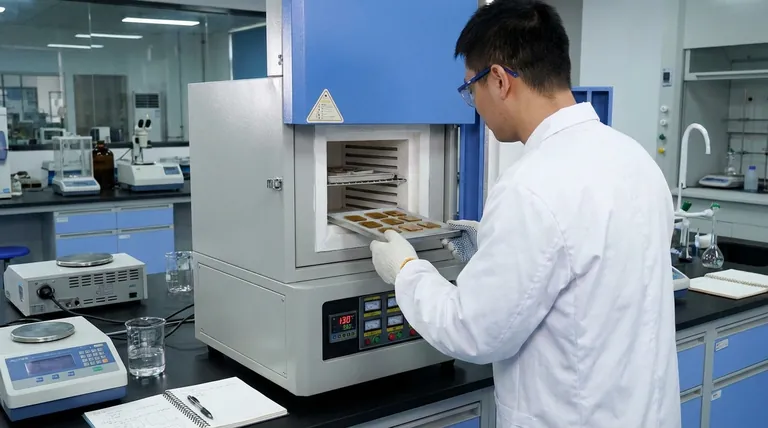
The Mechanics of Uniform Curing
Eliminating Thermal Gradients in Thick Samples
In static ovens, heat often penetrates a material from the outside in, causing the surface to cure faster than the center.
Forced convection ovens solve this by circulating hot air, which minimizes the temperature difference (gradient) between the interior and exterior of the sample.
This is particularly critical for thick samples, ensuring the material reaches thermal equilibrium quickly and cures consistently throughout its volume.
Driving the Chemical Reaction
The curing process relies on a specific chemical reaction between epoxy groups and amine curing agents.
This reaction requires sustained, even heat to facilitate full cross-linking of the molecular chains.
Without the uniform heat provided by forced convection, the cross-linking may be incomplete, leading to weak spots or compromised flame-retardant properties.
The Importance of Process Control
Executing Stepped Temperature Profiles
Curing complex mixtures containing DGBEA (Diglycidyl ether of bisphenol A) often requires a multi-stage heating process.
The primary reference highlights a specific requirement for a stepped environment, utilizing distinct phases at 130°C and 150°C.
Forced convection allows for rapid and precise adjustments to these temperature setpoints, ensuring the material spends the exact required time at each thermal stage.
Common Pitfalls to Avoid
The Risk of Static Heating
Attempting to cure these specific mixtures without forced air circulation often leads to thermal stratification.
In a static environment, hot air rises and stagnates, creating "hot spots" and "cold spots" within the chamber.
This lack of uniformity prevents the precise 130°C/150°C stepping required, resulting in a product where the outer shell is over-cured while the inner core remains under-cured.
Making the Right Choice for Your Goal
To achieve the high-performance structure described in the reference, consider the following when setting up your curing process:
- If your primary focus is structural integrity: Ensure your oven creates enough airflow to penetrate thick samples, guaranteeing full cross-linking from core to surface.
- If your primary focus is process consistency: Program your oven to strictly follow the stepped temperature profile (e.g., 130°C to 150°C) to accommodate the specific chemistry of DGBEA and amine agents.
Uniform thermal management is the key to transforming a raw resin mixture into a durable, fully cured flame-retardant material.
Summary Table:
| Feature | Forced Convection Benefit | Impact on Epoxy Curing |
|---|---|---|
| Airflow | Active circulation & distribution | Prevents hot/cold spots & thermal stratification |
| Temperature Gradient | Minimizes core-to-surface delta | Ensures consistent cross-linking in thick samples |
| Process Control | Rapid, precise stepped profiles | Accurate execution of 130°C/150°C curing stages |
| Material Integrity | Uniform thermal equilibrium | Maximizes structural strength & flame retardancy |
Elevate Your Material Performance with KINTEK
Precision is non-negotiable when curing high-performance flame-retardant resins. KINTEK provides industry-leading forced convection ovens and high-temperature lab furnaces designed to eliminate thermal gradients and ensure perfect cross-linking every time.
Backed by expert R&D and manufacturing, we offer a comprehensive range of Muffle, Tube, Rotary, Vacuum, and CVD systems, all fully customizable to meet your unique laboratory needs.
Ready to achieve superior structural integrity? Contact us today to consult with our experts and find the ideal thermal solution for your research and production.
References
- Younghun Kim, Gyojic Shin. Influence of Thiol-Functionalized Polysilsesquioxane/Phosphorus Flame-Retardant Blends on the Flammability and Thermal, Mechanical, and Volatile Organic Compound (VOC) Emission Properties of Epoxy Resins. DOI: 10.3390/polym16060842
This article is also based on technical information from Kintek Furnace Knowledge Base .
Related Products
- Multi Heating Zones CVD Tube Furnace Machine for Chemical Vapor Deposition Equipment
- High Temperature Muffle Oven Furnace for Laboratory Debinding and Pre Sintering
- 1400℃ Muffle Oven Furnace for Laboratory
- 1700℃ High Temperature Muffle Oven Furnace for Laboratory
- Laboratory Muffle Oven Furnace with Bottom Lifting
People Also Ask
- What is the function of a multi-zone tube furnace in CVD synthesis? Master 2D In2Se3 Nanosheet Precision
- What environmental protection applications utilize multi zone tube furnaces? Unlock Precision in Waste Treatment and Green Tech
- What temperature-related capabilities make multi zone tube furnaces valuable for research? Unlock Precision Thermal Control
- What role do multi zone tube furnaces play in new energy research? Unlock Precise Thermal Control for Innovation
- Why are multi zone tube furnaces particularly useful for nanomaterial research? Unlock Precise Thermal Control for Advanced Synthesis






