
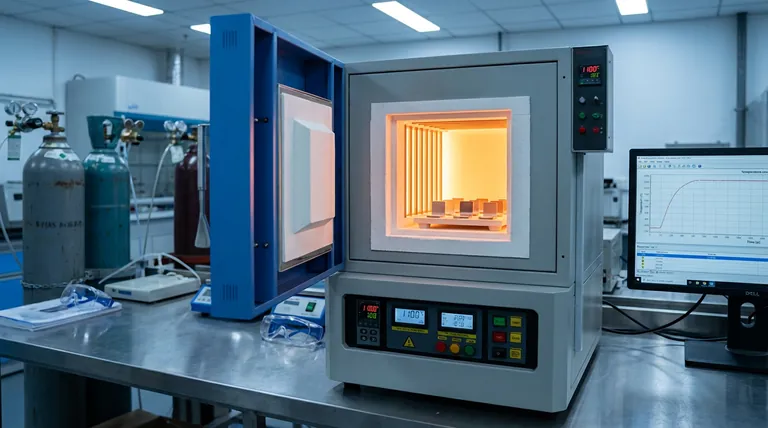
A high-precision muffle furnace serves as the critical simulation environment for validating the durability of coatings used in extreme applications like gas turbines. It contributes to evaluation by establishing a rigorously stable 1100°C thermal field and controlled airflow, which forces the coating to undergo accelerated oxidation. This controlled exposure allows researchers to isolate temperature as a variable and accurately predict how long a coating will protect the underlying substrate before failure.
The core value of the muffle furnace in this context is repeatability. By maintaining an exact environment over hundreds of hours, the furnace ensures that the formation of the protective $\alpha$-Al2O3 film is driven solely by material properties, enabling a precise quantitative analysis of the coating’s lifespan and resistance to peeling.
Simulating Extreme Operating Environments
Precise Thermal Stability
To evaluate a coating's performance, the testing environment must replicate the intense heat of a gas turbine.
A high-precision muffle furnace maintains a uniform thermal field at 1100°C. This stability is essential because even minor fluctuations in temperature can alter the rate of oxidation, leading to skewed data regarding the coating's endurance.
Controlled Atmosphere and Airflow
Heat alone is not sufficient; the chemical environment must also be controlled.
The furnace maintains a constant airflow during the test. This ensures a consistent supply of oxygen, which is required to react with elements in the bond coat (such as aluminum, chromium, and nickel) to form the Thermally Grown Oxide (TGO) layer.
The Mechanism of Coating Evaluation
Inducing Protective Oxide Growth
The primary goal of these tests is to observe the formation of a specific protective layer.
Under the 1100°C conditions provided by the furnace, aluminide coatings on nickel-based substrates oxidize to form a dense $\alpha$-Al2O3 (alumina) film. This film acts as a shield, slowing down further degradation of the metal beneath it.
Quantifying Spallation Resistance
The furnace enables researchers to determine exactly when this protection fails.
By subjecting the samples to long-term exposure (often lasting 400 hours or more), researchers can measure the "spallation resistance"—the coating's ability to resist peeling off. This data allows for the calculation of the coating's expected service life in real-world applications.
The Role of Automation and Cycling
Executing Thermal Cycles
Real-world engines do not run at a constant temperature forever; they heat up and cool down.
Advanced muffle furnaces utilize automated programs to strictly adhere to time-temperature curves. A common cycle involves holding the high temperature for 55 minutes followed by 5 minutes of rapid cooling, introducing thermal stress that tests the mechanical integrity of the bond.
Eliminating Human Error
Consistency is the bedrock of comparative analysis.
Automated control ensures that every test sample undergoes identical thermal stress cycles. This removes human error from the equation, ensuring that any difference in failure time is due to the pre-oxidation state or material quality, not inconsistent testing procedures.
Understanding the Trade-offs
Static vs. Dynamic Simulation
While a muffle furnace excels at simulating temperature and chemical oxidation, it does not perfectly replicate the physical environment of a turbine.
These furnaces typically provide a "static" or low-flow environment. They do not simulate the high-velocity gas erosion or mechanical debris impact that occurs inside an operating engine, which can also contribute to coating failure.
Duration of Testing
High-precision oxidation tests are inherently time-consuming.
Because the goal is to simulate long-term endurance, tests frequently run for hundreds of hours. This makes the reliability of the furnace paramount; a single equipment fault at hour 300 could invalidate weeks of data collection.
Making the Right Choice for Your Goal
To maximize the value of your oxidation tests, align your equipment capabilities with your specific research objectives.
- If your primary focus is Lifespan Prediction: Prioritize a furnace with exceptional thermal uniformity to ensure the $\alpha$-Al2O3 growth rate is consistent across all samples.
- If your primary focus is Failure Analysis: Ensure the furnace has programmable cooling capabilities to simulate the thermal cycling (rapid heating and cooling) that triggers spallation.
The muffle furnace effectively transforms a chaotic combustion environment into a controlled laboratory variable, providing the objective data needed to certify high-temperature coatings.
Summary Table:
| Feature | Contribution to Coating Evaluation |
|---|---|
| 1100°C Thermal Stability | Ensures uniform $\alpha$-Al2O3 film growth and repeatable data. |
| Controlled Airflow | Provides consistent oxygen supply for Thermally Grown Oxide (TGO) formation. |
| Automated Cycling | Simulates engine thermal stress to quantify spallation resistance. |
| Long-term Reliability | Maintains environment integrity over 400+ hour endurance tests. |
Elevate Your Material Testing Precision
Don’t compromise your research with inconsistent thermal data. KINTEK provides industry-leading high-temperature solutions, backed by expert R&D and manufacturing. Our customizable Muffle, Tube, Rotary, Vacuum, and CVD systems are engineered to provide the rigorous thermal stability required for 1100°C oxidation tests and beyond.
Whether you are predicting coating lifespan or performing complex failure analysis, KINTEK delivers the reliability your lab needs.
Contact KINTEK Today to Optimize Your Lab
References
- Effect of Ni-Based Superalloy on the Composition and Lifetime of Aluminide Coatings. DOI: 10.3390/ma18133138
This article is also based on technical information from Kintek Furnace Knowledge Base .
Related Products
- 1800℃ High Temperature Muffle Oven Furnace for Laboratory
- 1700℃ High Temperature Muffle Oven Furnace for Laboratory
- 1400℃ Muffle Oven Furnace for Laboratory
- 1200℃ Muffle Oven Furnace for Laboratory
- High Temperature Muffle Oven Furnace for Laboratory Debinding and Pre Sintering
People Also Ask
- How does a high-temperature laboratory muffle furnace affect material properties? Transform Anodic Oxide Films Fast
- What is the primary function of a high-temperature laboratory muffle furnace in chemical synthesis? Achieve Precision.
- Why is a laboratory high-temperature muffle furnace used for BaTiO3? Achieve Optimal Tetragonal Crystalline Phases
- How is a laboratory high-temperature muffle furnace used to evaluate porous Co-Al materials? Precision Thermal Analysis
- Why is a laboratory high-temperature muffle furnace required for LaNixFe1-xO3 catalysts? Optimize Two-Stage Synthesis



















