
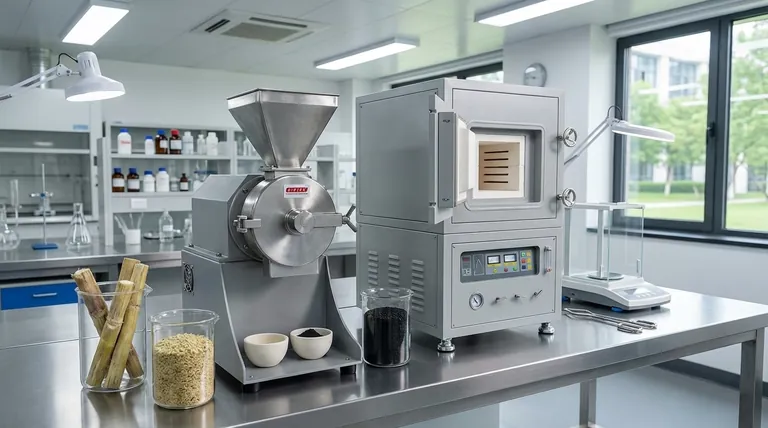
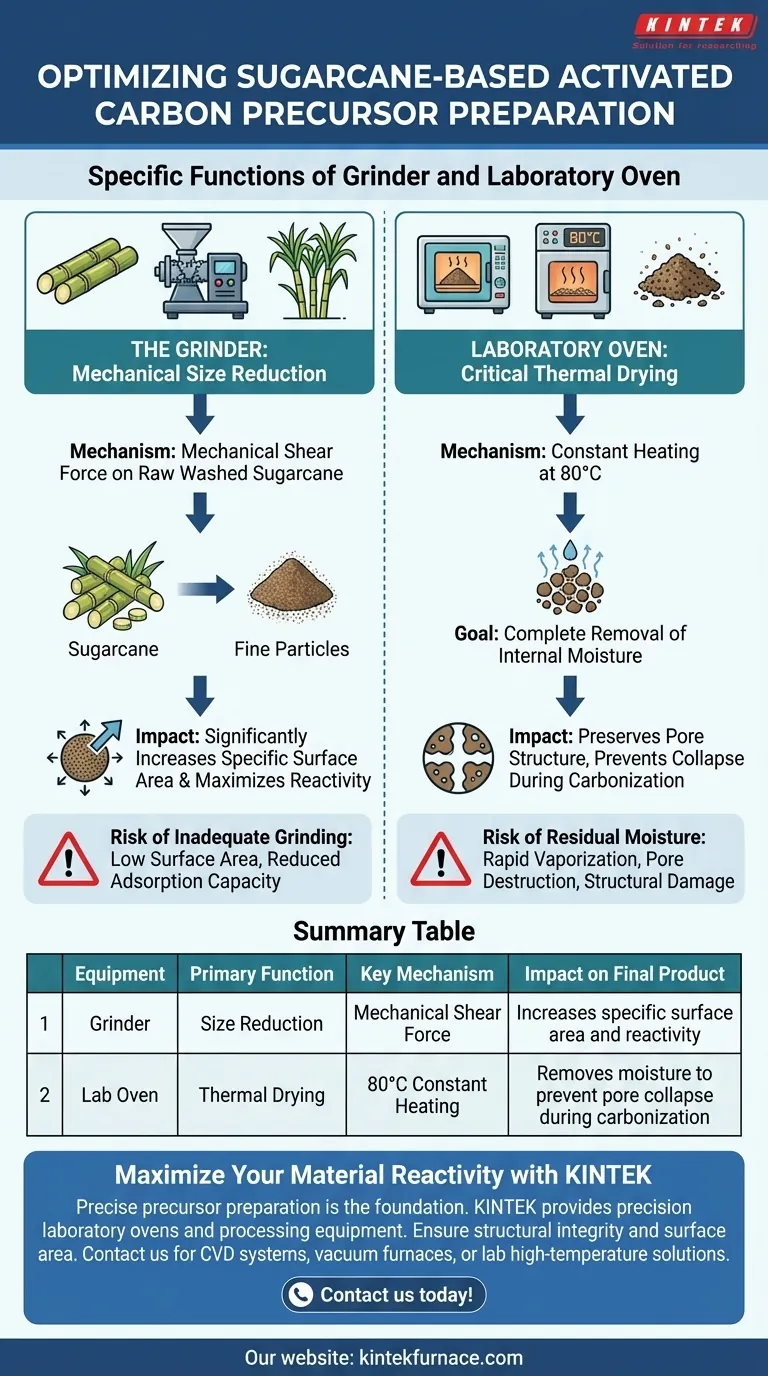
The specific functions of the grinder and laboratory oven are mechanical size reduction and critical moisture elimination. during the precursor phase. The grinder utilizes mechanical shear force to process washed sugarcane into fine particles, directly increasing the specific surface area available for future reactions. The laboratory oven operates at 80°C to remove internal moisture, a vital step that stabilizes the biomass structure against damage during later high-temperature processing.
Success in activated carbon production relies on properly conditioning the raw biomass. The grinder maximizes the material's reactivity by increasing surface area, while the oven prevents the catastrophic collapse of pore structures by removing water before carbonization.
The Role of Mechanical Size Reduction
Mechanism of Action
The grinder serves as the primary tool for physical conditioning. It applies mechanical shear force to the raw, washed sugarcane.
This mechanical action breaks down the fibrous biomass into fine particles.
Impact on Surface Area
The creation of fine particles is not merely for handling purposes; it is a chemical necessity. By reducing particle size, the grinder significantly increases the material's specific surface area.
This increased surface area exposes more of the biomass, making it highly receptive to subsequent reactions in the activation process.
The Criticality of Thermal Drying
Moisture Removal Strategy
Following the grinding process, the laboratory oven is employed to dry the material at a controlled temperature of 80°C.
The specific goal of this phase is the complete removal of internal moisture trapped within the biomass matrix.
Preserving Pore Structure
This drying step is a preventative measure against structural damage. If moisture remains in the precursor, the high temperatures used in the subsequent carbonization stage would cause rapid water vaporization.
Rapid vaporization creates internal pressure that can lead to the collapse of the material's pore structure. By pre-drying the material, the oven ensures the internal architecture remains intact for activation.
Risks of Improper Processing
The Cost of Inadequate Grinding
If the grinder fails to produce sufficiently fine particles, the specific surface area will remain low.
This limits the efficiency of subsequent reactions, potentially resulting in activated carbon with lower adsorption capacity.
The Danger of Residual Moisture
Skipping the drying stage or failing to maintain 80°C can compromise the final product's quality.
Entering carbonization with wet biomass triggers rapid vaporization (steam generation), which mechanically destroys the pores necessary for activated carbon to function.
Optimizing the Precursor Stage
To ensure the production of high-quality sugarcane-based activated carbon, prioritize the following control points:
- If your primary focus is Maximizing Reactivity: Ensure the grinder applies sufficient shear force to produce fine, consistent particles with high surface area.
- If your primary focus is Structural Integrity: Strictly maintain the laboratory oven at 80°C until all internal moisture is removed to prevent pore collapse during carbonization.
Proper precursor preparation transforms raw waste into a stable, highly reactive foundation for advanced carbon materials.
Summary Table:
| Equipment | Primary Function | Key Mechanism | Impact on Final Product |
|---|---|---|---|
| Grinder | Size Reduction | Mechanical Shear Force | Increases specific surface area and reactivity |
| Lab Oven | Thermal Drying | 80°C Constant Heating | Removes moisture to prevent pore collapse during carbonization |
Maximize Your Material Reactivity with KINTEK
Precise precursor preparation is the foundation of high-performance activated carbon. Backed by expert R&D and world-class manufacturing, KINTEK provides the precision laboratory ovens and processing equipment needed to ensure your biomass maintains its structural integrity and surface area.
Whether you require specialized CVD systems, vacuum furnaces, or customizable lab high-temperature solutions, our team is ready to support your unique research and production goals.
Ready to optimize your carbonization process? Contact us today to find the perfect equipment for your lab!
Visual Guide
References
- Yanan Zhao, Jian Wang. Magnetically recoverable bagasse-activated carbon composite anodes for sediment microbial fuel cells: enhanced performance in chromium-contaminated soil remediation. DOI: 10.1039/d5ra02890f
This article is also based on technical information from Kintek Furnace Knowledge Base .
Related Products
- 1200℃ Muffle Oven Furnace for Laboratory
- 1400℃ Muffle Oven Furnace for Laboratory
- 1800℃ High Temperature Muffle Oven Furnace for Laboratory
- High Temperature Muffle Oven Furnace for Laboratory Debinding and Pre Sintering
- Laboratory Muffle Oven Furnace with Bottom Lifting
People Also Ask
- How does a high-temperature laboratory muffle furnace affect material properties? Transform Anodic Oxide Films Fast
- What is the primary function of a high-temperature laboratory muffle furnace in chemical synthesis? Achieve Precision.
- How is a laboratory muffle furnace used in 3D-printed PP-CF cross-linking? Achieve Thermal Stability at 150 °C
- What is the role of a laboratory high-temperature muffle furnace in iron analysis? Key to Precise Sample Mineralization
- Why is a laboratory high-temperature muffle furnace used for BaTiO3? Achieve Optimal Tetragonal Crystalline Phases












