
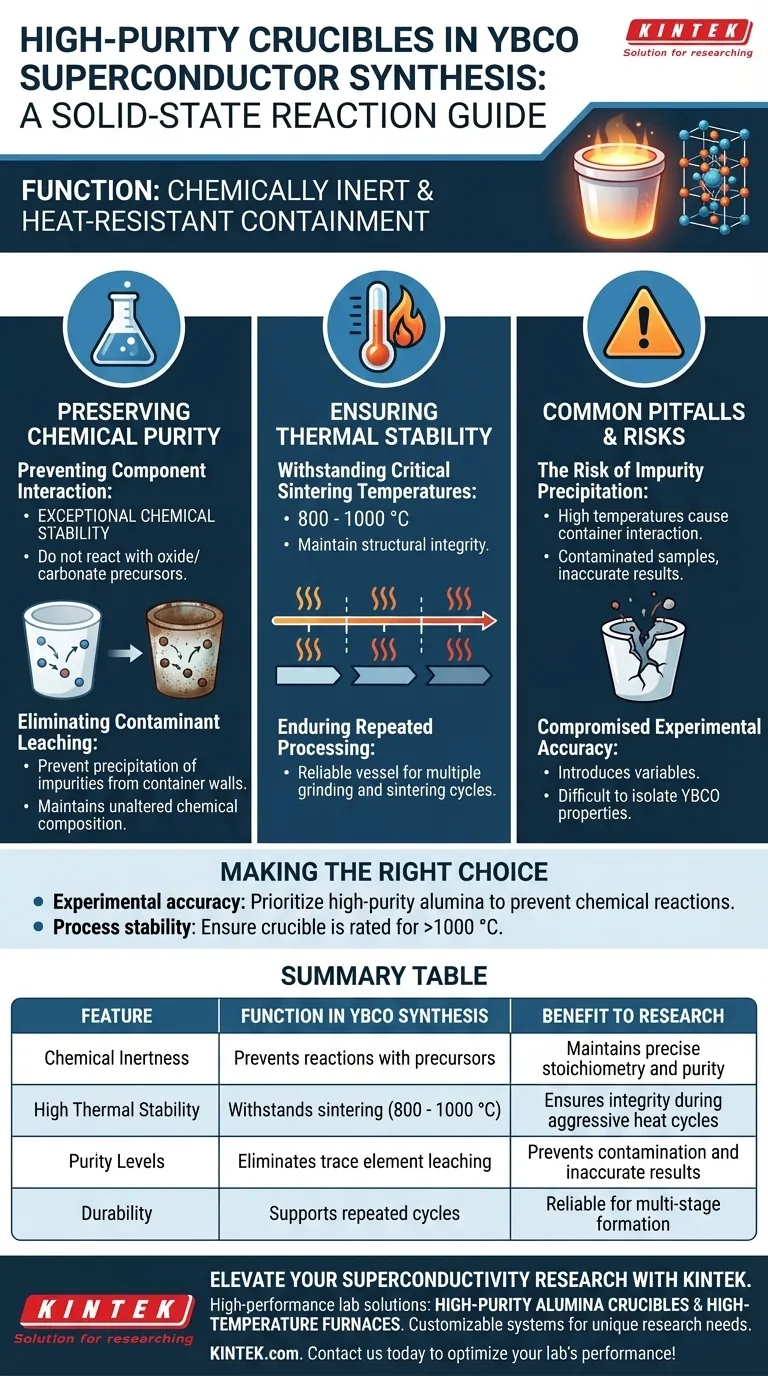
High-purity alumina or ceramic crucibles function as chemically inert, heat-resistant containment vessels crucial for the synthesis of YBCO superconductors. Specifically, they house the reactive raw material powders during the solid-state reaction method, ensuring the sample remains stable and uncontaminated while subjected to extreme temperatures.
The integrity of a superconducting sample depends entirely on preventing external chemical interference during synthesis. High-purity crucibles provide a stable reaction environment that withstands temperatures between 800 and 1000 °C without releasing container-wall impurities into the delicate oxide mixture.
Preserving Chemical Purity
The primary challenge in synthesizing YBCO via solid-state reaction is maintaining the precise stoichiometry of the sample.
Preventing Component Interaction
High-purity alumina crucibles are preferred because they possess exceptional chemical stability. They do not react with most chemical raw materials used in superconductor synthesis, specifically the oxide or carbonate precursors.
Eliminating Contaminant Leaching
Standard ceramic vessels may degrade under heat, releasing trace elements into the sample. High-purity crucibles effectively prevent the precipitation of impurities from the container walls. This lack of interaction ensures the chemical composition of the YBCO sample remains unaltered throughout the process.
Ensuring Thermal Stability
The solid-state reaction method involves aggressive thermal cycles that would compromise lesser materials.
Withstanding Critical Sintering Temperatures
YBCO synthesis requires a sintering phase with temperatures ranging from 800 to 1000 °C. The crucible must maintain structural integrity and thermal stability within this specific window to provide a secure reaction space.
Enduring Repeated Processing
Synthesis often requires repeated grinding and sintering cycles to achieve the correct phase formation. The crucible must serve as a reliable vessel throughout these multiple heating stages without degrading physically or chemically.
Common Pitfalls and Risks
While high-purity crucibles are the standard, failing to prioritize their quality introduces significant variables into the experiment.
The Risk of Impurity Precipitation
If a crucible lacks sufficient purity or inertness, the high processing temperatures will cause the container material to interact with the sample. This leads to contaminated samples, rendering the experimental results regarding superconductivity inaccurate or useless.
Compromised Experimental Accuracy
The goal of using high-purity alumina is to ensure accuracy of experimental results. Any compromise in the container's inertness introduces variables that make it impossible to determine if observed properties are due to the YBCO structure or foreign contaminants.
Making the Right Choice for Your Goal
When selecting containment for solid-state synthesis, align your choice with your specific experimental requirements.
- If your primary focus is experimental accuracy: Prioritize high-purity alumina to strictly prevent chemical reactions between the container walls and your precursor oxides.
- If your primary focus is process stability: Ensure your chosen crucible is rated for thermal stability exceeding 1000 °C to survive the repeated heating cycles necessary for phase formation.
Success in superconductor synthesis begins with the container: a vessel that remains invisible to the chemistry inside it.
Summary Table:
| Feature | Function in YBCO Synthesis | Benefit to Research |
|---|---|---|
| Chemical Inertness | Prevents reactions between crucible and oxide precursors | Maintains precise stoichiometry and sample purity |
| High Thermal Stability | Withstands sintering temperatures (800 - 1000 °C) | Ensures structural integrity during aggressive heat cycles |
| Purity Levels | Eliminates leaching of trace elements from container walls | Prevents contamination and inaccurate experimental results |
| Durability | Supports repeated grinding and sintering cycles | Provides a reliable vessel for multi-stage phase formation |
Elevate Your Superconductivity Research with KINTEK
Precision in YBCO synthesis starts with the quality of your containment. KINTEK provides high-performance lab solutions backed by expert R&D and manufacturing. Our high-purity alumina crucibles and high-temperature furnace systems—including Muffle, Tube, and Vacuum options—are designed to meet the rigorous demands of solid-state reactions.
Whether you need standard specifications or fully customizable systems for unique research needs, KINTEK ensures your materials remain uncontaminated and your thermal cycles remain precise. Contact us today to optimize your lab's performance!
Visual Guide
References
- T. Chattopadhyay. Superconductivity in High-Temperature Materials. DOI: 10.36948/ijfmr.2025.v07i05.55511
This article is also based on technical information from Kintek Furnace Knowledge Base .
Related Products
- 1400℃ High Temperature Laboratory Tube Furnace with Alumina Tube
- 1700℃ High Temperature Laboratory Tube Furnace with Alumina Tube
- Magnesium Extraction and Purification Condensing Tube Furnace
- Vacuum Induction Melting Furnace
People Also Ask
- How do high-temperature laboratory tube furnaces ensure environmental stability? Precision Thermal Reduction Tips
- How are high-temperature laboratory tube furnaces applied in long-term vacuum homogenization heat treatments for intermetallic samples?
- How are high-temp tube furnaces used to measure diffusion coefficients per Fick's law? Master Precision Annealing
- How are high-temperature tube furnaces applied in testing ceramic-supported alloy membranes? Insights
- How does a laboratory high-temperature tube furnace contribute to the conversion of electrospun fibers? Expert Insights



