Knowledge What are the primary objectives of using a blast drying oven for In2O3/C nanofibers? Ensure Structural Integrity
Author avatar

Tech Team · Kintek Furnace

Updated 2 days ago

What are the primary objectives of using a blast drying oven for In2O3/C nanofibers? Ensure Structural Integrity


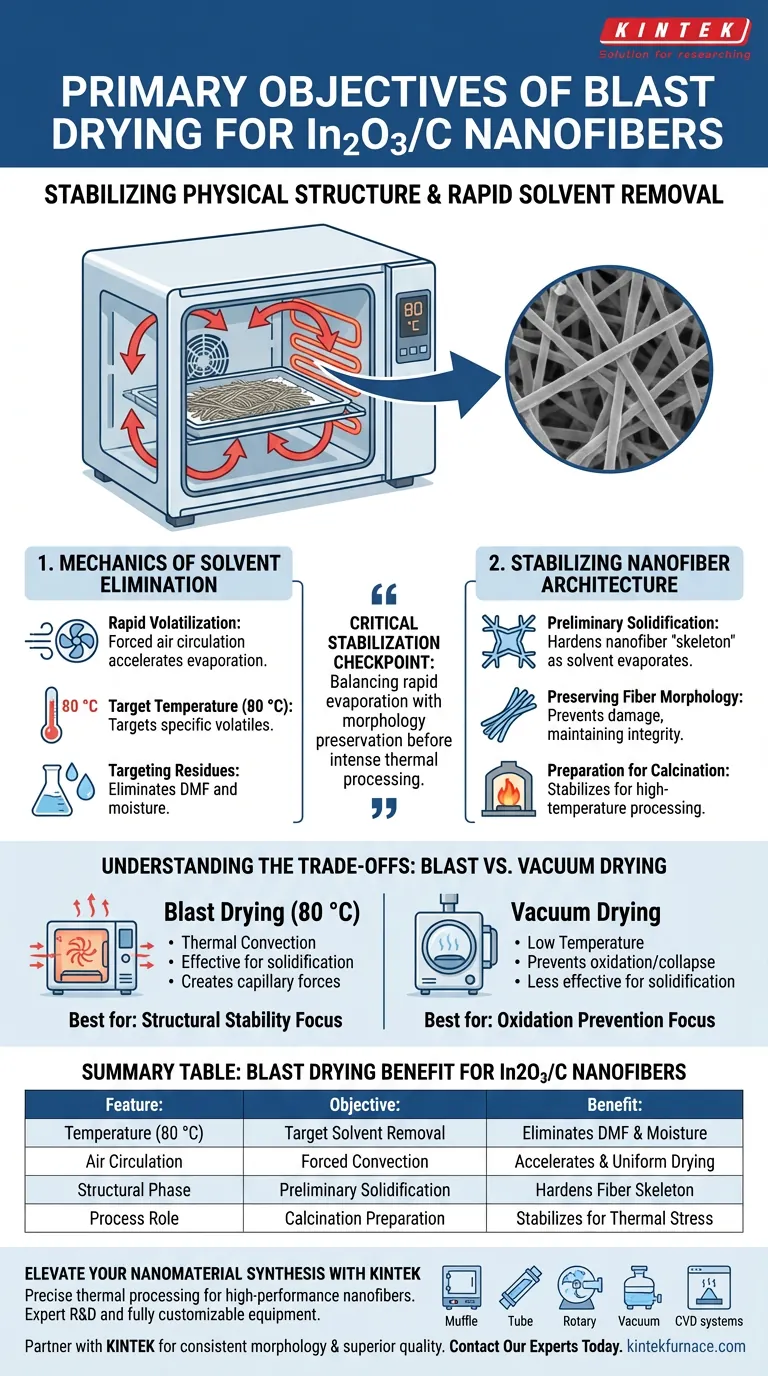
The primary objective of using a blast drying oven for In2O3/C nanofibers is to stabilize the material's physical structure through the rapid removal of volatile components. Typically operating at 80 °C, this heat treatment eliminates residual organic solvents, such as N,N-Dimethylformamide (DMF), and adsorbed moisture from the as-spun fiber mats. Crucially, this process achieves preliminary solidification of the nanofiber skeleton, ensuring the morphology remains intact prior to high-temperature calcination.

The blast drying stage serves as a critical stabilization checkpoint, balancing the need for rapid solvent evaporation with the necessity of preserving the delicate nanofiber geometry before the material undergoes intense thermal processing.

The Mechanics of Solvent Elimination

Rapid Volatilization

The blast drying oven utilizes forced air circulation to accelerate the evaporation process.

By maintaining a consistent temperature of 80 °C, the oven targets specific volatile components remaining from the electrospinning process.

Targeting Specific Residues

The primary targets during this phase are residual organic solvents, specifically DMF, and any moisture adsorbed from the environment.

Removing these impurities is essential to prevent structural defects or uncontrolled reactions during subsequent heating stages.

Stabilizing the Nanofiber Architecture

Preliminary Solidification

Beyond simple drying, this step acts as a hardening phase for the nanofiber "skeleton."

As the solvent evaporates, the polymer-precursor matrix solidifies, locking the fibers into their as-spun arrangement.

Preserving Fiber Morphology

The temperature control provided by the blast oven is precise enough to dry the material without degrading it.

This ensures that the fiber morphology is not damaged or distorted, maintaining the surface area and structural integrity required for the final product.

Preparation for Calcination

This drying phase is a prerequisite for the high-temperature calcination process.

By removing volatiles and solidifying the structure beforehand, the material is mechanically prepared to withstand the thermal stresses of carbonization and crystallization that follow.

Understanding the Trade-offs

Blast Drying vs. Vacuum Drying

While a blast drying oven is effective for solidifying In2O3/C skeletons, it relies on thermal convection and higher temperatures (80 °C).

In contrast, vacuum drying is often used for materials that are highly sensitive to oxidation or capillary collapse, such as MoSe2 nanosheets.

Risk of Structural Collapse

Blast drying is efficient, but creates capillary forces during evaporation that could theoretically damage extremely fragile structures.

However, for In2O3/C nanofibers, the blast oven strikes the right balance: it provides the necessary heat for solidification that vacuum drying (which typically operates at lower temperatures to prevent phase transformations) might not achieve as effectively for this specific precursor.

Optimizing the Drying Strategy

To ensure high-quality nanofiber synthesis, align your drying method with your structural goals.

  • If your primary focus is Structural Stability: Prioritize the blast drying oven at 80 °C to achieve rapid solvent removal and the necessary solidification of the In2O3/C skeleton.
  • If your primary focus is Oxidation Prevention: Verify the sensitivity of your specific precursor; if the material is prone to phase transformation or pore collapse at 80 °C, a vacuum approach might be required, though it is less standard for this specific nanofiber type.

Successful drying solidifies the precursor's physical foundation, ensuring the final calcined material retains the desired nanofiber morphology.

Summary Table:

Feature Blast Drying Objective Benefit for In2O3/C Nanofibers
Temperature (80 °C) Target Solvent Removal Eliminates DMF and moisture effectively
Air Circulation Forced Convection Accelerates evaporation and ensures uniform drying
Structural Phase Preliminary Solidification Hardens fiber skeleton to prevent morphology collapse
Process Role Calcination Preparation Stabilizes material for high-temperature thermal stress

Elevate Your Nanomaterial Synthesis with KINTEK

Precise thermal processing is the foundation of high-performance nanofiber production. Backed by expert R&D and manufacturing, KINTEK offers a comprehensive range of laboratory solutions, including high-precision Muffle, Tube, Rotary, Vacuum, and CVD systems.

Whether you need to stabilize In2O3/C skeletons or execute complex calcination, our equipment is fully customizable to meet your unique research and industrial needs. Partner with KINTEK to ensure consistent morphology and superior material quality.

Contact Our Experts Today to find the perfect thermal solution for your lab.

Visual Guide
What are the primary objectives of using a blast drying oven for In2O3/C nanofibers? Ensure Structural Integrity Visual Guide

References

  1. Wenhe Xie, Xiaolei Sun. Encapsulating Ultrafine In2O3 Particles in Carbon Nanofiber Framework as Superior Electrode for Lithium-Ion Batteries. DOI: 10.3390/inorganics12120336

This article is also based on technical information from Kintek Furnace Knowledge Base .

Related Products

People Also Ask

Related Products

1200℃ Muffle Oven Furnace for Laboratory

1200℃ Muffle Oven Furnace for Laboratory

KINTEK KT-12M Muffle Furnace: Precision 1200°C heating with PID control. Ideal for labs needing rapid, uniform heat. Explore models & customization options.

Vacuum Heat Treat Furnace with Ceramic Fiber Liner

Vacuum Heat Treat Furnace with Ceramic Fiber Liner

KINTEK's Vacuum Furnace with Ceramic Fiber Lining offers precise high-temperature processing up to 1700°C, ensuring uniform heat distribution and energy efficiency. Ideal for labs and production.

1400℃ High Temperature Laboratory Tube Furnace with Quartz and Alumina Tube

1400℃ High Temperature Laboratory Tube Furnace with Quartz and Alumina Tube

KINTEK's Tube Furnace with Alumina Tube: Precision high-temperature processing up to 2000°C for labs. Ideal for material synthesis, CVD, and sintering. Customizable options available.

Vertical Laboratory Quartz Tube Furnace Tubular Furnace

Vertical Laboratory Quartz Tube Furnace Tubular Furnace

Precision KINTEK Vertical Tube Furnace: 1800℃ heating, PID control, customizable for labs. Ideal for CVD, crystal growth & materials testing.

1700℃ High Temperature Laboratory Tube Furnace with Quartz or Alumina Tube

1700℃ High Temperature Laboratory Tube Furnace with Quartz or Alumina Tube

KINTEK's Tube Furnace with Alumina Tube: Precision heating up to 1700°C for material synthesis, CVD, and sintering. Compact, customizable, and vacuum-ready. Explore now!

Vacuum Dental Porcelain Sintering Furnace for Dental Laboratories

Vacuum Dental Porcelain Sintering Furnace for Dental Laboratories

KinTek Vacuum Porcelain Furnace: Precision dental lab equipment for high-quality ceramic restorations. Advanced firing control & user-friendly operation.

Electric Rotary Kiln Continuous Working Small Rotary Furnace Kiln for Pyrolysis Plant Heating

Electric Rotary Kiln Continuous Working Small Rotary Furnace Kiln for Pyrolysis Plant Heating

KINTEK's electric rotary furnaces offer precision heating up to 1100°C for calcination, drying, and pyrolysis. Durable, efficient, and customizable for labs and production. Explore models now!

Vacuum Induction Melting Furnace and Arc Melting Furnace

Vacuum Induction Melting Furnace and Arc Melting Furnace

Explore KINTEK's Vacuum Induction Melting Furnace for high-purity metal processing up to 2000℃. Customizable solutions for aerospace, alloys, and more. Contact us today!

Vacuum Hot Press Furnace Machine Heated Vacuum Press Tube Furnace

Vacuum Hot Press Furnace Machine Heated Vacuum Press Tube Furnace

Discover KINTEK's advanced Vacuum Tube Hot Press Furnace for precise high-temperature sintering, hot pressing, and material bonding. Customizable solutions for labs.

Small Vacuum Heat Treat and Tungsten Wire Sintering Furnace

Small Vacuum Heat Treat and Tungsten Wire Sintering Furnace

Compact vacuum tungsten wire sintering furnace for labs. Precise, mobile design with superior vacuum integrity. Ideal for advanced material research. Contact us!

Electric Rotary Kiln Pyrolysis Furnace Plant Machine Small Rotary Kiln Calciner

Electric Rotary Kiln Pyrolysis Furnace Plant Machine Small Rotary Kiln Calciner

KINTEK Electric Rotary Kiln: Precise 1100℃ calcination, pyrolysis & drying. Eco-friendly, multi-zone heating, customizable for lab & industrial needs.

High Pressure Laboratory Vacuum Tube Furnace Quartz Tubular Furnace

High Pressure Laboratory Vacuum Tube Furnace Quartz Tubular Furnace

KINTEK High Pressure Tube Furnace: Precision heating up to 1100°C with 15Mpa pressure control. Ideal for sintering, crystal growth, and lab research. Customizable solutions available.

Vacuum Heat Treat Sintering Furnace with Pressure for Vacuum Sintering

Vacuum Heat Treat Sintering Furnace with Pressure for Vacuum Sintering

KINTEK's Vacuum Pressure Sintering Furnace offers 2100℃ precision for ceramics, metals, and composites. Customizable, high-performance, and contamination-free. Get a quote now!

1200℃ Split Tube Furnace Laboratory Quartz Tube Furnace with Quartz Tube

1200℃ Split Tube Furnace Laboratory Quartz Tube Furnace with Quartz Tube

Discover KINTEK's 1200℃ Split Tube Furnace with quartz tube for precise high-temperature lab applications. Customizable, durable, and efficient. Get yours now!

CF KF Flange Vacuum Electrode Feedthrough Lead Sealing Assembly for Vacuum Systems

CF KF Flange Vacuum Electrode Feedthrough Lead Sealing Assembly for Vacuum Systems

Reliable CF/KF flange vacuum electrode feedthrough for high-performance vacuum systems. Ensures superior sealing, conductivity & durability. Customizable options available.

Spark Plasma Sintering SPS Furnace

Spark Plasma Sintering SPS Furnace

Discover KINTEK's advanced Spark Plasma Sintering (SPS) Furnace for rapid, precise material processing. Customizable solutions for research and production.

Silicon Carbide SiC Thermal Heating Elements for Electric Furnace

Silicon Carbide SiC Thermal Heating Elements for Electric Furnace

High-performance SiC heating elements for labs, offering 600-1600°C precision, energy efficiency, and long lifespan. Customizable solutions available.

Cylindrical Resonator MPCVD Machine System for Lab Diamond Growth

Cylindrical Resonator MPCVD Machine System for Lab Diamond Growth

KINTEK MPCVD Systems: Grow high-quality diamond films with precision. Reliable, energy-efficient, and beginner-friendly. Expert support available.

Vacuum Hot Press Furnace Machine for Lamination and Heating

Vacuum Hot Press Furnace Machine for Lamination and Heating

KINTEK Vacuum Lamination Press: Precision bonding for wafer, thin-film & LCP applications. 500°C max temp, 20-ton pressure, CE certified. Custom solutions available.

Chairside Dental Porcelain Zirconia Sintering Furnace with Transformer for Ceramic Restorations

Chairside Dental Porcelain Zirconia Sintering Furnace with Transformer for Ceramic Restorations

Dental Porcelain Speedy Sintering Furnace: Fast 9-minute zirconia sintering, 1530°C precision, SiC heaters for dental labs. Boost productivity today!


Leave Your Message
