
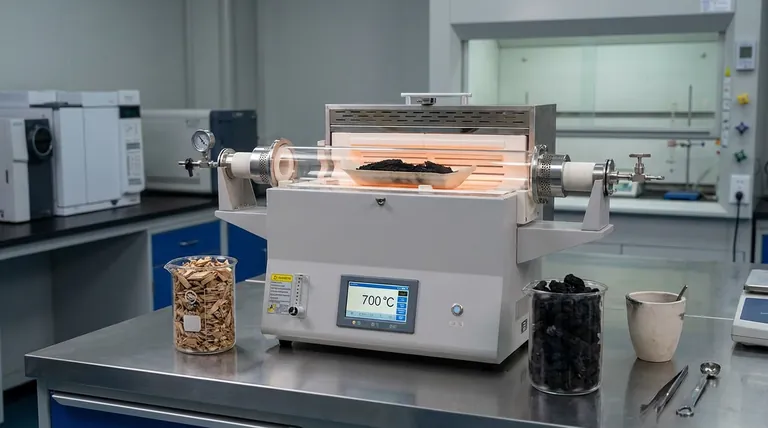
Precise temperature control in industrial muffle or tube furnaces is the defining factor that drives the decomposition of biomass into biochar. By maintaining a specific thermal environment, typically between 300 and 900 °C, these furnaces determine the biochar's physical architecture—specifically its surface area and pore quantity—and its chemical stability, known as aromaticity. Crucially, exact regulation prevents the carbon skeleton from cracking due to overheating, ensuring the material retains the structural integrity required for effective adsorption.
Core Insight The value of a muffle or tube furnace lies not just in generating heat, but in stabilizing the rate of decomposition. Precise control balances the removal of volatile organic compounds with the preservation of the carbon structure, directly dictating whether the final product will be a high-performance adsorbent or merely charred waste.
The Mechanics of Structural Formation
Defining the Operating Range
To initiate pyrolysis, industrial furnaces must maintain a strictly controlled environment within the 300 to 900 °C range. This thermal energy triggers the breakdown of biomass components like cellulose and lignin.
Preserving the Carbon Skeleton
The most critical function of temperature regulation is protecting the biochar's structural framework. If temperatures spike uncontrollably, the carbon skeleton can crack, destroying the material's mechanical strength and porosity.
Driving Aromaticity
Controlled heat facilitates the formation of aromatic carbon structures. This chemical transformation is essential for creating biochar with high adsorption activity, making it effective for environmental applications like pollutant removal.
The Role of Heating Rate
Regulating Volatile Release
Beyond the final temperature, the heating rate (e.g., 5°C/min or 15°C/min) controls how quickly volatile substances are expelled from the biomass. A controlled ramp-up ensures that internal heat transfer occurs uniformly, preventing rapid gas expansion that could rupture the pore structure.
Tuning Pore Networks
Manipulating the heating rate allows you to customize the microscopic texture of the biochar. By adjusting this variable, you can shift the ratio of micropores to mesopores, tailoring the material to target specific pollutants of varying molecular sizes.
Controlling the Reaction Atmosphere
Preventing Oxidation
Muffle and tube furnaces are designed to operate under oxygen-limited or anaerobic conditions. In tube furnaces specifically, a continuous flow of nitrogen is often used to flush oxygen from the reaction zone.
Ensuring Carbonization
This oxygen-free environment is mandatory for pyrolysis. It ensures the biomass undergoes carbonization rather than combustion, maximizing the final carbon content and yield.
Understanding the Trade-offs
The Temperature-Yield Inverse
There is an inherent trade-off between biochar quality and yield. Higher temperatures (e.g., 700°C) generally increase porosity and carbon content but significantly reduce the total mass yield of the biochar.
Thermal Uniformity Challenges
Inconsistent heating can lead to a heterogeneous product where some particles are fully carbonized while others remain raw. High-quality furnaces mitigate this by ensuring thermal uniformity, which is vital for producing commercial-grade soil amendments or adsorbents.
Making the Right Choice for Your Goal
To optimize your pyrolysis process, you must align your temperature strategy with your end-product requirements:
- If your primary focus is Adsorption Performance: Prioritize higher temperatures (600–900 °C) and slower heating rates to maximize surface area and develop a complex micropore network.
- If your primary focus is Biochar Yield: Operate at lower temperatures (300–500 °C) to retain more mass, though this will result in lower porosity and surface area.
- If your primary focus is Soil Amendment: Target a moderate temperature range (450–600 °C) to balance carbon stability with the retention of some volatile matter beneficial for soil microbiology.
Success in biochar production is ultimately a function of discipline—maintaining the precise thermal parameters that convert raw biomass into a stable, functional carbon material.
Summary Table:
| Parameter | Influence on Biochar Property | Impact of Precise Control |
|---|---|---|
| Temperature (300-900°C) | Surface area & Pore quantity | Prevents skeletal cracking & ensures structural integrity. |
| Heating Rate | Volatile release & Pore ratio | Controls micropore vs. mesopore development. |
| Atmosphere | Carbonization vs. Combustion | Ensures anaerobic conditions for maximum carbon yield. |
| Thermal Uniformity | Product Consistency | Eliminates heterogeneous batches and raw biomass remnants. |
Maximize Your Biochar Performance with KINTEK
Ready to transform your biomass research or production? Precise thermal regulation is the difference between high-performance adsorbents and charred waste. KINTEK provides industry-leading Muffle, Tube, Rotary, Vacuum, and CVD systems, all engineered for the rigorous demands of pyrolysis.
Backed by expert R&D and advanced manufacturing, our furnaces offer the thermal uniformity and atmosphere control necessary to customize your biochar's pore network and carbon stability. Whether you need standard lab high-temp furnaces or fully customizable systems for unique needs, KINTEK delivers the precision your process deserves.
Contact our experts today to find your custom thermal solution
References
- Yunfang Liu, Yibo Ma. Recent progress in TiO<sub>2</sub>–biochar-based photocatalysts for water contaminants treatment: strategies to improve photocatalytic performance. DOI: 10.1039/d3ra06910a
This article is also based on technical information from Kintek Furnace Knowledge Base .
Related Products
- Electric Rotary Kiln Small Rotary Furnace Biomass Pyrolysis Plant Rotating Furnace
- Electric Rotary Kiln Continuous Working Small Rotary Furnace Kiln for Pyrolysis Plant Heating
- Electric Rotary Kiln Pyrolysis Furnace Plant Machine Small Rotary Kiln Calciner
- Spark Plasma Sintering SPS Furnace
- Vacuum Heat Treat Sintering Furnace with Pressure for Vacuum Sintering
People Also Ask
- What are the key components of a rotary kiln electric furnace? Unlock Efficient Thermal Processing
- What are the main applications of a rotary kiln electric furnace? Achieve Uniform Heat Treatment for Powders
- What is the significance of the refractory lining in a rotary kiln electric furnace? Unlock Efficiency and Longevity
- What are the key components of a rotary kiln's construction? Discover the Essential Parts for Efficient Industrial Processing
- What role does the rotary kiln serve in coal-based DRI production? Unlock Cost-Effective Ironmaking Efficiency










