Knowledge How does the microarc produced by ion discharge function? Enhance Coating Bonding Strength via Surface Activation
Author avatar

Tech Team · Kintek Furnace

Updated 1 day ago

How does the microarc produced by ion discharge function? Enhance Coating Bonding Strength via Surface Activation


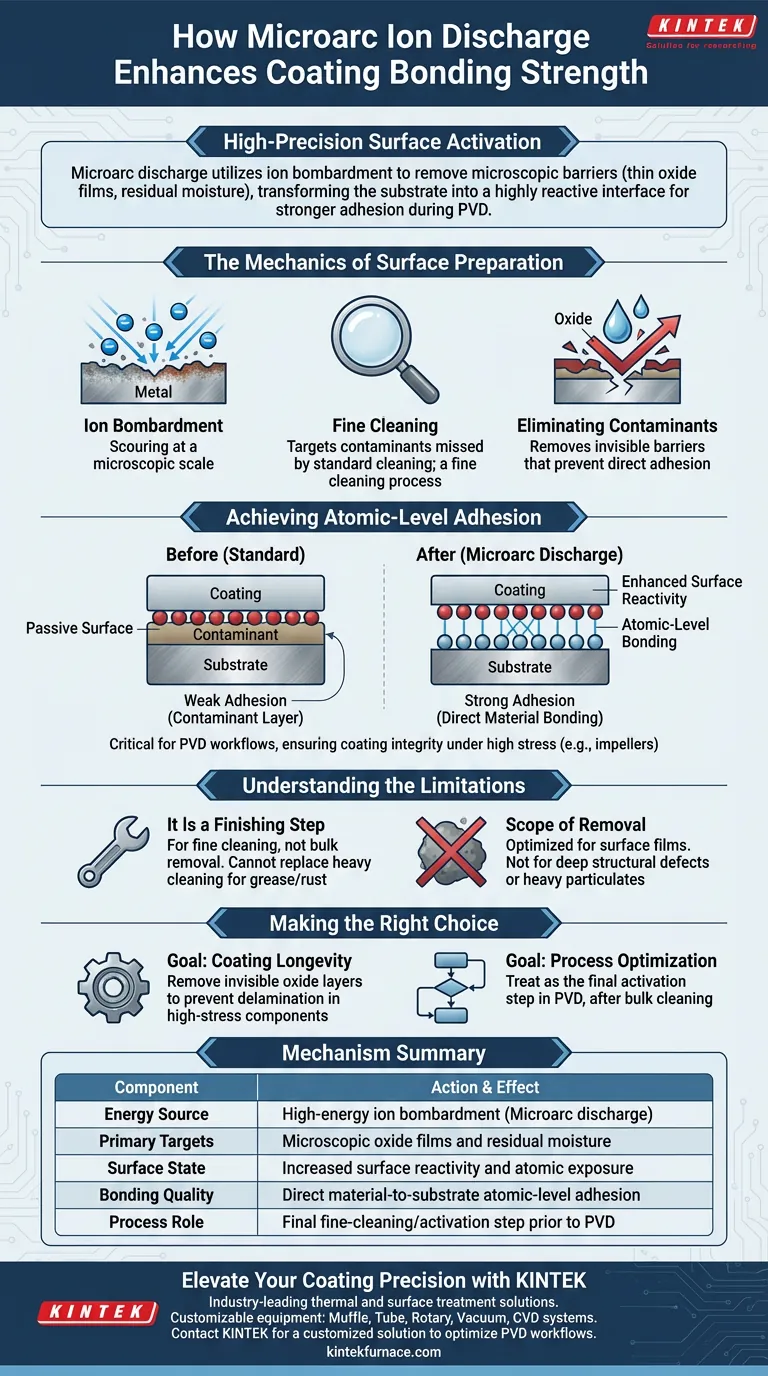
Microarc discharge functions as a high-precision surface activation technique that utilizes ion bombardment to prepare components for coating. This process works by aggressively removing microscopic barriers—specifically thin oxide films and residual moisture—to expose the raw, reactive material underneath.

By eliminating physical and chemical contaminants at the atomic level, microarc discharge transforms the substrate from a passive surface into a highly reactive interface, enabling stronger adhesion during Physical Vapor Deposition (PVD).
How does the microarc produced by ion discharge function? Enhance Coating Bonding Strength via Surface Activation

The Mechanics of Surface Preparation

Ion Bombardment

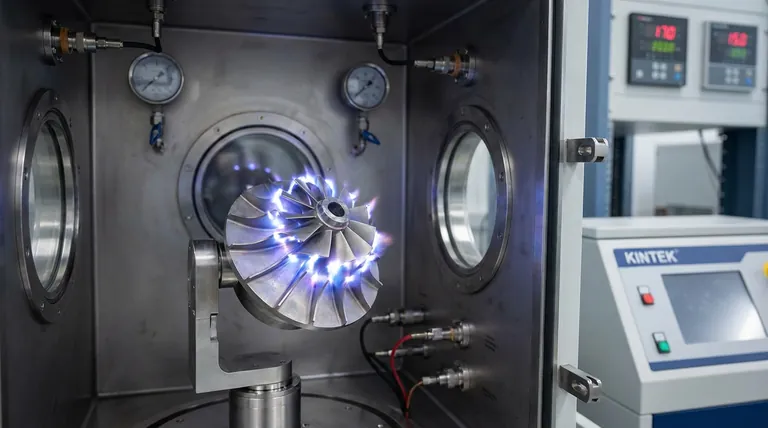
The core mechanism of this process is ion discharge. High-energy ions bombard the surface of the component, effectively scouring the material at a microscopic scale.

Fine Cleaning

This is not a bulk cleaning method; it is a fine cleaning process. It targets contaminants that standard washing or chemical cleaning might miss, ensuring the surface is pristine immediately prior to coating.

Eliminating Contaminants

The primary targets of this bombardment are extremely thin oxide films and residual moisture. These elements act as invisible barriers that prevent coatings from adhering directly to the metal substrate.

Achieving Atomic-Level Adhesion

Enhanced Surface Reactivity

Once the oxides and moisture are stripped away, the substrate's surface reactivity is significantly enhanced. The exposed metal atoms are energetically primed to interact with incoming coating materials.

Direct Material Bonding

This heightened reactivity facilitates atomic-level bonding. Instead of sitting on top of a contaminant layer, the ceramic or alloy phase coating bonds directly with the metal substrate.

Application in PVD

This step is particularly critical in Physical Vapor Deposition (PVD) workflows. For components like impellers, which face high stress, this pretreatment ensures the coating remains intact under operational loads.

Understanding the Limitations

It Is a Finishing Step

Microarc discharge is designed for fine cleaning, not gross material removal. It cannot replace the initial heavy cleaning steps required to remove bulk grease, oil, or thick rust.

Scope of Removal

The process is optimized for surface films, such as oxidation layers. Relying on it to remove deep-seated structural defects or heavy particulate matter will likely lead to suboptimal results.

Making the Right Choice for Your Goal

To maximize the effectiveness of microarc discharge in your coating workflow, consider the following:

  • If your primary focus is coating longevity: Ensure this step is utilized to remove invisible oxide layers, which are the leading cause of delamination in high-stress components like impellers.
  • If your primary focus is process optimization: Treat microarc discharge as the final activation step in your PVD sequence, strictly performed after all bulk cleaning is complete.

True adhesion strength is not just about the coating you apply, but the purity of the surface you apply it to.

Summary Table:

Mechanism Component Action & Effect
Energy Source High-energy ion bombardment (Microarc discharge)
Primary Targets Microscopic oxide films and residual moisture
Surface State Increased surface reactivity and atomic exposure
Bonding Quality Direct material-to-substrate atomic-level adhesion
Process Role Final fine-cleaning/activation step prior to PVD

Elevate Your Coating Precision with KINTEK

Don't let invisible contaminants compromise your material performance. KINTEK provides industry-leading thermal and surface treatment solutions backed by expert R&D and manufacturing. Whether you require Muffle, Tube, Rotary, Vacuum, or CVD systems, our equipment is fully customizable to meet the rigorous demands of your laboratory or production line.

Ensure maximum bonding strength and prevent delamination in your high-stress components today. Contact KINTEK for a customized solution and see how our advanced high-temp furnaces can optimize your PVD and surface activation workflows.

Visual Guide
How does the microarc produced by ion discharge function? Enhance Coating Bonding Strength via Surface Activation Visual Guide

References

  1. А.M. Yalova, Nazarii Bondar. The problem of increasing the working resource of energy equipment details. DOI: 10.31498/2225-6733.49.2.2024.321349

This article is also based on technical information from Kintek Furnace Knowledge Base .

Related Products

People Also Ask

Related Products

Vacuum Induction Melting Furnace and Arc Melting Furnace

Vacuum Induction Melting Furnace and Arc Melting Furnace

Explore KINTEK's Vacuum Induction Melting Furnace for high-purity metal processing up to 2000℃. Customizable solutions for aerospace, alloys, and more. Contact us today!

Chairside Dental Porcelain Zirconia Sintering Furnace with Transformer for Ceramic Restorations

Chairside Dental Porcelain Zirconia Sintering Furnace with Transformer for Ceramic Restorations

Dental Porcelain Speedy Sintering Furnace: Fast 9-minute zirconia sintering, 1530°C precision, SiC heaters for dental labs. Boost productivity today!

1400℃ Controlled Inert Nitrogen Atmosphere Furnace

1400℃ Controlled Inert Nitrogen Atmosphere Furnace

KT-14A Controlled Atmosphere Furnace for labs & industry. 1400°C max temp, vacuum sealing, inert gas control. Customizable solutions available.

Small Vacuum Heat Treat and Tungsten Wire Sintering Furnace

Small Vacuum Heat Treat and Tungsten Wire Sintering Furnace

Compact vacuum tungsten wire sintering furnace for labs. Precise, mobile design with superior vacuum integrity. Ideal for advanced material research. Contact us!

High Pressure Laboratory Vacuum Tube Furnace Quartz Tubular Furnace

High Pressure Laboratory Vacuum Tube Furnace Quartz Tubular Furnace

KINTEK High Pressure Tube Furnace: Precision heating up to 1100°C with 15Mpa pressure control. Ideal for sintering, crystal growth, and lab research. Customizable solutions available.

1700℃ Controlled Inert Nitrogen Atmosphere Furnace

1700℃ Controlled Inert Nitrogen Atmosphere Furnace

KT-17A Controlled Atmosphere Furnace: Precise 1700°C heating with vacuum & gas control. Ideal for sintering, research & material processing. Explore now!

Laboratory Vacuum Tilt Rotary Tube Furnace Rotating Tube Furnace

Laboratory Vacuum Tilt Rotary Tube Furnace Rotating Tube Furnace

KINTEK Laboratory Rotary Furnace: Precision heating for calcination, drying, sintering. Customizable solutions with vacuum & controlled atmosphere. Enhance research now!

High Temperature Muffle Oven Furnace for Laboratory Debinding and Pre Sintering

High Temperature Muffle Oven Furnace for Laboratory Debinding and Pre Sintering

KT-MD Debinding & Pre-Sintering Furnace for ceramics - precise temperature control, energy-efficient design, customizable sizes. Boost your lab efficiency today!

1400℃ Muffle Oven Furnace for Laboratory

1400℃ Muffle Oven Furnace for Laboratory

KT-14M Muffle Furnace: Precision 1400°C heating with SiC elements, PID control, and energy-efficient design. Ideal for labs.

Laboratory Muffle Oven Furnace with Bottom Lifting

Laboratory Muffle Oven Furnace with Bottom Lifting

Boost lab efficiency with KT-BL Bottom Lifting Furnace: precise 1600℃ control, superior uniformity, and enhanced productivity for material science and R&D.

1200℃ Split Tube Furnace Laboratory Quartz Tube Furnace with Quartz Tube

1200℃ Split Tube Furnace Laboratory Quartz Tube Furnace with Quartz Tube

Discover KINTEK's 1200℃ Split Tube Furnace with quartz tube for precise high-temperature lab applications. Customizable, durable, and efficient. Get yours now!

Vacuum Sealed Continuous Working Rotary Tube Furnace Rotating Tube Furnace

Vacuum Sealed Continuous Working Rotary Tube Furnace Rotating Tube Furnace

Precision rotary tube furnace for continuous vacuum processing. Ideal for calcination, sintering, and heat treatment. Customizable up to 1600℃.

Laboratory Quartz Tube Furnace RTP Heating Tubular Furnace

Laboratory Quartz Tube Furnace RTP Heating Tubular Furnace

KINTEK's RTP Rapid Heating Tube Furnace delivers precise temperature control, rapid heating up to 100°C/sec, and versatile atmosphere options for advanced lab applications.

Split Chamber CVD Tube Furnace with Vacuum Station CVD Machine

Split Chamber CVD Tube Furnace with Vacuum Station CVD Machine

Split Chamber CVD Tube Furnace with Vacuum Station - High precision 1200°C lab furnace for advanced materials research. Customizable solutions available.

Molybdenum Disilicide MoSi2 Thermal Heating Elements for Electric Furnace

Molybdenum Disilicide MoSi2 Thermal Heating Elements for Electric Furnace

High-performance MoSi2 heating elements for labs, reaching 1800°C with superior oxidation resistance. Customizable, durable, and reliable for high-temperature applications.

Multi Heating Zones CVD Tube Furnace Machine for Chemical Vapor Deposition Equipment

Multi Heating Zones CVD Tube Furnace Machine for Chemical Vapor Deposition Equipment

KINTEK's Multi-Zone CVD Tube Furnaces offer precision temperature control for advanced thin film deposition. Ideal for research and production, customizable for your lab needs.

Magnesium Extraction and Purification Condensing Tube Furnace

Magnesium Extraction and Purification Condensing Tube Furnace

Magnesium purification tube furnace for high-purity metal production. Achieve ≤10Pa vacuum, dual-zone heating. Ideal for aerospace, electronics, and lab research.

1700℃ High Temperature Laboratory Tube Furnace with Quartz or Alumina Tube

1700℃ High Temperature Laboratory Tube Furnace with Quartz or Alumina Tube

KINTEK's Tube Furnace with Alumina Tube: Precision heating up to 1700°C for material synthesis, CVD, and sintering. Compact, customizable, and vacuum-ready. Explore now!

1400℃ High Temperature Laboratory Tube Furnace with Quartz and Alumina Tube

1400℃ High Temperature Laboratory Tube Furnace with Quartz and Alumina Tube

KINTEK's Tube Furnace with Alumina Tube: Precision high-temperature processing up to 2000°C for labs. Ideal for material synthesis, CVD, and sintering. Customizable options available.

Custom Made Versatile CVD Tube Furnace Chemical Vapor Deposition CVD Equipment Machine

Custom Made Versatile CVD Tube Furnace Chemical Vapor Deposition CVD Equipment Machine

KINTEK's CVD Tube Furnace offers precision temperature control up to 1600°C, ideal for thin film deposition. Customizable for research and industrial needs.


Leave Your Message