
Precise spatial arrangement acts as a filter for thermal complexity. In magnesium combustion experiments, this arrangement is necessary to construct a rigorous heat balance model, allowing researchers to separate the heat generated by chemical reactions from the heat supplied by the ignition source or lost to the environment. Without these specific locations, it is impossible to distinguish between the various mechanisms driving temperature changes.
Core Takeaway
Strategic thermocouple placement transforms aggregate temperature data into a spatially resolved energy map. This differentiation is critical for isolating specific thermal events—such as phase changes and ignition heating—from the actual heat released during combustion.
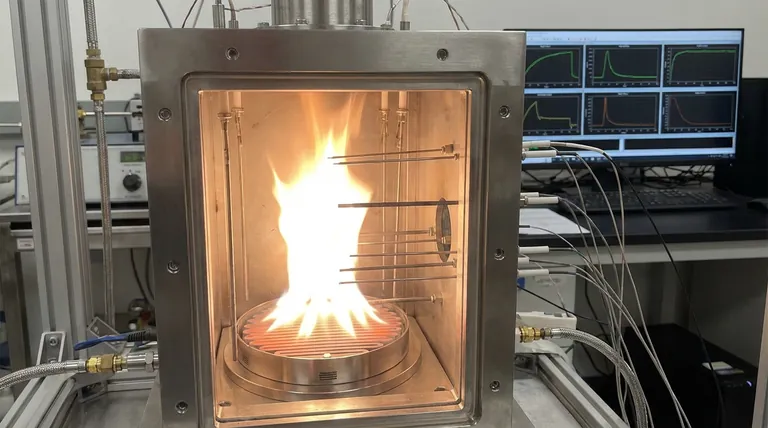
Constructing the Heat Balance Model
To understand magnesium combustion, you must measure more than just "how hot it gets." You must measure where the energy is flowing. The spatial arrangement of probes creates the framework for a complete energy budget.
Capturing Maximum Intensity
Probes placed near the ignition resistance wire serve a distinct function.
They record the maximum gas-phase temperatures at the heart of the reaction.
This data point establishes the upper limit of thermal intensity within the combustion zone.
Quantifying Environmental Loss
Simultaneously, probes must be positioned near the chamber walls.
These sensors are strictly responsible for evaluating heat loss and dissipation.
By measuring the temperature at the boundaries, researchers can calculate exactly how much energy is escaping to the surrounding environment.
Decoupling Complex Thermal Phenomena
Magnesium combustion is a multi-stage process. A precise sensor array allows you to mathematically disentangle simultaneous physical events.
Distinguishing Heat Sources
A major challenge is separating external energy inputs from internal reaction energy.
Proper spacing allows you to distinguish ignition heating (the energy you put in) from combustion heat release (the energy the magnesium puts out).
This ensures that the efficiency of the fuel is calculated accurately, without interference from the ignition source.
Identifying Energy Sinks
Temperature fluctuations are not always caused by heat generation; sometimes they signal energy consumption.
Spatial precision helps identify phase change energy consumption.
This reveals the specific moments when the magnesium absorbs heat to melt or vaporize, rather than releasing it.
Common Pitfalls in Measurement Strategy
While spatial arrangement provides clarity, it introduces complexity that must be managed. Understanding the limitations of your setup is just as important as the placement itself.
The Risk of Data Homogenization
If probes are placed too close together, their data streams will overlap.
This results in an inability to distinguish between local heat dissipation and active combustion.
You lose the ability to model the heat balance, reverting to a simple, uninformative average temperature.
Misinterpreting Boundary Conditions
Ignoring the chamber walls leads to significant errors in energy calculation.
If you fail to measure the wall temperature specifically, heat loss may be mistaken for a drop in combustion efficiency.
This leads to a fundamental misunderstanding of the material's actual performance.
Making the Right Choice for Your Goal
When designing your experiment, align your thermocouple placement with the specific data you need to extract from the heat balance model.
- If your primary focus is Reaction Intensity: Prioritize placement near the ignition wire to capture the peak gas-phase temperature and combustion heat release.
- If your primary focus is Thermal Efficiency: Ensure robust instrumentation near the chamber walls to strictly quantify heat dissipation and loss to the environment.
- If your primary focus is Material Behavior: Position probes to capture the subtle temperature plateaus that indicate phase change energy consumption.
By treating your thermocouple arrangement as a strategic architecture rather than a random distribution, you turn simple temperature readings into a comprehensive diagnostic of combustion physics.
Summary Table:
| Probe Location | Primary Function | Data Captured |
|---|---|---|
| Near Ignition Wire | Maximum Intensity Measurement | Peak gas-phase temperatures & combustion heat release |
| Near Chamber Walls | Environmental Loss Assessment | Heat dissipation rates & boundary energy escape |
| Specific Material Zones | Phase Change Monitoring | Energy sinks, melting, and vaporization plateaus |
| Strategic Spacing | Data Differentiation | Separation of external heating from chemical reaction heat |
Elevate Your Combustion Research with KINTEK Precision
Precise data starts with a high-performance thermal environment. Backed by expert R&D and manufacturing, KINTEK offers high-temperature Muffle, Tube, Rotary, Vacuum, and CVD systems—all fully customizable to accommodate your specific thermocouple arrays and experimental configurations.
Whether you are mapping heat balance models or studying phase changes, our lab furnaces provide the stability and control your magnesium combustion research demands. Our experts are ready to help you design a system tailored to your unique needs.
Contact KINTEK Today to Optimize Your Thermal Setup
Visual Guide

References
- Ioan Barabulica, Ioan Mămăligă. Experimental Study on the Reaction of Magnesium in Carbon Dioxide and Nitrogen Atmosphere. DOI: 10.3390/chemengineering8020041
This article is also based on technical information from Kintek Furnace Knowledge Base .
Related Products
People Also Ask
- What are the advantages of using a condensing tube furnace for magnesium extraction? Achieve High Purity and Efficient Metal Recovery
- What are the features of more elaborate tube furnaces? Precision Control for Advanced Thermal Processing
- Why use a tube furnace instead of a muffle furnace for annealing? Achieve Superior Process Control
- How do tube furnaces contribute to transport reactions and crystal production? Master High-Purity Synthesis with Precision Control
- What is a tube furnace and what is its primary use? Achieve Precision High-Temp Processing for Your Lab
