
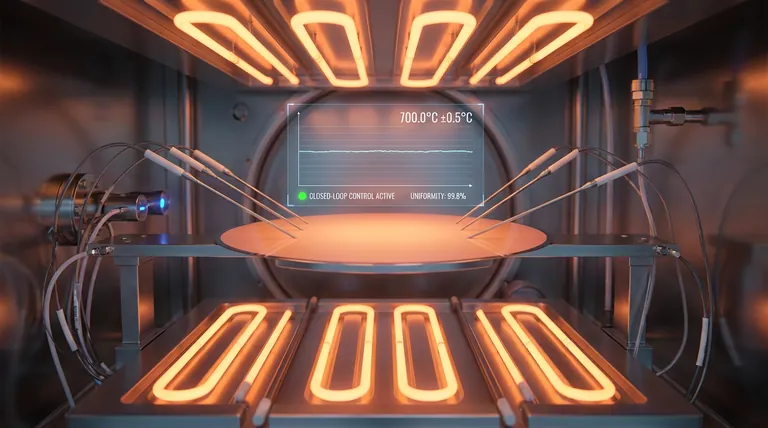
High-precision thermocouples and closed-loop control systems act as the primary stabilizers for film uniformity. By maintaining temperature accuracy within ±0.5 °C, these components ensure heat is distributed evenly across the substrate during Rapid Thermal Processing (RTP). This precise thermal environment forces the nickel silicide reaction to occur simultaneously across the wafer, effectively eliminating localized structural inconsistencies.
The integration of precise sensing and feedback loops transforms the RTP chamber into a uniform reaction environment, ensuring that phase transitions are synchronized across the entire wafer scale rather than being dictated by local thermal gradients.
The Mechanics of Thermal Precision
The Role of Closed-Loop Feedback
In Rapid Thermal Processing, temperature shifts happen in seconds. A closed-loop system continuously monitors the wafer temperature and adjusts the heating elements in real-time.
This constant feedback loop is the only way to maintain stability during rapid ramp-up and hold phases. It ensures that the target temperature is not just reached, but maintained uniformly across the substrate surface.
The Necessity of ±0.5 °C Accuracy
Standard thermocouples often lack the resolution required for advanced semiconductor applications. High-precision thermocouples with a tolerance of ±0.5 °C are essential in this context.
This tight tolerance minimizes the margin of error between the center and the edge of the wafer. It prevents thermal variations that could lead to uneven reaction rates in different zones of the substrate.
Impact on Phase Transitions
Synchronizing the Reaction
The formation of nickel silicide involves specific phase transitions that are highly sensitive to temperature.
When the temperature control is precise, these phase transitions occur in a synchronized manner across the entire wafer. This ensures that the chemical structure of the film is consistent from edge to edge.
Identifying Critical Temperatures
precise increment control allows engineers to pinpoint the exact critical temperatures required for silicidation reactions.
By isolating these specific thermal points, the process window can be optimized to favor the desired silicide phase. This eliminates the guesswork often associated with broader temperature tolerances.
Preventing Common Defects
Eliminating Unreacted Nickel
If heating is non-uniform, certain areas of the wafer may not reach the activation energy required for the reaction.
High-precision control ensures every millimeter of the substrate reaches the target temperature. This prevents the issue of unreacted nickel remaining on the surface after the process is complete.
Avoiding Mixed Phases
Thermal gradients often lead to the formation of non-uniform mixed phases, where different silicide structures coexist in the same film.
By enforcing a uniform thermal profile, the system promotes a single, homogeneous phase. This results in a film with consistent electrical and physical properties throughout.
Understanding the Trade-offs
Dependency on Sensor Calibration
While these systems offer superior uniformity, their performance is entirely dependent on the calibration of the thermocouples.
If the high-precision sensor drifts even slightly, the "precise" feedback loop will actively drive the system to the wrong temperature. Regular, rigorous calibration is required to maintain the ±0.5 °C standard.
Complexity of Tuning
Achieving synchronized phase transitions requires more than just installing high-end hardware; the PID (Proportional-Integral-Derivative) parameters of the control loop must be expertly tuned.
An improperly tuned loop can introduce oscillations, potentially causing more harm to the film structure than a simpler, open-loop system might.
Making the Right Choice for Your Goal
To maximize the quality of your nickel silicide films, align your equipment strategy with your specific processing objectives:
- If your primary focus is Process Development: Leverage the ±0.5 °C precision to identify the exact critical temperatures where phase transitions occur, allowing you to define a robust process window.
- If your primary focus is Yield Improvement: Rely on the closed-loop system's ability to synchronize reactions to eliminate localized defects like unreacted nickel or mixed phase regions.
True uniformity is not achieved by heating the wafer, but by controlling the reaction environment with absolute precision.
Summary Table:
| Component/Feature | Impact on Uniformity | Key Technical Benefit |
|---|---|---|
| High-Precision Thermocouples | Minimizes center-to-edge thermal gradients | Precision within ±0.5 °C tolerance |
| Closed-Loop Control | Real-time adjustment of heating elements | Maintains stability during rapid ramp-up |
| Phase Synchronization | Ensures simultaneous reaction across wafer | Eliminates mixed phases and unreacted Ni |
| Expert PID Tuning | Prevents temperature oscillations | Stabilizes the reaction environment |
Elevate Your Thin Film Precision with KINTEK
Achieving perfect film uniformity requires more than just heat—it demands absolute thermal control. KINTEK provides industry-leading Muffle, Tube, Rotary, Vacuum, and CVD systems engineered for the most demanding semiconductor and lab applications.
Backed by expert R&D and precision manufacturing, our high-temperature furnaces are fully customizable to meet your unique processing needs, ensuring your phase transitions are always synchronized and defect-free.
Ready to optimize your thermal processing? Contact KINTEK today to discuss your custom furnace solution.
References
- V. A. Lapitskaya, Maksim Douhal. Microstructure and Properties of Thin-Film Submicrostructures Obtained by Rapid Thermal Treatment of Nickel Films on Silicon. DOI: 10.3390/surfaces7020013
This article is also based on technical information from Kintek Furnace Knowledge Base .
Related Products
- Laboratory Quartz Tube Furnace RTP Heating Tubular Furnace
- Multi Heating Zones CVD Tube Furnace Machine for Chemical Vapor Deposition Equipment
- Custom Made Versatile CVD Tube Furnace Chemical Vapor Deposition CVD Equipment Machine
- Vacuum Hot Press Furnace Machine for Lamination and Heating
- Spark Plasma Sintering SPS Furnace
People Also Ask
- What physical conditions does a laboratory Tube Furnace provide for SOEC? Precision Heat for Solid Oxide Characterization
- What are the main features and functions of a laboratory tube furnace? Unlock Precise High-Temp Control for Your Lab
- What role does a laboratory tube furnace play in geological and mineralogical research? Unlock Earth's Secrets with Precision
- What conditions do tube furnaces provide for Au-Seeded TiO2 nanowires? Master Precision Thermal Synthesis
- Why is a laboratory tube furnace necessary for BiVO4/RGO synthesis? Achieve Precise Nano-Structure Control

















