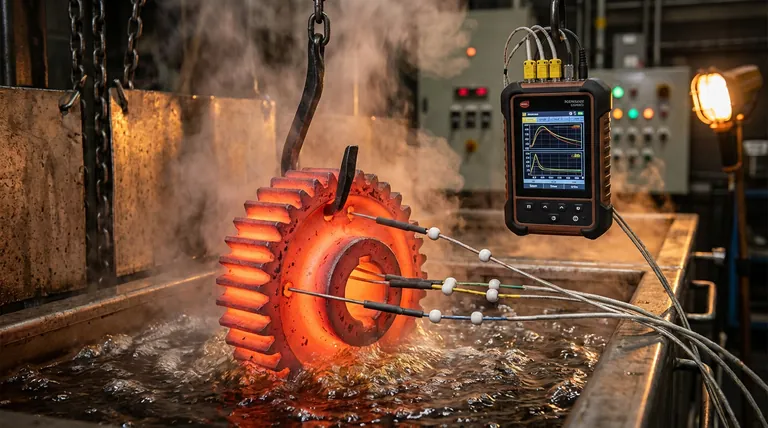
Accurate data acquisition is the cornerstone of reliable quenching analysis. Industrial K-type thermocouples and mobile data loggers are essential because they capture real-time time-temperature curves, known as cooling curves, directly from the specimen during the quenching process. By embedding these sensors into the material and utilizing data loggers designed for high-temperature environments, engineers can record the precise thermal history of a part as it undergoes rapid cooling.
These tools provide the physical ground truth necessary to calculate cooling rates during critical phase transitions. This empirical data is the only way to validate Finite Element Method (FEM) models and accurately predict the final hardness of the treated material.
Capturing the Thermal History
The Role of Embedded Sensors
To gather meaningful data, industrial K-type thermocouples must be physically embedded into the core or surface of the specimen.
This direct contact allows for the measurement of internal temperature gradients that surface-only scans cannot detect.
The Necessity of Mobile Data Loggers
Standard recording equipment cannot survive the harsh environment inside a quenching furnace or tank.
Mobile data loggers are essential because they travel with the specimen, operating reliably within high-temperature zones to capture continuous data without interruption.
The Critical Phase Transition
Monitoring the Austenite Transformation
The most vital data points occur as the specimen transitions from the high-temperature austenite zone to the transformation zone.
This typically happens between 800°C and 500°C.
Calculating Accurate Cooling Rates
The speed at which the metal cools through this specific temperature window dictates the microstructural changes in the material.
Thermocouples and loggers provide the granular resolution needed to calculate these cooling rates precisely, rather than relying on averages.
Validating Simulation and Quality
Grounding FEM Models in Reality
Finite Element Method (FEM) models are powerful simulation tools, but they remain theoretical until proven.
The data collected by these tools serves as the primary physical evidence required to validate whether an FEM model accurately reflects real-world physics.
Assessing Final Hardness
Material hardness is a direct function of the cooling rate.
By analyzing the captured cooling curves, engineers can assess the expected final hardness of the material, ensuring it meets structural requirements.
Common Pitfalls to Avoid
Sensor Placement Errors
The data is only as good as the sensor's position.
If the thermocouple is not securely embedded in the correct location (core vs. surface), the cooling curve will not reflect the true thermal stress the part is experiencing.
Over-Reliance on Simulation
A common mistake is assuming FEM models are correct without physical validation.
Without the "ground truth" provided by real-world logging, a simulation may look correct mathematically but fail to account for actual furnace conditions or transfer rates.
Making the Right Choice for Your Goal
To ensure you are gathering actionable data from your quenching experiments, align your equipment use with your specific objectives:
- If your primary focus is Model Calibration: Prioritize the precision of data between 800°C and 500°C to refine the accuracy of your FEM simulations.
- If your primary focus is Quality Assurance: Focus on comparing the recorded cooling rates against historical baselines to predict the final hardness consistency of the batch.
The combination of robust physical sensing and mobile logging transforms quenching from a guessing game into a precise, data-driven science.
Summary Table:
| Feature | Purpose in Quenching Experiments | Key Benefit |
|---|---|---|
| K-type Thermocouple | Embedded sensor for internal measurements | Captures core thermal history and gradients |
| Mobile Data Logger | On-site, high-temp data recording | Travels with specimen for continuous monitoring |
| 800°C to 500°C Window | Critical phase transition monitoring | Determines microstructural and hardness results |
| FEM Validation | Ground truth comparison with simulations | Confirms theoretical models match physical reality |
Optimize Your Thermal Processing with KINTEK Precision
Don't rely on theoretical models alone—achieve physical certainty in your quenching experiments. KINTEK provides industry-leading lab high-temperature solutions, including Muffle, Tube, Rotary, Vacuum, and CVD systems, all customizable to your specific research or production requirements. Backed by expert R&D and world-class manufacturing, we help you capture the precise data needed for superior material performance.
Ready to elevate your heat treatment accuracy? Contact our technical experts today to discuss your custom furnace needs.
References
- Artificial Intelligence Modeling of the Heterogeneous Gas Quenching Process for Steel Batches Based on Numerical Simulations and Experiments. DOI: 10.3390/dynamics4020023
This article is also based on technical information from Kintek Furnace Knowledge Base .
Related Products
- Multi Heating Zones CVD Tube Furnace Machine for Chemical Vapor Deposition Equipment
- High Temperature Muffle Oven Furnace for Laboratory Debinding and Pre Sintering
- Multi Zone Laboratory Quartz Tube Furnace Tubular Furnace
- Vertical Laboratory Quartz Tube Furnace Tubular Furnace
- 1200℃ Muffle Oven Furnace for Laboratory
People Also Ask
- What is the function of a multi-zone tube furnace in CVD synthesis? Master 2D In2Se3 Nanosheet Precision
- What role do multi zone tube furnaces play in new energy research? Unlock Precise Thermal Control for Innovation
- What environmental protection applications utilize multi zone tube furnaces? Unlock Precision in Waste Treatment and Green Tech
- Why are multi zone tube furnaces particularly useful for nanomaterial research? Unlock Precise Thermal Control for Advanced Synthesis
- What temperature-related capabilities make multi zone tube furnaces valuable for research? Unlock Precision Thermal Control