Precise control of the ammonia (NH3) to silane (SiH4) gas flow ratio is the fundamental mechanism for determining the stoichiometry of Silicon Nitride (SiN) films during PECVD. This ratio, often referred to as the R value, directly governs the degree of nitridation or silicification within the film. For single photon emitters, this precision is vital because it simultaneously allows you to tune the refractive index for optical confinement and minimize background fluorescence to ensure signal purity.
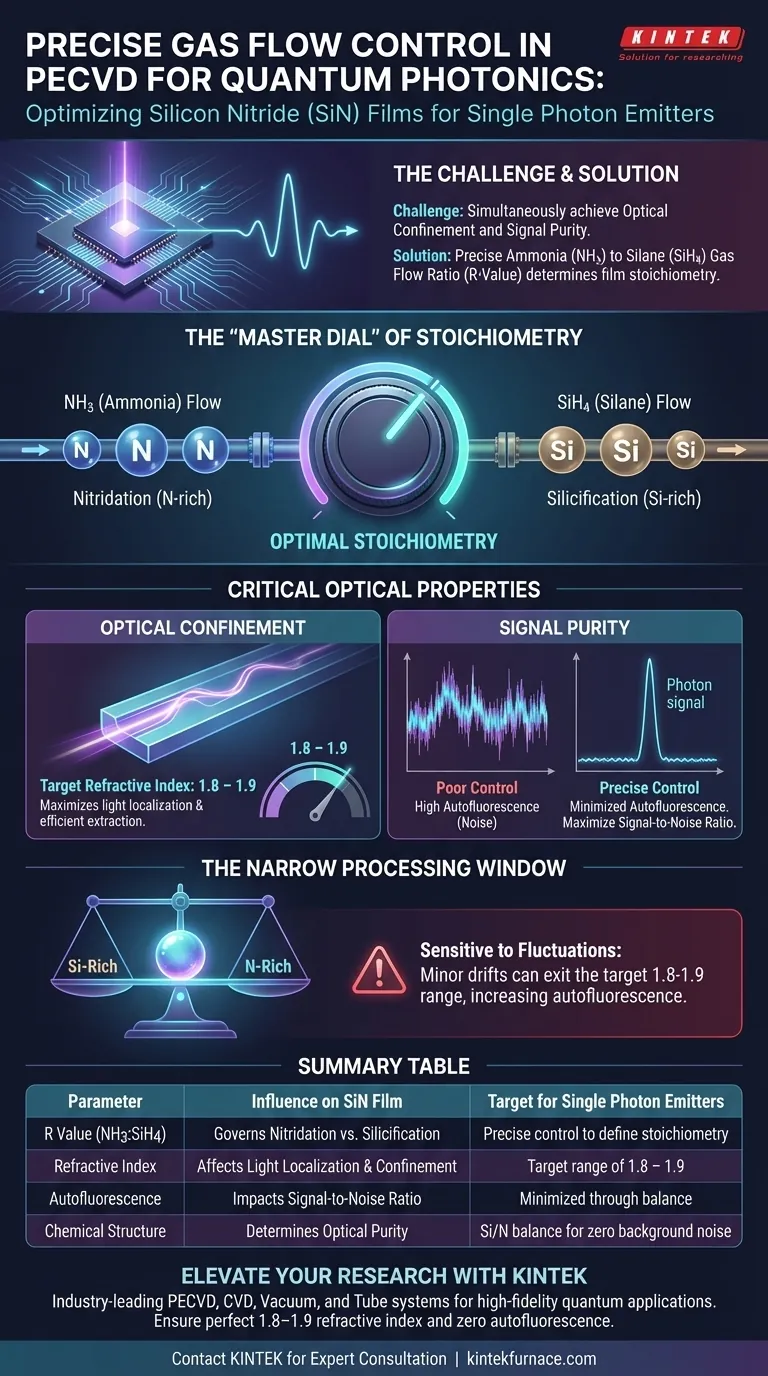
The gas flow ratio acts as a master dial for film composition, balancing chemical structure to achieve a specific refractive index (1.8–1.9) while suppressing autofluorescence to maximize the signal-to-noise ratio.
The Mechanics of Stoichiometry
Defining the R Value
In Plasma-Enhanced Chemical Vapor Deposition (PECVD), the relative abundance of reactant gases is not merely about supply; it is about chemical structure. The R value is the explicit ratio of ammonia flow to silane flow.
Nitridation vs. Silicification
Modifying this ratio shifts the film's composition along a spectrum. A higher ammonia flow promotes nitridation, resulting in nitrogen-rich films. Conversely, a higher silane flow increases silicification, leading to silicon-rich films. This chemical balance is the root cause of all subsequent optical behaviors.
Critical Optical Properties for Single Photon Emitters
Optimizing Light Localization
For single photon emitters, the ability to confine and guide light is paramount. This capability relies heavily on the material's refractive index.
By strictly regulating the gas flow ratio, you can fine-tune the refractive index to a target range of 1.8 to 1.9. This specific range is necessary to enhance light localization, ensuring efficient photon extraction and direction.
Ensuring Signal Purity
The most significant challenge in single photon detection is distinguishing the target photon from background noise.
Improper stoichiometry can lead to background autofluorescence, where the film itself emits light that obscures the signal. Precise flow control minimizes this background noise, thereby improving the signal-to-noise ratio and the purity of the detected single photons.
Understanding the Trade-offs
The Balance of Composition
There is often a narrow processing window to achieve optimal results.
Pushing the ratio too far toward silicification might increase the refractive index, but it risks altering the electronic band structure in a way that introduces optical losses or unwanted fluorescence.
Sensitivity to Fluctuations
Because the relationship between the R value and optical properties is direct, even minor fluctuations in mass flow controllers can lead to inconsistent film quality.
If the ratio drifts, the refractive index may exit the 1.8–1.9 target window, or autofluorescence may rise unexpectedly, rendering the device unsuitable for high-fidelity quantum applications.
Making the Right Choice for Your Goal
To maximize the performance of your single photon emitters, prioritize the stability of your gas delivery system.
- If your primary focus is Optical Confinement: Target a gas ratio that strictly maintains the refractive index between 1.8 and 1.9 to maximize light localization.
- If your primary focus is Detection Sensitivity: Prioritize a stoichiometry that minimizes the "degree of silicification" or "nitridation" associated with high autofluorescence to protect the signal-to-noise ratio.
Ultimately, the gas flow ratio is the bridge between raw chemical inputs and the high-precision optical performance required for quantum photonics.
Summary Table:
| Parameter | Influence on SiN Film | Target for Single Photon Emitters |
|---|---|---|
| R Value (NH3:SiH4) | Governs Nitridation vs. Silicification | Precise control to define film stoichiometry |
| Refractive Index | Affects Light Localization & Confinement | Target range of 1.8 – 1.9 |
| Autofluorescence | Impacts Signal-to-Noise Ratio | Minimized through stoichiometric balance |
| Chemical Structure | Determines Optical Purity | Silicon/Nitrogen balance for zero background noise |
Elevate Your Quantum Photonic Research with KINTEK
Precise gas control is the difference between a high-fidelity signal and background noise. KINTEK provides industry-leading PECVD systems and high-temp lab furnaces designed for the rigorous demands of Silicon Nitride film deposition. Backed by expert R&D and manufacturing, our equipment—including CVD, Vacuum, and Tube systems—is fully customizable to ensure your single photon emitters achieve the perfect 1.8–1.9 refractive index and zero autofluorescence.
Ready to optimize your thin-film stoichiometry?
Contact KINTEK today for expert consultation
Visual Guide
References
- Zachariah O. Martin, Vladimir M. Shalaev. Single-photon emitters in PECVD-grown silicon nitride films: from material growth to photophysical properties. DOI: 10.1515/nanoph-2024-0506
This article is also based on technical information from Kintek Furnace Knowledge Base .
Related Products
- Slide PECVD Tube Furnace with Liquid Gasifier PECVD Machine
- Inclined Rotary Plasma Enhanced Chemical Deposition PECVD Tube Furnace Machine
- Inclined Rotary Plasma Enhanced Chemical Deposition PECVD Tube Furnace Machine
- RF PECVD System Radio Frequency Plasma Enhanced Chemical Vapor Deposition
- Multi Heating Zones CVD Tube Furnace Machine for Chemical Vapor Deposition Equipment
People Also Ask
- What are the main advantages of PECVD tube furnaces compared to CVD tube furnaces? Lower Temp, Faster Deposition, and More
- What is plasma in the context of PECVD? Unlock Low-Temperature Thin Film Deposition
- What are the typical conditions for plasma-enhanced CVD processes? Achieve Low-Temperature Thin Film Deposition
- What plasma source is used in PE-CVD tube furnaces? Unlock Low-Temperature, High-Quality Deposition
- What are the advantages of using a tube furnace CVD system for Cu(111)/graphene? Superior Scalability and Quality