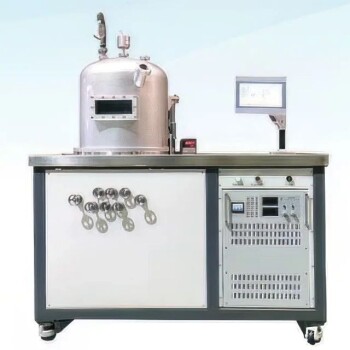
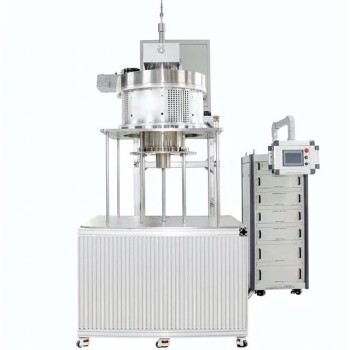
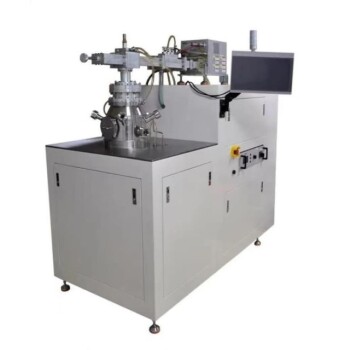
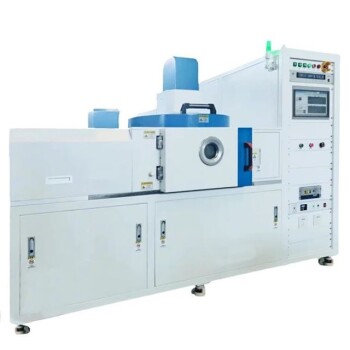
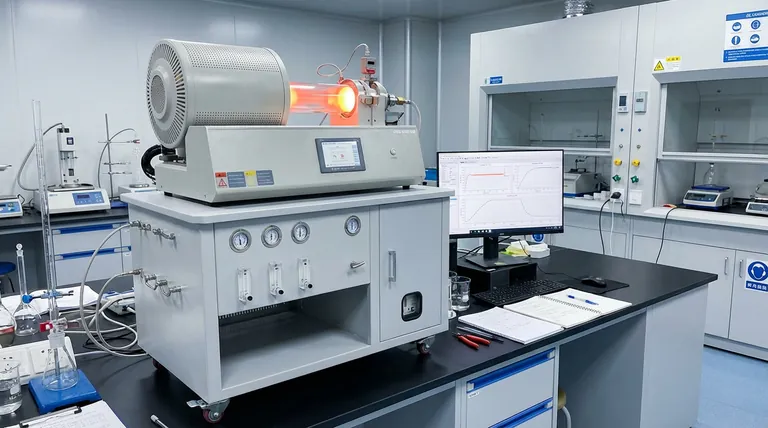
The Low-Pressure Chemical Vapor Deposition (LPCVD) system functions as the critical regulatory environment for synthesizing amorphous-crystalline mixed boron nitride (acm-BN). Its primary role is to orchestrate the decomposition and subsequent redeposition of boron and nitrogen atoms. By strictly managing vacuum levels, precursor flow rates, and reaction temperatures, the system ensures the material forms effectively rather than randomly.
The core capability of the LPCVD system is its precise regulation of the temperature-rise profile. This thermal control manages the material's phase transition, allowing researchers to dictate the exact ratio between amorphous and polycrystalline states in the final thin film.
Engineering the Synthesis Environment
Precise Atom Management
The synthesis of acm-BN requires more than simple mixing; it requires a controlled breakdown of components.
The LPCVD system provides the necessary conditions for the decomposition of precursors.
Once decomposed, the system facilitates the structured redeposition of boron and nitrogen atoms onto the substrate.
Governing Critical Variables
To achieve a mixed-phase material, the environment must remain stable yet responsive.
The system allows for the precise management of vacuum levels, which ensures the purity and pressure required for the reaction.
Simultaneously, it controls precursor flow rates to dictate exactly how much material enters the reaction chamber at any given moment.
Controlling the Phase Transition
Regulating the Temperature-Rise Profile
The most distinctive role of the LPCVD system in this context is its ability to regulate the temperature-rise profile.
This is not merely about maintaining a static temperature, but controlling how the heat evolves over time.
This specific control is identified as essential for managing the material's structural evolution.
Achieving Specific Mixed-Phase Ratios
The ultimate goal of using LPCVD is to avoid creating a purely amorphous or purely crystalline material.
By managing the thermal profile, the system controls the phase transition from a completely amorphous state to a polycrystalline state.
This capability enables the production of thin films with specific, tunable mixed-phase ratios tailored to the researcher's needs.
Operational Sensitivities and Constraints
Dependency on Parameter Precision
The LPCVD process relies heavily on the "highly controlled" nature of the environment.
Any deviation in vacuum pressure or precursor flow can disrupt the decomposition process.
Inconsistencies here can lead to unintended phase ratios, ruining the specific properties of the acm-BN.
Complexity of Profile Management
Regulating a temperature-rise profile is significantly more complex than maintaining a steady-state temperature.
This requires sophisticated equipment capable of dynamic thermal adjustments.
Failure to strictly adhere to the required profile will result in a loss of control over the amorphous-to-polycrystalline transition.
Making the Right Choice for Your Goal
To maximize the effectiveness of the LPCVD system in synthesizing acm-BN, focus on the specific parameters that influence your target material properties.
- If your primary focus is tuning material structure: Prioritize the regulation of the temperature-rise profile to control the transition from amorphous to polycrystalline phases.
- If your primary focus is reproducibility: strictly stabilize the vacuum levels and precursor flow rates to ensure consistent decomposition and redeposition.
By mastering the thermal and environmental variables within the LPCVD system, you transform the synthesis process from a random reaction into a precise engineering tool.
Summary Table:
| Key Parameter | Role in acm-BN Synthesis | Impact on Material Properties |
|---|---|---|
| Temperature-Rise Profile | Manages phase transition timing | Controls amorphous-to-polycrystalline ratio |
| Vacuum Levels | Ensures environment purity | Prevents contamination and stabilizes reaction |
| Precursor Flow Rate | Dictates atomic delivery speed | Influences film thickness and deposition uniformity |
| Thermal Regulation | Orchestrates atomic redeposition | Enables structural tuning of the thin film |
Elevate Your Thin-Film Research with KINTEK
Precise control over phase transitions requires high-performance hardware. KINTEK provides state-of-the-art LPCVD and CVD systems, specifically engineered to handle the complex temperature-rise profiles and vacuum stability essential for advanced materials like acm-BN.
Backed by expert R&D and world-class manufacturing, our lab high-temp furnaces—including Muffle, Tube, Rotary, and Vacuum systems—are fully customizable to meet your unique synthesis needs. Whether you are tuning mixed-phase ratios or ensuring batch-to-batch reproducibility, our technical team is ready to support your breakthrough.
Ready to optimize your deposition process? Contact KINTEK today for a custom solution.
References
- Synthesis of Amorphous‐Crystalline Mixture Boron Nitride for Balanced Resistive Switching Operation. DOI: 10.1002/smll.202503877
This article is also based on technical information from Kintek Furnace Knowledge Base .
Related Products
- Custom Made Versatile CVD Tube Furnace Chemical Vapor Deposition CVD Equipment Machine
- HFCVD Machine System Equipment for Drawing Die Nano Diamond Coating
- MPCVD Machine System Reactor Bell-jar Resonator for Lab and Diamond Growth
- 915MHz MPCVD Diamond Machine Microwave Plasma Chemical Vapor Deposition System Reactor
- Cylindrical Resonator MPCVD Machine System for Lab Diamond Growth
People Also Ask
- Why are CVD tube furnace sintering systems indispensable for 2D material research and production? Unlock Atomic-Scale Precision
- What is a CVD tube furnace and what is its primary function? Discover Precision Thin-Film Deposition
- Which industries and research fields benefit from CVD tube furnace sintering systems for 2D materials? Unlock Next-Gen Tech Innovations
- How does CVD tube furnace sintering enhance graphene growth? Achieve Superior Crystallinity and High Electron Mobility
- What temperature range do standard CVD tube furnaces operate at? Unlock Precision for Your Material Deposition