Knowledge Why is it necessary to grind iron concentrate to 5-10 microns? Optimize Your Iron Ore Reduction Kinetics
Author avatar

Tech Team · Kintek Furnace

Updated 1 day ago

Why is it necessary to grind iron concentrate to 5-10 microns? Optimize Your Iron Ore Reduction Kinetics


Precise particle preparation is the foundation of accurate kinetic data. Grinding iron concentrate to a specific size of 5–10 microns is necessary to drastically increase the surface area-to-volume ratio of the sample. This physical alteration maximizes the contact frequency between the reducing gas and solid particles, ensuring the experiment measures the true chemical reaction rate rather than physical diffusion limitations.

Core Takeaway Reducing particle size to 5–10 microns eliminates physical barriers to the reaction, allowing the reducing gas to interact instantaneously with the material. This ensures that experimental data accurately reflects the intrinsic reduction kinetics of the iron concentrate.
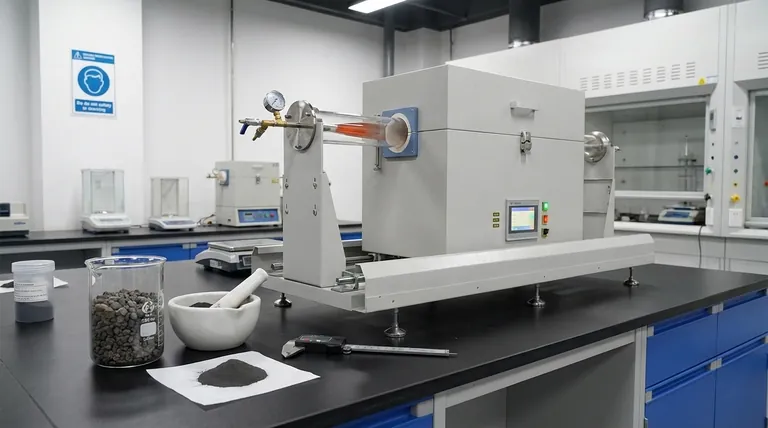
Why is it necessary to grind iron concentrate to 5-10 microns? Optimize Your Iron Ore Reduction Kinetics

The Physics of Reaction Efficiency

Maximizing Surface Area

The primary reason for grinding to the 5–10 micron range is to significantly increase the surface area-to-volume ratio.

When particles are coarse, the majority of the iron mass is locked inside the particle, inaccessible to the immediate reaction. By grinding the material down, you expose a vastly larger amount of surface area relative to the total volume of the sample.

Enhancing Gas-Solid Contact

Reduction is a surface-dependent process. It requires the reducing gas to physically collide with the solid iron concentrate.

The increased surface area created by grinding enhances the contact frequency between the gas molecules and the solid particles. More frequent contact points lead directly to a more efficient interaction.

Accelerating Interfacial Reactions

The ultimate goal of this preparation is to accelerate the interfacial chemical reaction process.

Because the gas can access the solid material more readily, the chemical transformation occurs without delay. This removes physical bottlenecks, allowing the reaction to proceed at its chemically determined speed.

The Critical Role of Data Integrity

Common Pitfalls to Avoid

If particles are not ground to this specific 5–10 micron range, experimental data becomes unreliable.

Larger particles introduce variables related to gas penetration depth and internal diffusion. These physical delays distort the measurement of reduction kinetics, making it difficult to isolate the true behavior of the material.

Ensuring Representative Results

To derive a mathematical model of how iron concentrate reduces, the inputs must be consistent.

Grinding ensures the measurements taken during the experiment are accurate and representative of the material's actual behavior. It standardizes the sample so that the data reflects chemical properties, not inconsistencies in particle geometry.

Making the Right Choice for Your Goal

To ensure your iron ore reduction experiments yield valid results, consider the following:

  • If your primary focus is Reaction Speed: Ensure particles are consistently ground to 5–10 microns to maximize gas-solid contact and accelerate the interfacial reaction.
  • If your primary focus is Kinetic Modeling: Strict adherence to this size range is required to eliminate diffusion errors and capture accurate, representative kinetic data.

Meticulous sample preparation is the only way to bridge the gap between theoretical chemistry and observable experimental results.

Summary Table:

Factor 5-10 Micron Particle Size Impact on Experiment
Surface Area Maximized relative to volume Higher reaction frequency
Gas-Solid Contact Increased frequency and access Eliminates diffusion bottlenecks
Reaction Type Interfacial chemical reaction Reflects true material kinetics
Data Integrity High consistency and accuracy Reliable for mathematical modeling

Elevate Your Metallurgical Research with KINTEK

Precision in particle preparation requires equally precise thermal processing. KINTEK provides industry-leading Muffle, Tube, Rotary, Vacuum, and CVD systems designed to handle specialized iron ore reduction experiments. Backed by expert R&D and advanced manufacturing, our lab high-temp furnaces are fully customizable to meet your unique kinetic modeling requirements.

Ready to achieve superior experimental accuracy? Contact our technical experts today to find the perfect thermal solution for your lab.

Visual Guide

Why is it necessary to grind iron concentrate to 5-10 microns? Optimize Your Iron Ore Reduction Kinetics Visual Guide

References

  1. Yuzhao Wang, Samuli Urpelainen. In Situ SXRD Study of Phase Transformations and Reduction Kinetics in Iron Ore During Hydrogen-Based High-Temperature Reduction. DOI: 10.1007/s11663-025-03725-2

This article is also based on technical information from Kintek Furnace Knowledge Base .

Related Products

People Also Ask

Related Products

Laboratory Quartz Tube Furnace RTP Heating Tubular Furnace

Laboratory Quartz Tube Furnace RTP Heating Tubular Furnace

KINTEK's RTP Rapid Heating Tube Furnace delivers precise temperature control, rapid heating up to 100°C/sec, and versatile atmosphere options for advanced lab applications.

Vacuum Sealed Continuous Working Rotary Tube Furnace Rotating Tube Furnace

Vacuum Sealed Continuous Working Rotary Tube Furnace Rotating Tube Furnace

Precision rotary tube furnace for continuous vacuum processing. Ideal for calcination, sintering, and heat treatment. Customizable up to 1600℃.

Vacuum Heat Treat Sintering and Brazing Furnace

Vacuum Heat Treat Sintering and Brazing Furnace

KINTEK Vacuum Brazing Furnaces deliver precision, clean joints with superior temperature control. Customizable for diverse metals, ideal for aerospace, medical, and thermal applications. Get a quote!

Laboratory Vacuum Tilt Rotary Tube Furnace Rotating Tube Furnace

Laboratory Vacuum Tilt Rotary Tube Furnace Rotating Tube Furnace

KINTEK Laboratory Rotary Furnace: Precision heating for calcination, drying, sintering. Customizable solutions with vacuum & controlled atmosphere. Enhance research now!

2200 ℃ Graphite Vacuum Heat Treat Furnace

2200 ℃ Graphite Vacuum Heat Treat Furnace

2200℃ Graphite Vacuum Furnace for high-temperature sintering. Precise PID control, 6*10⁻³Pa vacuum, durable graphite heating. Ideal for research & production.

Multi Heating Zones CVD Tube Furnace Machine for Chemical Vapor Deposition Equipment

Multi Heating Zones CVD Tube Furnace Machine for Chemical Vapor Deposition Equipment

KINTEK's Multi-Zone CVD Tube Furnaces offer precision temperature control for advanced thin film deposition. Ideal for research and production, customizable for your lab needs.

Multi Zone Laboratory Quartz Tube Furnace Tubular Furnace

Multi Zone Laboratory Quartz Tube Furnace Tubular Furnace

KINTEK Multi-Zone Tube Furnace: Precise 1700℃ heating with 1-10 zones for advanced material research. Customizable, vacuum-ready, and safety-certified.

1200℃ Split Tube Furnace Laboratory Quartz Tube Furnace with Quartz Tube

1200℃ Split Tube Furnace Laboratory Quartz Tube Furnace with Quartz Tube

Discover KINTEK's 1200℃ Split Tube Furnace with quartz tube for precise high-temperature lab applications. Customizable, durable, and efficient. Get yours now!

Vacuum Dental Porcelain Sintering Furnace for Dental Laboratories

Vacuum Dental Porcelain Sintering Furnace for Dental Laboratories

KinTek Vacuum Porcelain Furnace: Precision dental lab equipment for high-quality ceramic restorations. Advanced firing control & user-friendly operation.

Electric Rotary Kiln Pyrolysis Furnace Plant Machine Small Rotary Kiln Calciner

Electric Rotary Kiln Pyrolysis Furnace Plant Machine Small Rotary Kiln Calciner

KINTEK Electric Rotary Kiln: Precise 1100℃ calcination, pyrolysis & drying. Eco-friendly, multi-zone heating, customizable for lab & industrial needs.

Electric Rotary Kiln Small Rotary Furnace Biomass Pyrolysis Plant Rotating Furnace

Electric Rotary Kiln Small Rotary Furnace Biomass Pyrolysis Plant Rotating Furnace

KINTEK's Rotary Biomass Pyrolysis Furnace converts biomass to biochar, bio-oil, and syngas efficiently. Customizable for research or production. Get your solution now!

1700℃ High Temperature Laboratory Tube Furnace with Quartz or Alumina Tube

1700℃ High Temperature Laboratory Tube Furnace with Quartz or Alumina Tube

KINTEK's Tube Furnace with Alumina Tube: Precision heating up to 1700°C for material synthesis, CVD, and sintering. Compact, customizable, and vacuum-ready. Explore now!

1400℃ Muffle Oven Furnace for Laboratory

1400℃ Muffle Oven Furnace for Laboratory

KT-14M Muffle Furnace: Precision 1400°C heating with SiC elements, PID control, and energy-efficient design. Ideal for labs.

Laboratory Muffle Oven Furnace with Bottom Lifting

Laboratory Muffle Oven Furnace with Bottom Lifting

Boost lab efficiency with KT-BL Bottom Lifting Furnace: precise 1600℃ control, superior uniformity, and enhanced productivity for material science and R&D.

1700℃ High Temperature Muffle Oven Furnace for Laboratory

1700℃ High Temperature Muffle Oven Furnace for Laboratory

KT-17M Muffle Furnace: High-precision 1700°C lab furnace with PID control, energy efficiency, and customizable sizes for industrial & research applications.

915MHz MPCVD Diamond Machine Microwave Plasma Chemical Vapor Deposition System Reactor

915MHz MPCVD Diamond Machine Microwave Plasma Chemical Vapor Deposition System Reactor

KINTEK MPCVD Diamond Machine: High-quality diamond synthesis with advanced MPCVD technology. Faster growth, superior purity, customizable options. Boost production now!

High Temperature Muffle Oven Furnace for Laboratory Debinding and Pre Sintering

High Temperature Muffle Oven Furnace for Laboratory Debinding and Pre Sintering

KT-MD Debinding & Pre-Sintering Furnace for ceramics - precise temperature control, energy-efficient design, customizable sizes. Boost your lab efficiency today!

1400℃ High Temperature Laboratory Tube Furnace with Quartz and Alumina Tube

1400℃ High Temperature Laboratory Tube Furnace with Quartz and Alumina Tube

KINTEK's Tube Furnace with Alumina Tube: Precision high-temperature processing up to 2000°C for labs. Ideal for material synthesis, CVD, and sintering. Customizable options available.

Small Vacuum Heat Treat and Tungsten Wire Sintering Furnace

Small Vacuum Heat Treat and Tungsten Wire Sintering Furnace

Compact vacuum tungsten wire sintering furnace for labs. Precise, mobile design with superior vacuum integrity. Ideal for advanced material research. Contact us!

Chairside Dental Porcelain Zirconia Sintering Furnace with Transformer for Ceramic Restorations

Chairside Dental Porcelain Zirconia Sintering Furnace with Transformer for Ceramic Restorations

Dental Porcelain Speedy Sintering Furnace: Fast 9-minute zirconia sintering, 1530°C precision, SiC heaters for dental labs. Boost productivity today!


Leave Your Message

















