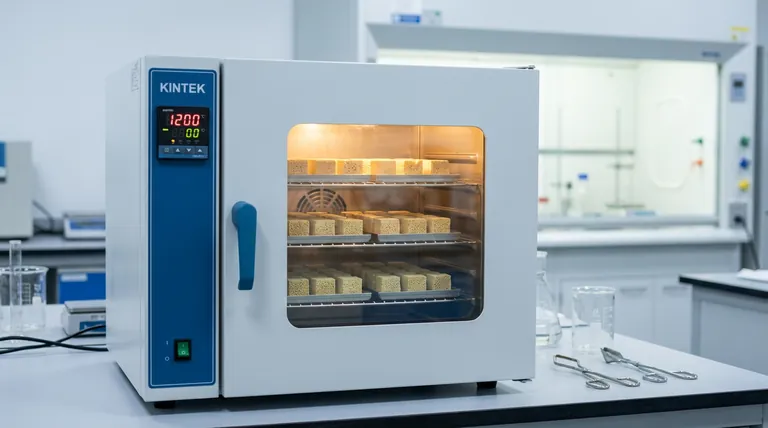
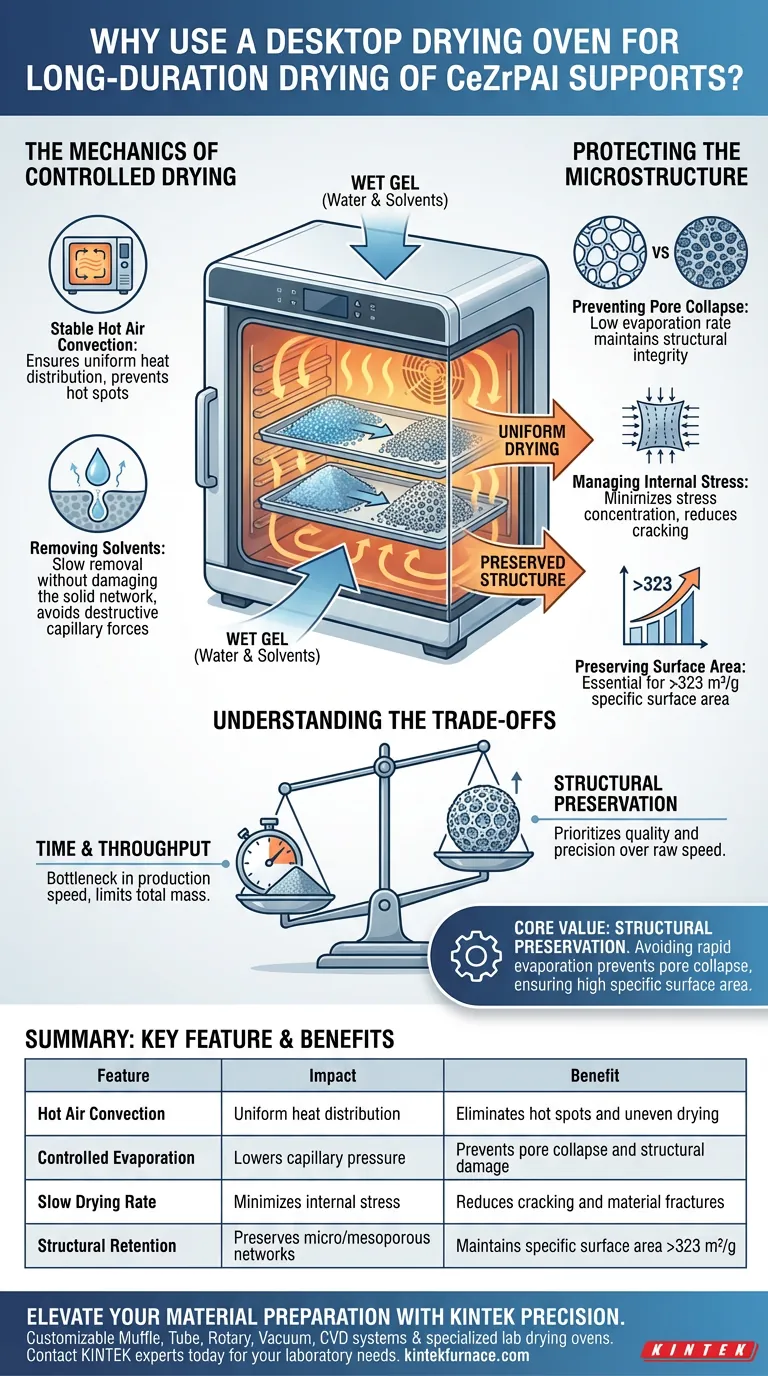
A desktop drying oven is utilized to create a stable, controlled hot air convection environment essential for processing CeZrPAl supports. This equipment ensures the slow and uniform removal of water and residual solvents from the wet gel generated during the sol-gel process. By strictly controlling the evaporation rate, the oven prevents internal stress concentrations that would otherwise destroy the material's delicate internal architecture.
The core value of this long-duration drying process is structural preservation. By avoiding rapid evaporation, the process prevents pore collapse, ensuring the final material retains the high specific surface area required for effective performance.
The Mechanics of Controlled Drying
Stable Hot Air Convection
The desktop drying oven provides a consistent thermal environment driven by hot air convection.
This stability is critical because it ensures that heat is distributed evenly across the material.
Uniform heat distribution prevents "hot spots" that could cause uneven drying rates within a single batch of wet gel.
Removing Solvents from Wet Gel
During the sol-gel process, the material exists as a wet gel saturated with water and solvents.
The drying phase must remove these liquids without damaging the solid network formed within the gel.
The oven facilitates this removal slowly, allowing solvents to escape from the gel network without generating destructive capillary forces.
Protecting the Microstructure
Preventing Pore Collapse
The primary risk during drying is pore collapse.
If liquid evaporates too quickly, the resulting capillary pressure can crush the delicate walls of the material's pores.
Long-duration drying in the oven mitigates this risk by keeping evaporation rates low enough to maintain structural integrity.
Managing Internal Stress
Rapid drying creates internal stress concentration within the material.
These stress points act as fracture sites, leading to cracks or a complete breakdown of the porous network.
The controlled environment of the oven ensures stress is minimized and distributed evenly, preserving the material's mechanical stability.
Preserving Surface Area
The ultimate goal of this careful drying is to maintain a high specific surface area.
The primary reference indicates that this process is essential for achieving a specific surface area of over 323 m²/g.
This high surface area is directly linked to the preservation of both microporous and mesoporous structures.
Understanding the Trade-offs
Time vs. Throughput
The most significant trade-off in this process is time efficiency.
"Long-duration" treatment creates a bottleneck in production speed, limiting how quickly supports can be manufactured.
However, attempting to accelerate this step creates an unacceptable risk of structural failure and reduced surface area.
Capacity Limitations
The use of a desktop unit implies a constraint on batch volume compared to larger industrial kilns.
While a desktop oven offers superior control for maintaining stability, it may limit the total mass of material that can be processed simultaneously.
This trade-off prioritizes quality and precision over raw mass-production speed.
Optimizing Your Preparation Process
To ensure the highest quality CeZrPAl supports, you must balance process efficiency with material integrity.
- If your primary focus is maximum surface area: Prioritize the stability of the convection environment and extend the drying duration to guarantee the metric exceeds 323 m²/g.
- If your primary focus is process speed: Recognize that this specific drying stage is non-negotiable; rushing it will result in pore collapse and a failed product.
Success in preparing CeZrPAl supports relies on accepting that slow, uniform drying is the only path to structural integrity.
Summary Table:
| Feature | Impact on CeZrPAl Supports | Benefit |
|---|---|---|
| Hot Air Convection | Uniform heat distribution | Eliminates hot spots and uneven drying |
| Controlled Evaporation | Lowers capillary pressure | Prevents pore collapse and structural damage |
| Slow Drying Rate | Minimizes internal stress | Reduces cracking and material fractures |
| Structural Retention | Preserves micro/mesoporous networks | Maintains specific surface area >323 m²/g |
Elevate Your Material Preparation with KINTEK Precision
Don't let pore collapse compromise your CeZrPAl research. KINTEK provides industry-leading drying solutions designed for high-precision applications. Backed by expert R&D and manufacturing, we offer customizable Muffle, Tube, Rotary, Vacuum, and CVD systems, alongside specialized lab drying ovens to ensure your materials achieve their maximum specific surface area.
Ready to optimize your drying process? Contact KINTEK experts today to find the perfect high-temp solution for your laboratory needs.
Visual Guide
References
- Feng Feng, Junchen Du. The Effect P Additive on the CeZrAl Support Properties and the Activity of the Pd Catalysts in Propane Oxidation. DOI: 10.3390/ma17051003
This article is also based on technical information from Kintek Furnace Knowledge Base .
Related Products
- High Temperature Muffle Oven Furnace for Laboratory Debinding and Pre Sintering
- Electric Rotary Kiln Pyrolysis Furnace Plant Machine Small Rotary Kiln Calciner
- Electric Rotary Kiln Continuous Working Small Rotary Furnace Kiln for Pyrolysis Plant Heating
- Vacuum Heat Treat Sintering and Brazing Furnace
- Electric Rotary Kiln Small Rotary Furnace for Activated Carbon Regeneration
People Also Ask
- What thermal phenomena occur during polymer binder burnout in ceramic green bodies? Lab Furnace Guide
- Why is controlled heat treatment in a muffle furnace necessary for calcined clay? Achieve Optimal Pozzolanic Activity
- What role does a high-temperature muffle furnace play in STFO synthesis? Achieve Pure Perovskite Results
- How does a high-temperature muffle furnace facilitate the formation of LaNbxAl1−xO3+δ perovskite structures? Key Roles
- What role does a high-temperature muffle furnace play in the multi-stage synthesis of Li0.5MnFe1.5O4? Key to Pure Spinel