
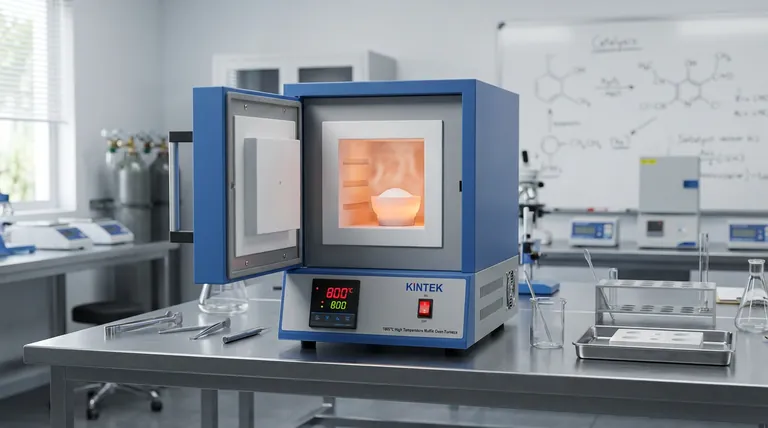
An industrial muffle furnace acts as the critical stabilization chamber in the synthesis of magnesium oxide (MgO)-based catalysts. Its primary function is to provide a constant, high-temperature environment—specifically maintaining a stable thermal field at 800°C—to drive the calcination process. This thermal treatment is required to decompose raw metal salt precursors and facilitate the thermal diffusion of active components, ensuring the final catalyst possesses the structural integrity and anti-sintering properties needed for the harsh conditions of dry reforming.
Core Takeaway The muffle furnace is not merely a heating device; it is a precision instrument for lattice engineering. By controlling the thermal environment, it transforms volatile precursors into a stable, crystalline solid solution that can withstand the intense thermal shocks characteristic of industrial gas reforming.
The Mechanism of Catalyst Formation
Thermal Decomposition of Precursors
The first stage of preparation involves the removal of volatile components. Raw materials for MgO catalysts often exist as carbonates or hydrated salts.
The muffle furnace facilitates the complete decomposition of metal salts. Through multi-stage calcination, it drives off water and carbon dioxide, leaving behind a pure oxide structure. This step is essential to prevent structural collapse during the actual catalytic reaction.
Promoting Thermal Diffusion
Heat alone is insufficient; the duration and stability of the heat are paramount. The furnace maintains temperatures at 800°C over extended periods to promote thermal diffusion.
This process encourages the active metal components to migrate and disperse uniformly onto the MgO support. This diffusion creates strong interactions between the metal and the support, which is vital for catalytic activity.
Formation of Solid Solutions
The ultimate goal of this thermal treatment is the creation of stable solid solutions. The muffle furnace enables the formation of specific crystalline phases within the MgO matrix.
Proper crystal development ensures that the active components are "locked" into the lattice. This structure significantly enhances the catalyst's anti-sintering capabilities, preventing the active surface area from degrading under high operating temperatures.
Critical Impacts on Performance
Enhancing Surface Alkalinity
For dry reforming of natural gas, the basicity of the support is crucial. The lattice reorganization promoted by the furnace helps form active magnesium oxide with high alkalinity.
This enhanced alkalinity improves the catalyst's ability to adsorb carbon dioxide. Efficient CO2 adsorption is a key mechanism in the dry reforming process, directly influencing the conversion rate of greenhouse gases.
Substrate Bonding and Durability
In industrial applications, catalysts are often applied to structured substrates like cordierite. The muffle furnace provides the thermal energy required for solid-phase thermochemical reactions.
By processing materials at temperatures that can range from 900°C to 1200°C depending on the specific formulation, the furnace ensures the oxide forms establish strong chemical bonds with the substrate. This prevents peeling and ensures the catalyst resists deactivation caused by repeated thermal shocks.
Understanding the Trade-offs
The Risk of Over-Sintering
While high temperatures are necessary for stability, there is a fine line between calcination and destruction. Excessive heat or uncontrolled temperature spikes can lead to premature sintering.
If the temperature exceeds the optimal window for the specific formulation, the pores of the catalyst may collapse, drastically reducing the specific surface area and rendering the catalyst inactive before it is ever used.
The Cost of Thermal Stability
Achieving a highly stable crystalline structure often requires longer dwell times in the furnace. This increases energy consumption and production time.
Manufacturers must balance the need for a perfectly ordered lattice (which resists degradation) against the economic constraints of energy-intensive high-temperature processing.
Making the Right Choice for Your Goal
The specific parameters you set on your muffle furnace will dictate the final characteristics of your MgO catalyst.
- If your primary focus is Long-Term Stability: Prioritize extended dwell times at 800°C to maximize the formation of solid solutions and enhance anti-sintering resistance.
- If your primary focus is Substrate Adhesion: Utilize higher temperature ranges (up to 1200°C) to facilitate solid-phase reactions that chemically bond the catalyst to cordierite or ceramic supports.
- If your primary focus is Reactivity: Focus on precise multi-stage calcination to maximize lattice reorganization and alkalinity for better CO2 adsorption.
The muffle furnace transforms raw chemical potential into a durable, industrial-grade tool capable of surviving the extreme environment of dry reforming.
Summary Table:
| Stage of Process | Function of Muffle Furnace | Impact on Catalyst Performance |
|---|---|---|
| Precursor Decomposition | Removal of volatiles (H2O, CO2) | Ensures structural integrity & prevents collapse |
| Thermal Diffusion | Promoting active metal migration | Creates uniform dispersion & active site stability |
| Lattice Engineering | Formation of crystalline solid solutions | Enhances anti-sintering & thermal shock resistance |
| Surface Modification | Enhancing MgO basicity (alkalinity) | Improves CO2 adsorption and conversion rates |
| Substrate Bonding | Solid-phase thermochemical reactions | Prevents catalyst peeling from ceramic supports |
Elevate Your Catalyst Synthesis with KINTEK Precision
Maximize the efficiency of your MgO-based catalysts with high-performance thermal solutions. Backed by expert R&D and manufacturing, KINTEK offers a comprehensive range of Muffle, Tube, Rotary, Vacuum, and CVD systems, all fully customizable to meet your specific research or production needs.
Whether you are focusing on lattice reorganization or large-scale substrate bonding, our furnaces provide the temperature uniformity required for industrial-grade results. Contact us today to find your custom heating solution and see how our expertise can drive your innovation forward.
References
- Hengchang Ni, Ping Li. Promotion Effect of H2S at High Concentrations on Catalytic Dry Reforming of Methane in Sour Natural Gas. DOI: 10.3390/catal14060352
This article is also based on technical information from Kintek Furnace Knowledge Base .
Related Products
- 1400℃ Muffle Oven Furnace for Laboratory
- 1700℃ High Temperature Muffle Oven Furnace for Laboratory
- 1200℃ Muffle Oven Furnace for Laboratory
- 1800℃ High Temperature Muffle Oven Furnace for Laboratory
- High Temperature Muffle Oven Furnace for Laboratory Debinding and Pre Sintering
People Also Ask
- How does a high-temperature laboratory muffle furnace affect material properties? Transform Anodic Oxide Films Fast
- What is the primary function of a high-temperature laboratory muffle furnace in chemical synthesis? Achieve Precision.
- How does a laboratory high-temperature muffle furnace contribute to the final formation of Bismuth Oxide nanosheets?
- What function does a muffle furnace perform in perovskite formation? Optimize Your Thermal Synthesis
- What is the function of a muffle furnace in MOF-derived zirconia conversion? Optimize Phase & Pore Engineering



















