
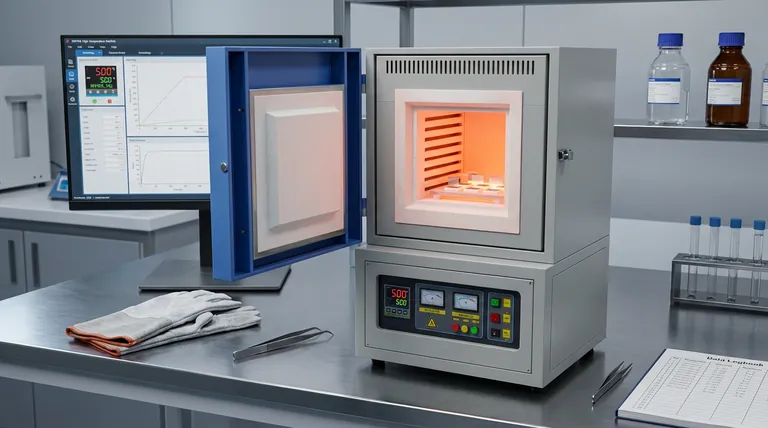
A Muffle Furnace is the primary instrument used to perform high-temperature annealing on Zinc Tin Oxide (ZTO) thin films. Specifically, it subjects the deposited films to a thermal treatment at 500 °C. This process is essential for transforming the material from a disordered, amorphous state into a stable, high-performance polycrystalline structure suitable for electronic applications.
Core Takeaway: The Muffle Furnace acts as a crystallization engine. By applying precise thermal energy, it drives atomic rearrangement in ZTO films, simultaneously eliminating internal defects and optimizing the optical transparency required for solar cell technology.
Driving Structural Transformation
From Amorphous to Polycrystalline
As deposited, ZTO films often exist in an amorphous or weakly crystalline state. The heat provided by the muffle furnace triggers a phase transition.
This thermal energy converts the material into a polycrystalline state. This structural organization is fundamental to the material's durability and performance.
Atomic Rearrangement
The 500 °C environment provides the necessary energy for atoms within the thin film to migrate.
This movement promotes atomic rearrangement, allowing atoms to settle into more stable lattice positions. This significantly improves the overall material crystallinity.
Mechanical and Physical Stabilization
Eliminating Internal Stress
During the initial deposition process, thin films accumulate significant internal stress. If left untreated, this can lead to delamination or cracking.
The annealing process acts as a stress-relief mechanism. It effectively eliminates these internal stresses, ensuring the film remains physically robust and adherent to the substrate.
Enhancing Material Density
While not explicitly detailed in every ZTO protocol, high-temperature annealing generally promotes densification.
By removing defects and encouraging lattice order, the furnace ensures the film becomes a cohesive, uniform layer rather than a porous coating.
Optimizing Optical Properties
Adjusting the Bandgap
For semiconductor materials like ZTO, the energy bandgap is a critical parameter.
The muffle furnace treatment modifies the film's electronic structure, directly adjusting the bandgap. This tuning is necessary to align the material's properties with the specific needs of the device it will inhabit.
Maximizing Transparency
High transparency is non-negotiable for window layers in photovoltaic devices.
The annealing process enhances the optical transmission of the ZTO film. This ensures that light can pass through the window layer efficiently to reach the active parts of a solar cell.
Understanding the Trade-offs
The Risk of Thermal Overload
While 500 °C is the target for this specific ZTO application, deviations can be detrimental.
Excessive temperatures can cause atomic diffusion between the film and the substrate, potentially contaminating the ZTO layer. It may also lead to unwanted phase separations that degrade electrical performance.
Process Uniformity
A muffle furnace must provide a uniform thermal field.
If the heat distribution is uneven, the film will suffer from inconsistent crystallinity. This results in "hot spots" or areas of high resistance, compromising the reliability of the final solar cell.
Making the Right Choice for Your Goal
To apply this to your specific project, consider your end-use requirements:
- If your primary focus is Solar Cell Efficiency: Prioritize the 500 °C annealing cycle to maximize transparency and bandgap alignment, ensuring the window layer allows maximum light transmission.
- If your primary focus is Mechanical Durability: Focus on the stress-relief aspects of the annealing process to prevent delamination or cracking in harsh operating environments.
Ultimately, the muffle furnace is not just a heater; it is the tool that finalizes the atomic architecture of your ZTO film.
Summary Table:
| Process Objective | Mechanism | Key Benefit |
|---|---|---|
| Structural Transformation | Amorphous to Polycrystalline | Enhanced material durability and electron mobility |
| Mechanical Stability | Internal Stress Relief | Prevents film delamination and cracking |
| Optical Optimization | Bandgap Adjustment | Maximizes transparency for solar cell window layers |
| Physical Integrity | Densification | Creates a cohesive, uniform, and defect-free layer |
Elevate Your Material Research with KINTEK
Precise thermal architecture is the difference between a failing film and a high-performance semiconductor. KINTEK provides industry-leading high-temperature solutions—including Muffle, Tube, Rotary, Vacuum, and CVD systems—specifically designed to meet the rigorous demands of ZTO annealing and advanced material science.
Backed by expert R&D and precision manufacturing, our furnaces are fully customizable to ensure perfect thermal uniformity and defect-free results for your unique laboratory needs.
Ready to optimize your thin-film crystallization? Contact our technical experts today to find the perfect furnace for your application.
References
- Ashish Khandelwal, K. S. Sharma. Effect of Different Compositions of Mixed Metal Oxides (Zinc Oxide and Tin Oxide) on Structural and Optical Properties for the Application of Window Layers in Solar Cells. DOI: 10.3329/jsr.v16i1.64157
This article is also based on technical information from Kintek Furnace Knowledge Base .
Related Products
- 1400℃ Muffle Oven Furnace for Laboratory
- 1700℃ High Temperature Muffle Oven Furnace for Laboratory
- 1800℃ High Temperature Muffle Oven Furnace for Laboratory
- 1200℃ Muffle Oven Furnace for Laboratory
- High Temperature Muffle Oven Furnace for Laboratory Debinding and Pre Sintering
People Also Ask
- How does a high-temperature laboratory muffle furnace affect material properties? Transform Anodic Oxide Films Fast
- What is the primary function of a high-temperature laboratory muffle furnace in chemical synthesis? Achieve Precision.
- How does a laboratory high-temperature muffle furnace contribute to the final formation of Bismuth Oxide nanosheets?
- What role does a muffle furnace play in refractory bricks? Enhance Performance and Durability Testing
- What is the muffle furnace function in ilmenite oxidative roasting? Enhance Phase Change & Magnetic Separation



















