
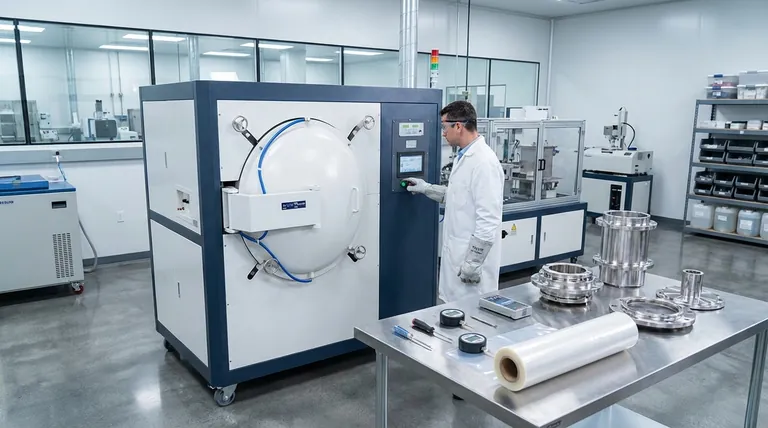
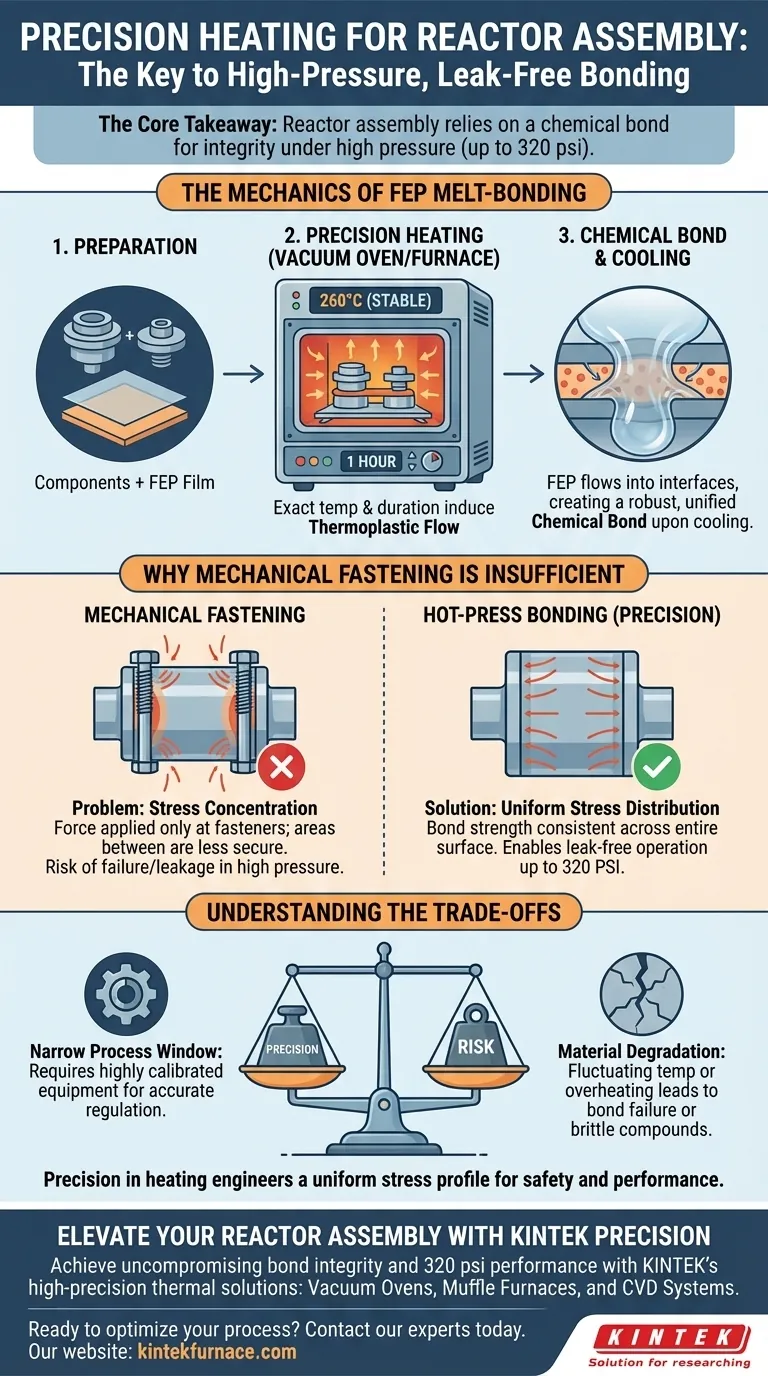
Precision heating equipment is strictly required to accurately control the melt-bonding process of Fluorinated Ethylene Propylene (FEP) films used in reactor assembly. By maintaining a specific, stable environment—typically 260°C for exactly one hour—these furnaces allow the FEP to undergo thermoplastic flow, penetrating component interfaces to create a bond that mechanical fastening cannot achieve.
The Core Takeaway Reactor assembly relies on a chemical bond rather than mechanical force to ensure integrity under high pressure. Precision vacuum ovens are essential to facilitate the thermoplastic flow of FEP films, creating a unified, leak-free component capable of withstanding pressures up to 320 psi.
The Mechanics of FEP Melt-Bonding
Achieving Thermoplastic Flow
The central objective of using a precision oven is to induce thermoplastic flow.
FEP films must be heated to a precise target temperature of 260°C and held there for a specific duration, such as one hour. This precise thermal exposure causes the film to soften and flow into the microscopic interfaces of the aligned reactor components.
Creating a Robust Chemical Bond
Once the heating cycle is complete, the cooling process solidifies the FEP.
This creates a robust chemical bond between the components. Unlike a temporary seal, this process fuses the parts into a single, cohesive unit designed for high-performance operation.
Why Mechanical Fastening is Insufficient
The Problem with Stress Concentration
Standard mechanical fastening, such as using bolts or screws, creates points of high stress.
Force is applied only where the fasteners are located, leaving the areas between them less secure. In high-pressure environments, these uneven stress concentrations can lead to structural failure or leakage.
Uniform Stress Distribution
Hot-press bonding provides uniform stress distribution across the entire bonded surface.
Because the FEP film penetrates the entire interface, the bond strength is consistent throughout the assembly. This uniformity is the key factor that allows the reactor to operate leak-free at high pressures, specifically up to 320 psi.
Understanding the Trade-offs
Precision vs. Simplicity
While hot-press bonding offers superior performance, it demands a much narrower process window than mechanical assembly.
Requires highly calibrated equipment. Standard ovens that fluctuate in temperature cannot be used; accurate regulation is necessary to ensure atomic diffusion or polymer flow occurs without overheating the materials.
Risk of Material Degradation
If the temperature is not controlled precisely, the bond will fail.
In general bonding contexts, excessive heat can lead to local melting of the substrate matrix or the formation of brittle compounds. Precision equipment mitigates this risk by ensuring the temperature stays exactly within the range required for the bond, preserving the mechanical properties of the joint.
Making the Right Choice for Your Goal
To ensure the success of your reactor assembly, apply these principles based on your specific requirements:
- If your primary focus is High-Pressure Integrity: Prioritize precision ovens that can maintain 260°C without fluctuation to guarantee the FEP creates a leak-free seal capable of 320 psi.
- If your primary focus is Material Longevity: Use vacuum environments to prevent oxidation and precise thermal ramping to avoid degrading the component materials during the bonding phase.
Precision in heating is not just about melting the film; it is about engineering a uniform stress profile that guarantees safety and performance.
Summary Table:
| Feature | Mechanical Fastening | Hot-Press Bonding (Precision Oven) |
|---|---|---|
| Bond Type | Physical/Mechanical | Chemical/Thermoplastic Flow |
| Stress Distribution | Concentrated at fasteners | Uniform across surface |
| Pressure Rating | Lower, prone to leaks | Up to 320 psi (Leak-free) |
| Equipment Requirement | Manual tools | Precision 260°C Vacuum/Heating Oven |
| Material Integrity | Potential deformation | Preserved via controlled thermal window |
Elevate Your Reactor Assembly with KINTEK Precision
Achieve uncompromising bond integrity and 320 psi performance with KINTEK’s high-precision thermal solutions. Backed by expert R&D and world-class manufacturing, we provide high-performance Vacuum Ovens, Muffle Furnaces, and CVD systems designed to meet the strict 260°C process windows required for FEP melt-bonding. Whether you need standard lab heating or a fully customizable system for unique industrial scales, KINTEK ensures uniform heat distribution and oxidation prevention for your most critical components.
Ready to optimize your hot-press bonding process? Contact our experts today to find the perfect furnace solution.
Visual Guide
References
- Chan Ho Song, Chan Pil Park. Flow Reactor for Sustainable Electrosynthesis Fabricated via Cost‐Effective Electroplating and Adhesive Bonding. DOI: 10.1002/cssc.202501123
This article is also based on technical information from Kintek Furnace Knowledge Base .
Related Products
- Vacuum Heat Treat Sintering and Brazing Furnace
- Vacuum Heat Treat Sintering Furnace Molybdenum Wire Vacuum Sintering Furnace
- Dental Porcelain Zirconia Sintering Ceramic Vacuum Press Furnace
- Vacuum Hot Press Furnace Machine for Lamination and Heating
- Vacuum Hot Press Furnace Machine Heated Vacuum Press
People Also Ask
- What is one of the most important uses of vacuum heat treating furnaces in aerospace? Achieve Superior Strength in Aircraft Alloys
- What are the benefits of using vacuum heat treating furnaces for metal alloys? Achieve Superior Metal Properties and Performance
- How does vacuum heat treating affect the grain structure of metal alloys? Achieve Precise Microstructure Control
- What is the temperature of a vacuum furnace brazing? Optimize Your Joint Strength and Cleanliness
- What are the steps involved in a typical vacuum brazing treatment? Master the Process for Strong, Clean Joints






