
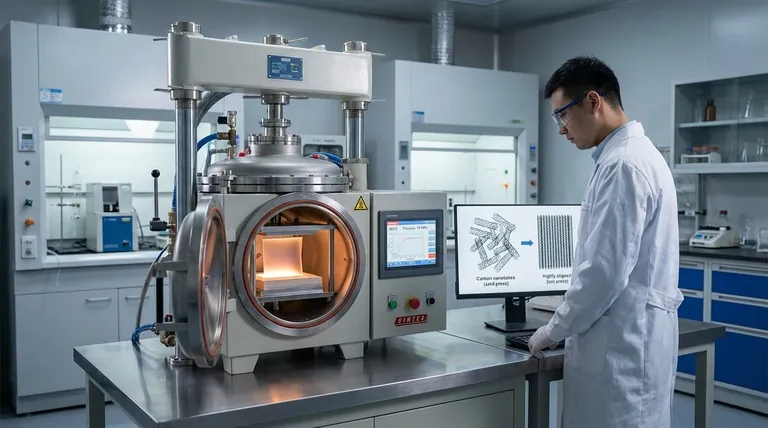
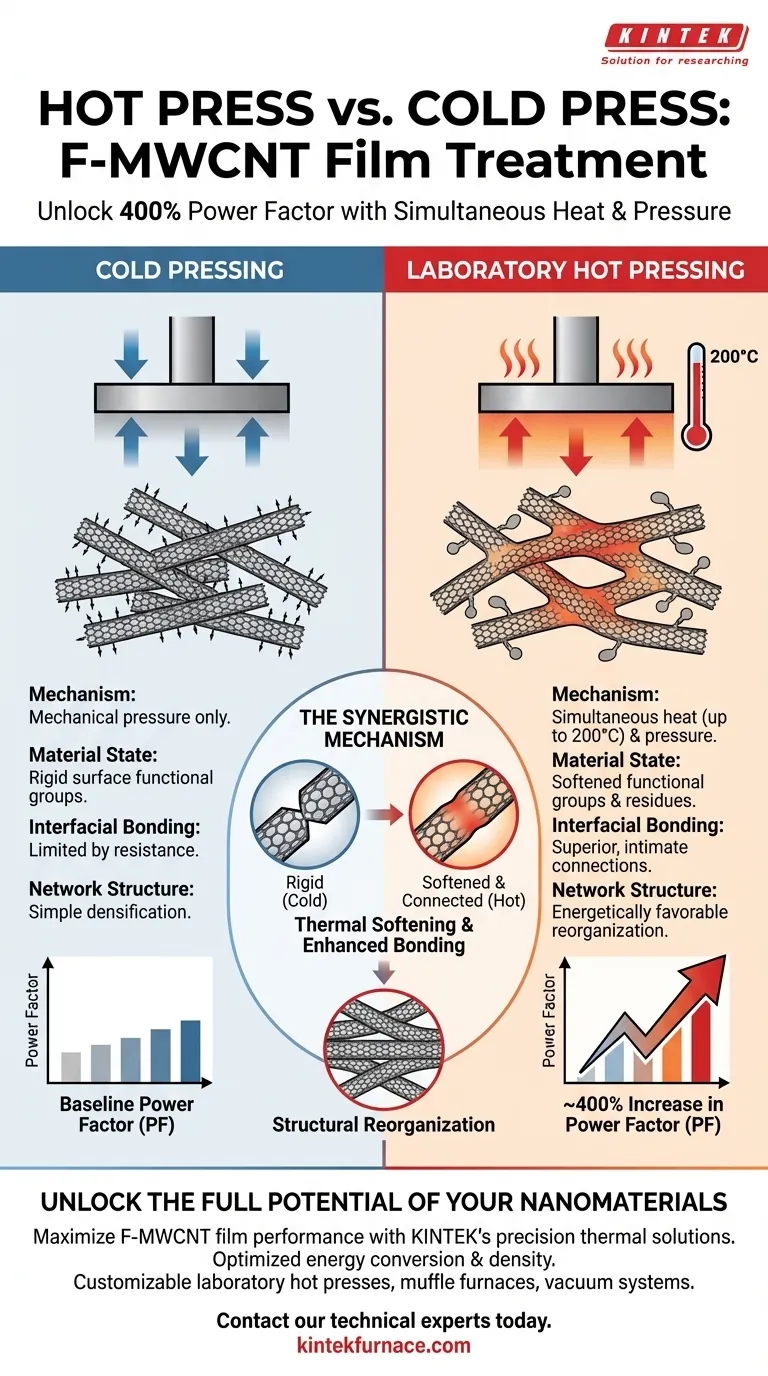
A laboratory hot press offers a decisive advantage over cold pressing by applying simultaneous thermal energy and mechanical pressure to the sample. While cold pressing relies solely on force to densify the material, adding a controlled thermal environment fundamentally alters how the functionalized multi-walled carbon nanotube (F-MWCNT) network organizes itself.
Core Takeaway: By integrating heat (up to 200°C) with mechanical pressure, you soften surface functional groups to create significantly tighter nanotube connections. This synergistic effect promotes structural reorganization and can increase the Power Factor (PF) of the films by approximately 400% compared to cold-pressed samples.
The Synergistic Mechanism of Heat and Pressure
Thermal Softening of Functional Groups
The primary limitation of cold pressing is that it works against the material's natural rigidity. In a hot press, the heat serves to soften the functional groups and residues located on the nanotube surfaces.
Enhancing Interfacial Bonding
When these surface groups soften, they become more malleable. This allows the mechanical pressure to force the nanotubes into tighter, more intimate connections than would be possible at room temperature. The result is superior interfacial bonding between the individual nanotubes.
Quantifiable Performance Gains
Structural Reorganization
The combination of heat and pressure does more than just compact the film; it drives a structural reorganization of the carbon nanotube network. The thermal energy allows the network to settle into a more energetically favorable, efficient configuration.
Significant Increase in Power Factor
The structural benefits translate directly into measurable performance metrics. Data indicates that this synchronized thermal and mechanical action boosts the Power Factor (PF) of the films by approximately 400% compared to samples that were only cold-pressed.
Understanding the Operational Parameters
Controlled Thermal Environment
The advantages of this method rely on precise temperature regulation. The process utilizes a controlled environment capable of reaching up to 200°C.
The Necessity of Synchronization
It is not enough to simply heat the sample before or after pressing. The simultaneity of the thermal and mechanical forces is the key factor that locks the structural reorganization into place, ensuring the performance gains are permanent.
Making the Right Choice for Your Goal
To maximize the efficiency of your F-MWCNT films, consider the following recommendations based on your performance targets:
- If your primary focus is maximizing energy conversion: Adopt a hot press workflow to capitalize on the potential 400% increase in Power Factor.
- If your primary focus is optimizing network density: Utilize the heating capabilities to soften residues, ensuring the tightest possible interfacial bonding between nanotubes.
Integrating simultaneous heat and pressure is the most effective method for unlocking the full electrical potential of functionalized nanotube networks.
Summary Table:
| Feature | Cold Pressing | Laboratory Hot Pressing |
|---|---|---|
| Mechanism | Mechanical pressure only | Simultaneous heat (up to 200°C) & pressure |
| Material State | Rigid surface functional groups | Softened functional groups & residues |
| Interfacial Bonding | Limited by material resistance | Superior, intimate nanotube connections |
| Network Structure | Simple densification | Energetically favorable reorganization |
| Power Factor (PF) | Baseline performance | ~400% Increase compared to cold press |
| Primary Outcome | Basic compaction | Optimized energy conversion & density |
Unlock the Full Potential of Your Nanomaterials
Maximize the performance of your F-MWCNT films with KINTEK’s precision thermal solutions. Backed by expert R&D and world-class manufacturing, KINTEK offers a comprehensive range of laboratory hot presses, muffle furnaces, and vacuum systems, all customizable to meet your specific research parameters. Whether you need to optimize interfacial bonding or achieve a 400% boost in Power Factor, our systems provide the synchronized control necessary for breakthrough results.
Ready to elevate your material science? Contact our technical experts today to find the perfect high-temp solution for your lab.
Visual Guide
References
- Nimra Naeem, Muhammad Farooq. Facile development of carbon nanotube (CNT)-based flexible thermoelectric materials for energy-harvesting applications. DOI: 10.1039/d4ra02914c
This article is also based on technical information from Kintek Furnace Knowledge Base .
Related Products
- Vacuum Hot Press Furnace Machine for Lamination and Heating
- Vacuum Hot Press Furnace Machine Heated Vacuum Press
- 600T Vacuum Induction Hot Press Vacuum Heat Treat and Sintering Furnace
- Vacuum Hot Press Furnace Machine Heated Vacuum Press Tube Furnace
- High Pressure Laboratory Vacuum Tube Furnace
People Also Ask
- What are the primary components of a vacuum hot press furnace? Master the Core Systems for Precise Material Processing
- What safety features are incorporated in vacuum hot press furnaces? Ensure Operator and Equipment Protection
- What are the benefits of the vacuum environment system in a vacuum hot press furnace? Unlock High-Density Sintering
- What industries benefit from the use of vacuum hot press furnaces? Unlock High-Performance Materials for Your Industry
- How does the uniaxial pressure applied by a vacuum hot press furnace affect the microstructure of ZrC-SiC materials?

















