
At their core, vacuum hot press furnaces offer transformative advantages over traditional furnaces by fundamentally changing the processing environment. By combining heat and pressure in a controlled vacuum, they eliminate atmospheric variables like oxygen, enabling the creation of materials with superior density, purity, and mechanical properties that are often unattainable with conventional methods.
The crucial difference is control. Traditional furnaces apply heat in an uncontrolled atmosphere, leading to contamination and imperfections. A vacuum hot press furnace provides a pristine, highly-regulated environment, allowing for the precise manipulation of a material's final structure and performance.
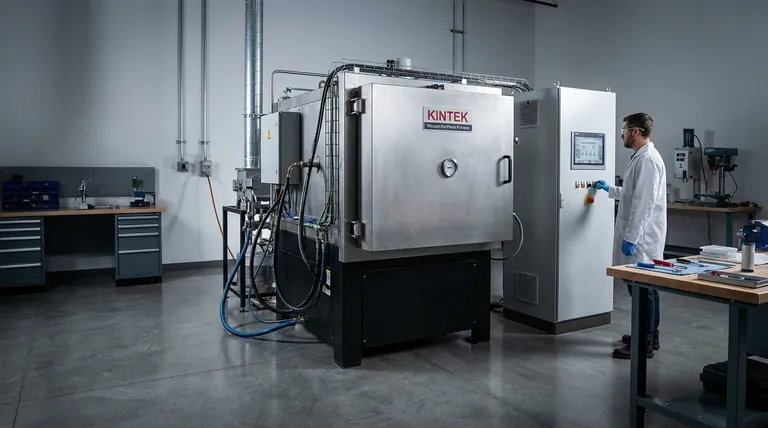
The Fundamental Advantage: Total Environmental Control
The defining feature of a vacuum furnace is its ability to remove the atmosphere from the heating chamber. This single change is the source of most of its key benefits.
Eliminating Oxidation and Contamination
In a traditional furnace, the ambient air—rich with oxygen, nitrogen, and moisture—reacts with the hot material. This causes oxidation, decarburization, and other unwanted chemical reactions that degrade the material's surface and integrity.
A vacuum furnace removes these reactive gases. This process creates a clean environment that results in a brighter, higher-purity final product without the need for post-processing to remove contaminated surface layers.
Removing Trapped Gases and Byproducts
The vacuum actively pulls volatile byproducts and trapped gases out of the material being processed. This degassing action during heating is critical for achieving a higher-purity product and preventing internal defects.
Superior Material Quality and Properties
By controlling the environment, vacuum hot press furnaces produce materials with demonstrably better characteristics. The simultaneous application of pressure further enhances these outcomes.
Achieving Maximum Density and Strength
The combination of a vacuum environment and applied pressure is exceptionally effective at reducing porosity. It physically compresses the material, eliminating internal voids and encouraging strong atomic bonds between grains.
This process, known as densification, results in materials that are significantly stronger and less prone to failure than those processed in traditional furnaces.
Enhancing Final Metallurgical Properties
Heat treatment in a vacuum prevents the formation of an oxide layer, which can interfere with processes like brazing or welding. It also minimizes distortion, leading to improved dimensional stability.
The result is enhanced metallurgical properties, including greater hardness, improved strength, and superior wear resistance, all achieved with high precision.
Unmatched Process Precision and Efficiency
Beyond material quality, vacuum furnaces offer significant operational advantages that lead to more reliable and efficient production.
Precise and Uniform Temperature Management
The vacuum environment and advanced insulation allow for extremely uniform heat distribution. This eliminates hot and cold spots within the chamber, ensuring the entire workpiece receives the exact same thermal treatment.
This level of temperature control, often managed within a few degrees, is critical for sensitive, high-performance materials.
Accelerated Cycle Times with Rapid Cooling
Many vacuum furnaces are equipped with systems for rapid cooling, or quenching. By backfilling the chamber with an inert gas like argon or nitrogen, the material can be cooled quickly and controllably.
This capability not only helps lock in desired metallurgical properties but also significantly shortens the overall process cycle time, increasing throughput.
Automated Control for Perfect Repeatability
Modern vacuum furnaces are computer-controlled, allowing for the automation of the entire heating and cooling cycle. This removes the potential for human error and guarantees that every run is identical.
This process repeatability is essential for industries like aerospace, medical, and electronics, where quality control and consistency are non-negotiable.
Understanding the Trade-offs
While the advantages are significant, vacuum technology is not the universal solution for every heating application. Objectivity requires acknowledging its specific context.
Higher Initial Cost and Complexity
Vacuum hot press furnaces are more complex machines than traditional box furnaces. The inclusion of vacuum pumps, seals, and sophisticated control systems results in a higher initial capital investment.
Increased Maintenance Requirements
The components that enable the furnace's high performance, particularly the vacuum system, require regular and specialized maintenance to ensure they operate correctly and prevent leaks.
Suitability for the Application
For simple applications like tempering low-carbon steel, where a small amount of surface oxidation is acceptable or easily removed, the expense and complexity of a vacuum furnace may not be justifiable. The choice of technology must match the demands of the material and the end goal.
Making the Right Choice for Your Goal
Selecting the right furnace technology depends entirely on the material requirements and production goals.
- If your primary focus is producing advanced materials with maximum density, purity, and strength: The controlled environment of a vacuum hot press furnace is essential.
- If your primary focus is high-volume, simple heat treatment where surface finish is not critical: A traditional atmosphere furnace can be a more cost-effective solution.
- If your primary focus is process repeatability and meeting stringent industry certifications (e.g., aerospace): The precision and computer control of a vacuum furnace are non-negotiable.
Ultimately, choosing a vacuum hot press furnace is an investment in achieving a level of material quality and process control that traditional methods simply cannot offer.
Summary Table:
| Advantage | Vacuum Hot Press Furnace | Traditional Furnace |
|---|---|---|
| Processing Environment | Controlled Vacuum | Ambient Air / Atmosphere |
| Oxidation & Contamination | Eliminated | High Risk |
| Final Material Density | Maximum (Near Theoretical) | Lower (Porosity Present) |
| Process Repeatability | High (Computer Controlled) | Variable |
| Ideal For | Advanced Materials, Aerospace, Medical | Simple Heat Treatment, High-Volume |
Ready to Achieve Superior Material Quality?
Leveraging exceptional R&D and in-house manufacturing, KINTEK provides diverse laboratories with advanced high-temperature furnace solutions. Our deep customization capabilities ensure our Vacuum & Atmosphere Furnaces and Hot Press Systems precisely meet your unique requirements for achieving maximum density, purity, and repeatable results.
Contact our experts today to discuss how a custom vacuum furnace solution can transform your material processing.
Visual Guide

Related Products
- Vacuum Hot Press Furnace Machine for Lamination and Heating
- 600T Vacuum Induction Hot Press Vacuum Heat Treat and Sintering Furnace
- Vacuum Hot Press Furnace Machine Heated Vacuum Press Tube Furnace
- Vacuum Hot Press Furnace Machine Heated Vacuum Press
- High Pressure Laboratory Vacuum Tube Furnace
People Also Ask
- What are the primary components of a vacuum hot press furnace? Master the Core Systems for Precise Material Processing
- What safety features are incorporated in vacuum hot press furnaces? Ensure Operator and Equipment Protection
- What are the benefits of the vacuum environment system in a vacuum hot press furnace? Unlock High-Density Sintering
- What industries benefit from the use of vacuum hot press furnaces? Unlock High-Performance Materials for Your Industry
- Why is a high vacuum environment crucial when preparing copper-carbon nanotube composites in a vacuum hot press furnace? Achieve Superior Composite Integrity



















