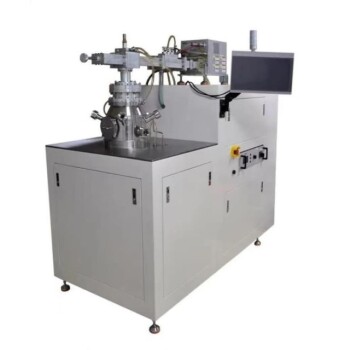
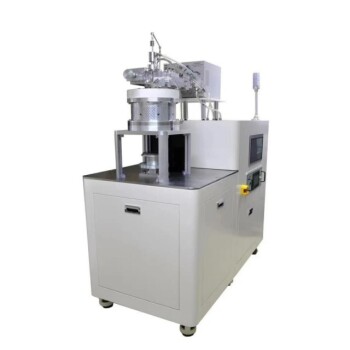
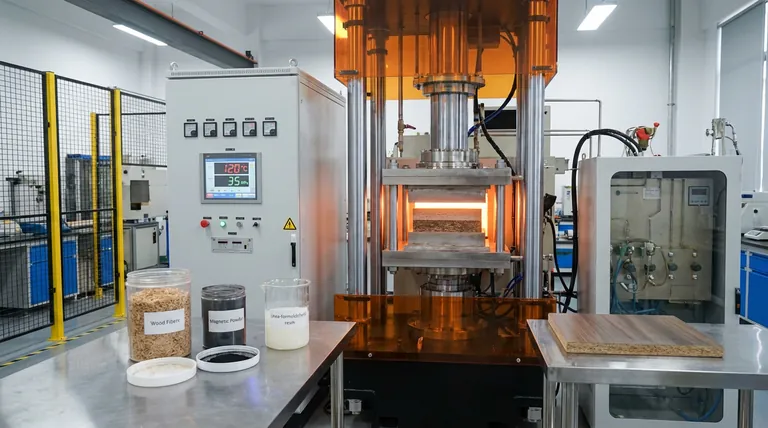
A high-performance laboratory hot press machine serves as the definitive catalyst in the creation of wood-based magnetic composite materials. By applying a sustained pressure of 35 MPa at a precise temperature of 120°C for 30 minutes, it triggers the essential chemical and physical changes required to transform loose components into a high-strength, functional particleboard.
The hot press does more than shape the material; it fundamentally alters its structure. By driving the cross-linking of resin and eliminating porosity, it ensures magnetic nanoparticles are permanently encapsulated to guarantee physical stability and hardness.
Driving the Chemical Transformation
Initiating Resin Cross-Linking
The primary role of the hot press is to activate the urea-formaldehyde resin distributed throughout the composite.
The machine creates the thermal environment necessary to trigger a cross-linking reaction. This chemical process transforms the liquid or semi-solid resin into a rigid, cured state, acting as the glue that binds the wood fibers together.
The Critical Process Parameters
Achieving a successful cure is not just about applying heat; it requires a precise combination of variables.
The process demands a constant temperature of 120°C and a high pressure of 35 MPa. These conditions must be maintained strictly for a duration of 30 minutes to ensure the reaction permeates the entire material volume.
Structural Integrity and Performance
Locking in Magnetic Properties
A unique challenge of this composite is retaining the magnetic nanoparticles within the wood fiber matrix.
The hot press ensures these particles are firmly "locked" in place. By curing the resin under high pressure, the machine prevents particle migration, ensuring uniform magnetic capabilities throughout the finished board.
Eliminating Internal Defects
The application of 35 MPa of pressure serves a vital structural function: densification.
This extreme pressure collapses and eliminates internal pores that naturally exist between wood fibers. Removing these voids is essential for providing the particleboard with the necessary hardness and internal bonding strength.
Understanding the Process Criticality
The Risk of Insufficient Pressure
If the pressure drops below the required 35 MPa, the composite is likely to retain internal air gaps.
This porosity leads to weak internal bonding and reduced physical stability. The high-performance nature of the press is specifically required to deliver the force needed to fully densify the wood-fiber matrix.
The Role of Time in Curing
The 30-minute duration is critical for the thermal lag and reaction kinetics.
Heat takes time to transfer from the press platens to the core of the material. Cutting this time short risks an incomplete cure in the center of the board, leading to a product that may look finished on the outside but lacks structural integrity on the inside.
Making the Right Choice for Your Goal
To maximize the quality of your wood-based magnetic composites, you must prioritize specific control parameters based on your desired outcome:
- If your primary focus is mechanical hardness: Prioritize the maintenance of 35 MPa pressure to fully eliminate internal pores and densify the wood fiber matrix.
- If your primary focus is composite stability: Ensure the 120°C temperature is held constant for the full 30 minutes to guarantee complete cross-linking of the urea-formaldehyde resin.
precision in the hot press cycle is the difference between a loose mixture of fibers and a high-performance magnetic composite.
Summary Table:
| Process Parameter | Required Value | Role in Curing Process |
|---|---|---|
| Temperature | 120°C | Activates urea-formaldehyde resin cross-linking |
| Pressure | 35 MPa | Eliminates internal porosity and densifies fibers |
| Duration | 30 Minutes | Ensures thermal penetration and complete chemical reaction |
| Core Outcome | Structural Integrity | Permanent encapsulation of magnetic nanoparticles |
Elevate Your Composite Material Research with KINTEK
Precision is the difference between a loose mixture and a high-performance material. Backed by expert R&D and manufacturing, KINTEK offers high-performance laboratory hot presses, Muffle, Tube, and Vacuum systems—all customizable to meet your unique research needs. Whether you are curing magnetic composites or developing advanced materials, our equipment ensures the exact pressure and temperature control required for success.
Ready to optimize your curing process? Contact KINTEK today to discuss your project requirements!
References
- Róger Moya, Karla J. Merazzo. Magnetic and Physical-Mechanical Properties of Wood Particleboards Composite (MWPC) Fabricated with FE3o4 Nanoparticles and Three Plantation Wood. DOI: 10.22382/wfs-2023-19
This article is also based on technical information from Kintek Furnace Knowledge Base .
Related Products
- Vacuum Hot Press Furnace Machine for Lamination and Heating
- Vacuum Hot Press Furnace Machine Heated Vacuum Press
- Vacuum Hot Press Furnace Machine Heated Vacuum Press Tube Furnace
- 600T Vacuum Induction Hot Press Vacuum Heat Treat and Sintering Furnace
- High Pressure Laboratory Vacuum Tube Furnace
People Also Ask
- What are the primary components of a vacuum hot press furnace? Master the Core Systems for Precise Material Processing
- What are the benefits of the vacuum environment system in a vacuum hot press furnace? Unlock High-Density Sintering
- What safety features are incorporated in vacuum hot press furnaces? Ensure Operator and Equipment Protection
- What industries benefit from the use of vacuum hot press furnaces? Unlock High-Performance Materials for Your Industry
- Which process parameters must be optimized for specific materials in a vacuum hot press furnace? Achieve Optimal Density and Microstructure