
Multi-stage pressure regulation is required to accommodate the drastic physical changes aluminum undergoes during the sintering cycle. While high pressure is necessary to bond solid layers initially, pressure must be significantly reduced once the temperature exceeds the melting point of aluminum (approximately 665°C) to prevent the liquid metal from being squeezed out of the composite structure.
This regulation acts as a critical control mechanism for reaction stoichiometry. It balances the mechanical force needed for densification against the delicate containment required during the liquid phase, ensuring the final material retains the correct chemical composition.
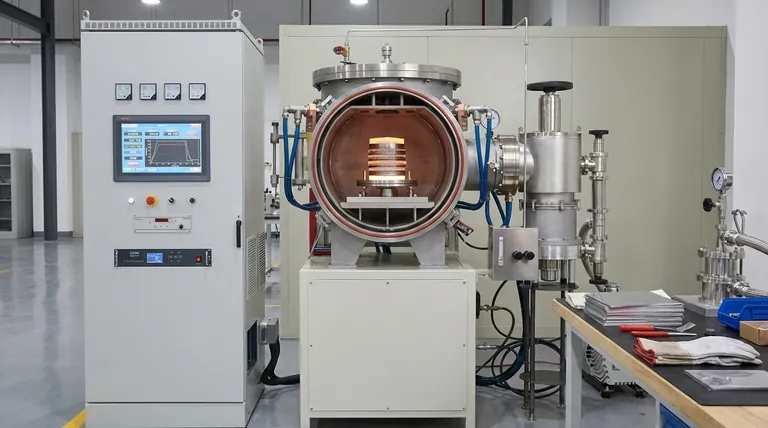
The Dual-Stage Sintering Logic
To understand the need for variable pressure, one must look at the physical state of the materials at different points in the heating curve. The process is divided into two distinct phases with opposing requirements.
Stage 1: Solid-Phase Diffusion (Low Temperature)
In the initial stage, both Titanium and Aluminum exist as solids. The primary goal here is to establish physical contact and initiate atomic diffusion.
High pressure (e.g., 3.8 MPa) is applied during this phase.
This mechanical force eliminates microscopic gaps between the stacked foils. It shortens the distance atoms must travel, driving the initial bonding between the Titanium and Aluminum layers before melting occurs.
Stage 2: Liquid-Phase Reaction (High Temperature)
As the temperature rises above 665°C, aluminum transitions from solid to liquid. This creates a risk of material loss.
Low pressure (e.g., 0.5 MPa) is mandated during this phase.
If high pressure were maintained while the aluminum is liquid, the molten metal would be mechanically squeezed out from between the Titanium layers. Reducing the pressure creates a containment environment, keeping the liquid aluminum inside the matrix so it can react properly to form the desired aluminides (Al3Ti).
The Role of the Vacuum Environment
While pressure regulation manages density and stoichiometry, the vacuum environment ensures the chemical integrity of the bond.
Eliminating Oxidation Barriers
Titanium and Aluminum have a high affinity for oxygen. Even trace amounts of oxygen can form brittle oxide layers on the foil surfaces.
These oxide layers act as barriers that hinder atomic diffusion. The high vacuum environment prevents these films from forming, ensuring a "clean" metal-to-metal interface for optimal bonding.
Preventing Gas Defects
Before the layers are compressed by the multi-stage pressure, gas pockets may exist between the sheets.
The vacuum aids in exhausting these residual gases. This prevents the formation of internal pores, ensuring the final composite achieves high density and structural integrity.
Risks of Improper Pressure Regulation
Failing to adjust pressure dynamically creates distinct failure modes depending on the stage of the error.
The Consequence of Constant High Pressure
If the operator fails to drop the pressure during the high-temperature phase, the liquid aluminum is ejected.
This alters the reaction stoichiometry, leaving insufficient aluminum to react with the titanium. The result is a composite with incorrect phase composition and unpredictable mechanical properties.
The Consequence of Insufficient Initial Pressure
If the pressure is too low during the solid phase, the layers will not achieve sufficient contact.
This results in delamination or weak bonding. Without the initial mechanical compression, the atomic diffusion channels are never established, and the final material will likely suffer from macroscopic defects.
Making the Right Choice for Your Goal
Successful sintering of Ti-Al3Ti composites depends on precise timing relative to the melting point of the constituent metals.
- If your primary focus is Interfacial Bonding: Ensure high pressure (approx. 3.8 MPa) is applied early to force intimate contact between solid foils.
- If your primary focus is Chemical Accuracy: strictly monitor the 665°C threshold and reduce pressure (to approx. 0.5 MPa) immediately to retain liquid aluminum.
- If your primary focus is Dimensional Stability: Maintain a holding pressure during the cooling phase (below 300°C) to prevent spring-back and thermal cracking.
Mastering this pressure profile transforms the volatile liquid phase from a manufacturing liability into a mechanism for creating a flawless, high-density composite.
Summary Table:
| Sintering Stage | Material State | Pressure Level | Primary Objective |
|---|---|---|---|
| Stage 1: Solid-Phase | Solid Ti & Al | High (e.g., 3.8 MPa) | Drive atomic diffusion & eliminate gaps |
| Stage 2: Liquid-Phase | Liquid Al (>665°C) | Low (e.g., 0.5 MPa) | Contain molten metal & ensure stoichiometry |
| Stage 3: Cooling | Solid Composite | Holding Pressure | Prevent spring-back & thermal cracking |
Achieve Precision in Advanced Material Synthesis with KINTEK
Mastering the delicate balance of temperature and pressure is critical for successful Ti-Al3Ti laminate production. Backed by expert R&D and world-class manufacturing, KINTEK offers high-performance Vacuum Hot Press systems, Muffle, Tube, Rotary, and CVD furnaces—all fully customizable to handle complex multi-stage cycles.
Whether you are scaling up production or conducting specialized research, our systems provide the precise control needed to prevent material loss and ensure chemical integrity. Contact us today to discuss your unique needs and see how our lab high-temp solutions can elevate your material performance.
Visual Guide

Related Products
- Vacuum Hot Press Furnace Machine for Lamination and Heating
- 600T Vacuum Induction Hot Press Vacuum Heat Treat and Sintering Furnace
- Vacuum Hot Press Furnace Machine Heated Vacuum Press Tube Furnace
- Vacuum Hot Press Furnace Machine Heated Vacuum Press
- High Pressure Laboratory Vacuum Tube Furnace
People Also Ask
- What are the primary components of a vacuum hot press furnace? Master the Core Systems for Precise Material Processing
- What safety features are incorporated in vacuum hot press furnaces? Ensure Operator and Equipment Protection
- What are the benefits of the vacuum environment system in a vacuum hot press furnace? Unlock High-Density Sintering
- What industries benefit from the use of vacuum hot press furnaces? Unlock High-Performance Materials for Your Industry
- What is a vacuum hot press furnace? Unlock Superior Material Performance



















