
Uniaxial pressure functions as a critical mechanical catalyst that accelerates the sintering process beyond what thermal energy alone can achieve. In a carbon tube vacuum hot press furnace, this pressure physically forces ceramic particles together, effectively lowering the required temperature for densification and enabling the removal of microscopic voids that would otherwise destroy optical transparency.
Core Takeaway The application of uniaxial pressure solves the fundamental conflict in ceramic processing: achieving near-theoretical density without using excessive heat. By mechanically driving densification, you can eliminate light-scattering pores while maintaining a fine grain structure, a balance that is virtually impossible to achieve with pressureless sintering alone.
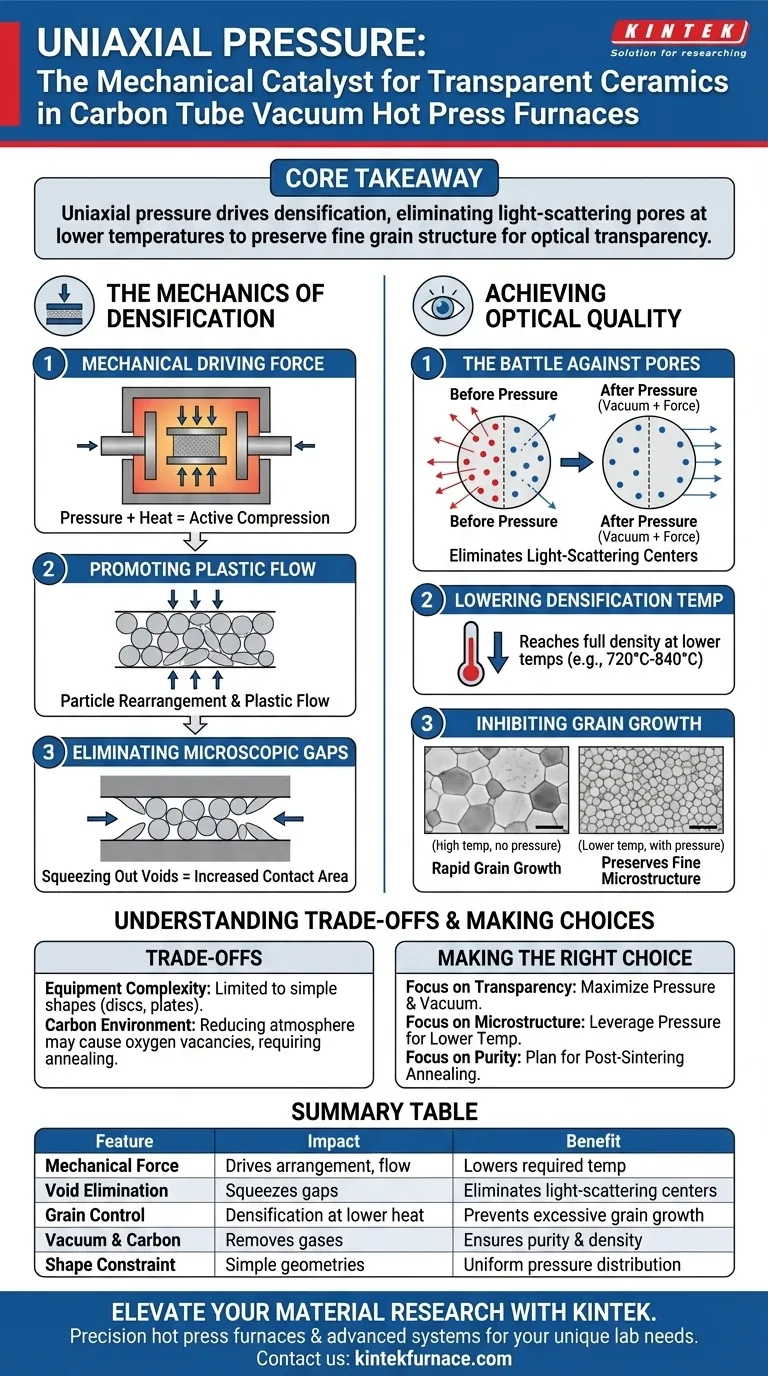
The Mechanics of Densification
The Mechanical Driving Force
In standard sintering, heat acts as the primary energy source to fuse particles. In a vacuum hot press furnace, uniaxial pressure provides an additional mechanical driving force. This force supplements the thermal energy, actively compressing the material rather than relying solely on atomic diffusion.
Promoting Plastic Flow
The applied pressure induces plastic flow and particle rearrangement within the ceramic powder. This means individual particles are physically shifted and deformed to fit closer together, effectively interlocking the microstructure.
Eliminating Microscopic Gaps
By forcing this microscopic deformation, the pressure effectively squeezes out internal voids. This significantly increases the effective contact area, allowing for faster and more complete bonding between particles.
Achieving Optical Quality
The Battle Against Pores
For a ceramic to be transparent, it must be virtually free of porosity; even tiny pores act as light-scattering centers, rendering the material opaque. The combination of high vacuum (to remove interstitial gases) and mechanical pressure (to close voids) is the core method for eliminating these residual pores.
Lowering the Densification Temperature
Perhaps the most significant role of pressure is that it lowers the temperature required to reach full density. Because mechanical force is doing part of the work, the ceramic creates a dense "green body" at temperatures significantly lower (e.g., 720°C-840°C for certain materials) than those required in pressureless sintering.
Inhibiting Grain Growth
There is a direct link between temperature and grain size: higher temperatures usually lead to rapid, uncontrolled grain growth. By allowing for sintering at lower temperatures, uniaxial pressure inhibits excessive grain growth. This preserves the fine microstructure necessary for superior mechanical strength and optical clarity.
Understanding the Trade-offs
Equipment Complexity and Throughput
While effective, introducing uniaxial pressure limits the geometry of the parts you can produce. Unlike pressureless sintering, which can handle complex shapes, hot pressing is generally restricted to simple shapes like discs or plates due to the constraints of the mold and the direction of the force.
The Carbon Environment
The "Carbon Tube" aspect of the furnace introduces a reducing atmosphere. While the pressure achieves density, the vacuum and carbon environment can strip oxygen from the lattice, creating oxygen vacancies or color centers.
- Note: This often necessitates a post-processing step (annealing in an air atmosphere) to re-oxidize the material and restore full transparency.
Making the Right Choice for Your Goal
To maximize the effectiveness of your sintering process, consider your specific endpoints:
- If your primary focus is Optical Transparency: Prioritize high pressure and vacuum levels to eliminate all residual pores and light-scattering centers.
- If your primary focus is Microstructural Control: Leverage the pressure to reduce maximum sintering temperatures, ensuring grains remain small and uniform.
- If your primary focus is Material Purity: Be prepared to anneal your samples post-sintering to correct oxygen deficiencies caused by the vacuum-carbon environment.
Uniaxial pressure is not just a compaction tool; it is the lever that allows you to decouple density from temperature, granting you precise control over the optical properties of your final ceramic.
Summary Table:
| Feature | Impact on Transparent Ceramics | Benefit |
|---|---|---|
| Mechanical Force | Drives particle rearrangement and plastic flow | Lowers required sintering temperature |
| Void Elimination | Squeezes out microscopic internal gaps | Eliminates light-scattering centers |
| Grain Control | Enables densification at lower heat | Prevents excessive grain growth |
| Vacuum & Carbon | Removes interstitial gases/reduces atmosphere | Ensures material purity and density |
| Shape Constraint | Restricted to discs/plates/simple geometries | Uniform pressure distribution |
Elevate Your Material Research with KINTEK
Precision in pressure and temperature is the key to mastering optical transparency. Backed by expert R&D and world-class manufacturing, KINTEK offers high-performance Muffle, Tube, Rotary, Vacuum, and CVD systems, including advanced hot press furnaces fully customizable for your unique laboratory needs.
Whether you are aiming for near-theoretical density or precise microstructural control, our engineering team provides the specialized tools to help you succeed. Contact us today to find the perfect high-temp solution for your lab!
Visual Guide
Related Products
- Vacuum Hot Press Furnace Machine Heated Vacuum Press Tube Furnace
- High Pressure Laboratory Vacuum Tube Furnace
- 600T Vacuum Induction Hot Press Vacuum Heat Treat and Sintering Furnace
- Vacuum Hot Press Furnace Machine for Lamination and Heating
- Vacuum Hot Press Furnace Machine Heated Vacuum Press
People Also Ask
- Why use Vacuum Hot Press (VHP) for ZnS Ceramics? Achieve Superior IR Transparency and Mechanical Strength
- What are the benefits of the vacuum environment system in a vacuum hot press furnace? Unlock High-Density Sintering
- What safety features are incorporated in vacuum hot press furnaces? Ensure Operator and Equipment Protection
- How does the uniaxial pressure applied by a vacuum hot press furnace affect the microstructure of ZrC-SiC materials?
- How does a vacuum hot press furnace promote densification in the manufacturing of graphite flake/copper composites? Achieve Superior Composite Materials



















