Knowledge What is the primary function of a vacuum hot press furnace in the preparation of Fe-based amorphous alloy/aluminum microlaminated composites? Achieve Perfect Solid-State Bonding
Author avatar

Tech Team · Kintek Furnace

Updated 1 day ago

What is the primary function of a vacuum hot press furnace in the preparation of Fe-based amorphous alloy/aluminum microlaminated composites? Achieve Perfect Solid-State Bonding


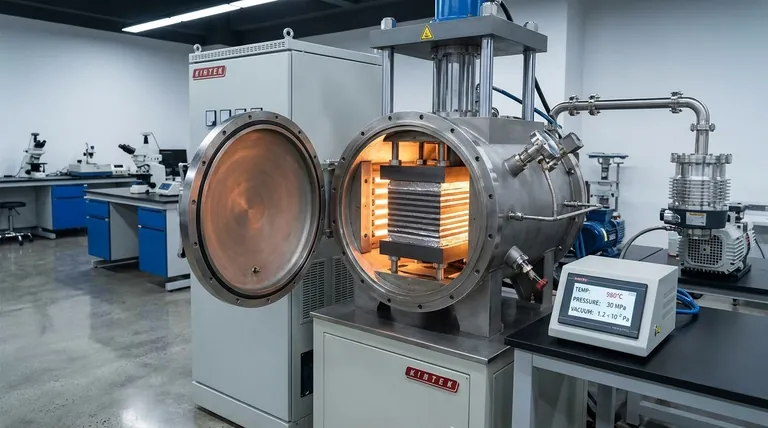
The vacuum hot press furnace serves as the fundamental integration tool for preparing Fe-based amorphous alloy/aluminum microlaminated composites. It provides a controlled environment that simultaneously applies thermal activation and mechanical pressure within a high-vacuum chamber. This combination is essential to achieve solid-state metallurgical bonding, prevent the rapid oxidation of aluminum, and ensure the complete densification of the composite layers.

The core value of this equipment lies in its ability to overcome the natural barriers to bonding between Iron and Aluminum. By removing oxygen and applying pressure-assisted heat, it forces atoms to diffuse across layers, creating a unified, high-strength structural material without melting the components.
What is the primary function of a vacuum hot press furnace in the preparation of Fe-based amorphous alloy/aluminum microlaminated composites? Achieve Perfect Solid-State Bonding

The Mechanics of Composite Formation

Preventing Oxidation Barriers

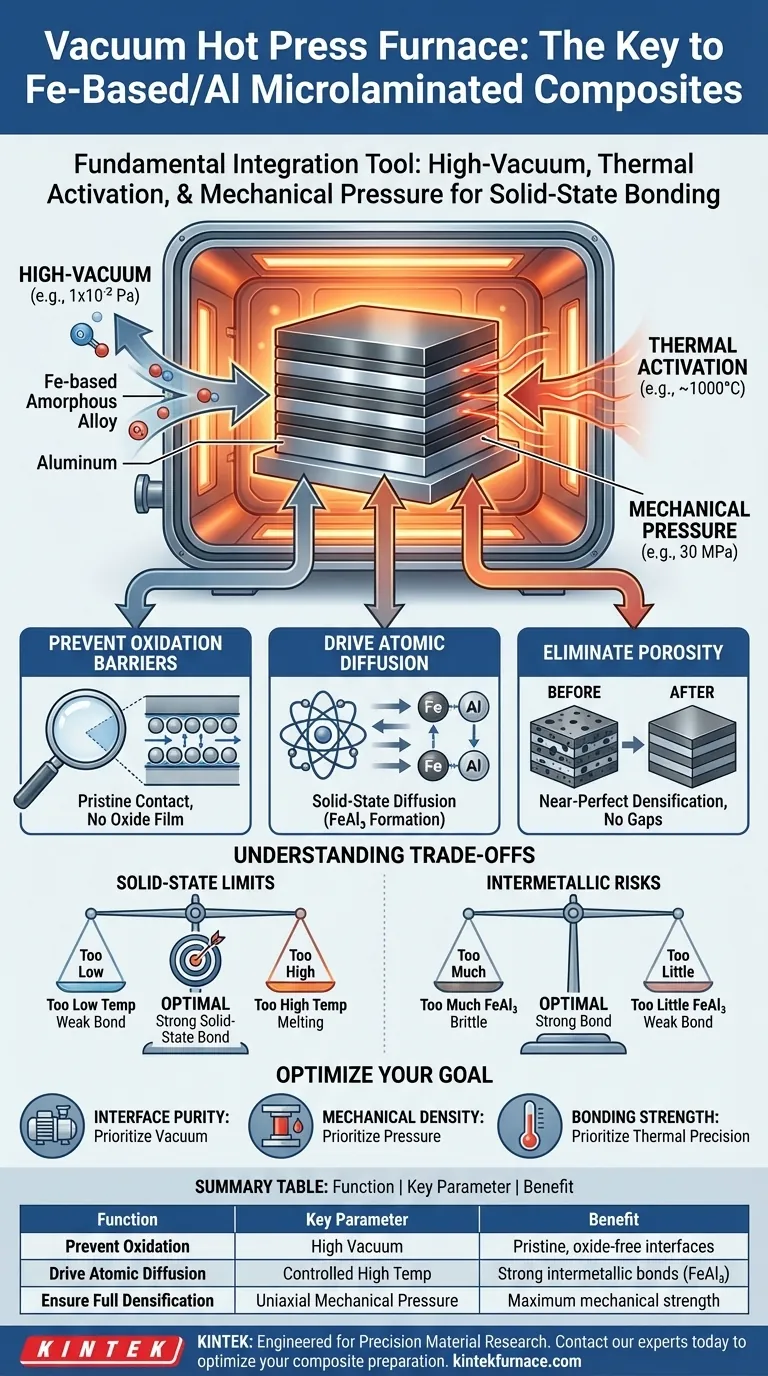
The presence of oxygen is the primary enemy of Aluminum bonding. Aluminum naturally forms a tough oxide film that acts as a barrier to atomic interaction. The furnace creates a high-vacuum environment (e.g., $1 \times 10^{-2}$ Pa) to prevent these oxide films from forming. This ensures a pristine contact interface, maintaining open channels for elemental diffusion between the amorphous alloy and aluminum layers.

Driving Atomic Diffusion

Merely pressing layers together is insufficient for structural integrity; the materials must bond at an atomic level. The furnace uses thermal activation (e.g., temperatures around 1000°C, depending on the specific alloy) to stimulate the movement of iron and aluminum atoms. This promotes solid-state diffusion, leading to the formation of controlled intermetallic compounds like $FeAl_3$, which are responsible for the high-strength metallurgical bond.

Eliminating Porosity

Gaps and voids between layers severely compromise the mechanical strength of a composite. The furnace applies uniaxial mechanical pressure (e.g., 30 MPa) to the material stack. This pressure forces plastic deformation and rearrangement of the materials, effectively squeezing out gas pockets and closing interlayer pores to achieve near-perfect densification.

Understanding the Trade-offs

Solid-State Limits vs. Bonding Quality

While high temperature aids diffusion, the process must remain a solid-state reaction. If the temperature is too low, diffusion is sluggish, and the bond will be weak. However, if the temperature is too high, you risk melting the aluminum or altering the properties of the Fe-based amorphous alloy. The furnace allows for precise thermal control to hit this narrow window.

Intermetallic Formation Risks

The formation of compounds like $FeAl_3$ is necessary for bonding, but an over-abundance can be detrimental. Thick layers of intermetallics can introduce brittleness to the composite. The vacuum hot press process requires careful calibration of time and temperature to ensure enough diffusion for adhesion, but not so much that the interface becomes brittle.

Making the Right Choice for Your Goal

To optimize the preparation of your Fe-based/Aluminum composites, consider these operational priorities:

  • If your primary focus is Interface Purity: Prioritize the vacuum capabilities of the furnace; a higher vacuum level is non-negotiable to strip away adsorbed moisture and prevent oxide barriers.
  • If your primary focus is Mechanical Density: Focus on the hydraulic pressure capacity; higher pressure is required to facilitate plastic deformation and eliminate microscopic pores at the interface.
  • If your primary focus is Bonding Strength: Concentrate on thermal precision; you must maintain temperatures that maximize atomic diffusion ($FeAl_3$ formation) without crossing into liquid-phase reactions.

Mastering the vacuum hot press parameters transforms incompatible distinct layers into a single, high-performance engineering material.

Summary Table:

Function Key Parameter Benefit
Prevent Oxidation High Vacuum (e.g., 1x10⁻² Pa) Creates pristine, oxide-free bonding interfaces
Drive Atomic Diffusion Controlled High Temperature (e.g., ~1000°C) Promotes formation of strong intermetallic bonds (e.g., FeAl₃)
Ensure Full Densification Uniaxial Mechanical Pressure (e.g., 30 MPa) Eliminates porosity for maximum mechanical strength

Ready to transform your material research with precision-controlled solid-state bonding?

Our vacuum hot press furnaces are engineered to deliver the exact combination of high vacuum, precise temperature control, and uniform pressure required for creating high-performance microlaminated composites like Fe-based amorphous alloy/aluminum. Backed by expert R&D and manufacturing, KINTEK offers Muffle, Tube, Rotary, Vacuum, CVD systems, and other lab high-temp furnaces, all customizable for unique needs.

Contact our experts today to discuss how a KINTEK vacuum hot press furnace can be optimized for your specific composite preparation goals.

Visual Guide
What is the primary function of a vacuum hot press furnace in the preparation of Fe-based amorphous alloy/aluminum microlaminated composites? Achieve Perfect Solid-State Bonding Visual Guide

Related Products

People Also Ask

Related Products

2200 ℃ Tungsten Vacuum Heat Treat and Sintering Furnace

2200 ℃ Tungsten Vacuum Heat Treat and Sintering Furnace

2200°C Tungsten Vacuum Furnace for high-temperature materials processing. Precise control, superior vacuum, customizable solutions. Ideal for research & industrial applications.

Vacuum Heat Treat Furnace with Ceramic Fiber Liner

Vacuum Heat Treat Furnace with Ceramic Fiber Liner

KINTEK's Vacuum Furnace with Ceramic Fiber Lining offers precise high-temperature processing up to 1700°C, ensuring uniform heat distribution and energy efficiency. Ideal for labs and production.

600T Vacuum Induction Hot Press Vacuum Heat Treat and Sintering Furnace

600T Vacuum Induction Hot Press Vacuum Heat Treat and Sintering Furnace

600T Vacuum Induction Hot Press Furnace for precise sintering. Advanced 600T pressure, 2200°C heating, vacuum/atmosphere control. Ideal for research & production.

High Pressure Laboratory Vacuum Tube Furnace Quartz Tubular Furnace

High Pressure Laboratory Vacuum Tube Furnace Quartz Tubular Furnace

KINTEK High Pressure Tube Furnace: Precision heating up to 1100°C with 15Mpa pressure control. Ideal for sintering, crystal growth, and lab research. Customizable solutions available.

Vacuum Heat Treat Sintering Furnace with Pressure for Vacuum Sintering

Vacuum Heat Treat Sintering Furnace with Pressure for Vacuum Sintering

KINTEK's Vacuum Pressure Sintering Furnace offers 2100℃ precision for ceramics, metals, and composites. Customizable, high-performance, and contamination-free. Get a quote now!

2200 ℃ Graphite Vacuum Heat Treat Furnace

2200 ℃ Graphite Vacuum Heat Treat Furnace

2200℃ Graphite Vacuum Furnace for high-temperature sintering. Precise PID control, 6*10⁻³Pa vacuum, durable graphite heating. Ideal for research & production.

1700℃ High Temperature Laboratory Tube Furnace with Quartz or Alumina Tube

1700℃ High Temperature Laboratory Tube Furnace with Quartz or Alumina Tube

KINTEK's Tube Furnace with Alumina Tube: Precision heating up to 1700°C for material synthesis, CVD, and sintering. Compact, customizable, and vacuum-ready. Explore now!

9MPa Air Pressure Vacuum Heat Treat and Sintering Furnace

9MPa Air Pressure Vacuum Heat Treat and Sintering Furnace

Achieve superior ceramic densification with KINTEK's advanced air pressure sintering furnace. High-pressure up to 9MPa, precise 2200℃ control.

Vacuum Heat Treat Sintering and Brazing Furnace

Vacuum Heat Treat Sintering and Brazing Furnace

KINTEK Vacuum Brazing Furnaces deliver precision, clean joints with superior temperature control. Customizable for diverse metals, ideal for aerospace, medical, and thermal applications. Get a quote!

Vacuum Heat Treat Sintering Furnace Molybdenum Wire Vacuum Sintering Furnace

Vacuum Heat Treat Sintering Furnace Molybdenum Wire Vacuum Sintering Furnace

KINTEK's Vacuum Molybdenum Wire Sintering Furnace excels in high-temperature, high-vacuum processes for sintering, annealing, and material research. Achieve precise 1700°C heating with uniform results. Custom solutions available.

1700℃ High Temperature Muffle Oven Furnace for Laboratory

1700℃ High Temperature Muffle Oven Furnace for Laboratory

KT-17M Muffle Furnace: High-precision 1700°C lab furnace with PID control, energy efficiency, and customizable sizes for industrial & research applications.

1400℃ Muffle Oven Furnace for Laboratory

1400℃ Muffle Oven Furnace for Laboratory

KT-14M Muffle Furnace: Precision 1400°C heating with SiC elements, PID control, and energy-efficient design. Ideal for labs.

Small Vacuum Heat Treat and Tungsten Wire Sintering Furnace

Small Vacuum Heat Treat and Tungsten Wire Sintering Furnace

Compact vacuum tungsten wire sintering furnace for labs. Precise, mobile design with superior vacuum integrity. Ideal for advanced material research. Contact us!

1400℃ High Temperature Laboratory Tube Furnace with Quartz and Alumina Tube

1400℃ High Temperature Laboratory Tube Furnace with Quartz and Alumina Tube

KINTEK's Tube Furnace with Alumina Tube: Precision high-temperature processing up to 2000°C for labs. Ideal for material synthesis, CVD, and sintering. Customizable options available.

Laboratory Muffle Oven Furnace with Bottom Lifting

Laboratory Muffle Oven Furnace with Bottom Lifting

Boost lab efficiency with KT-BL Bottom Lifting Furnace: precise 1600℃ control, superior uniformity, and enhanced productivity for material science and R&D.

High Temperature Muffle Oven Furnace for Laboratory Debinding and Pre Sintering

High Temperature Muffle Oven Furnace for Laboratory Debinding and Pre Sintering

KT-MD Debinding & Pre-Sintering Furnace for ceramics - precise temperature control, energy-efficient design, customizable sizes. Boost your lab efficiency today!

1400℃ Controlled Inert Nitrogen Atmosphere Furnace

1400℃ Controlled Inert Nitrogen Atmosphere Furnace

KT-14A Controlled Atmosphere Furnace for labs & industry. 1400°C max temp, vacuum sealing, inert gas control. Customizable solutions available.

Mesh Belt Controlled Atmosphere Furnace Inert Nitrogen Atmosphere Furnace

Mesh Belt Controlled Atmosphere Furnace Inert Nitrogen Atmosphere Furnace

KINTEK Mesh Belt Furnace: High-performance controlled atmosphere furnace for sintering, hardening & heat treatment. Customizable, energy-efficient, precise temperature control. Get a quote now!

Multi Heating Zones CVD Tube Furnace Machine for Chemical Vapor Deposition Equipment

Multi Heating Zones CVD Tube Furnace Machine for Chemical Vapor Deposition Equipment

KINTEK's Multi-Zone CVD Tube Furnaces offer precision temperature control for advanced thin film deposition. Ideal for research and production, customizable for your lab needs.

Laboratory Quartz Tube Furnace RTP Heating Tubular Furnace

Laboratory Quartz Tube Furnace RTP Heating Tubular Furnace

KINTEK's RTP Rapid Heating Tube Furnace delivers precise temperature control, rapid heating up to 100°C/sec, and versatile atmosphere options for advanced lab applications.


Leave Your Message


















