
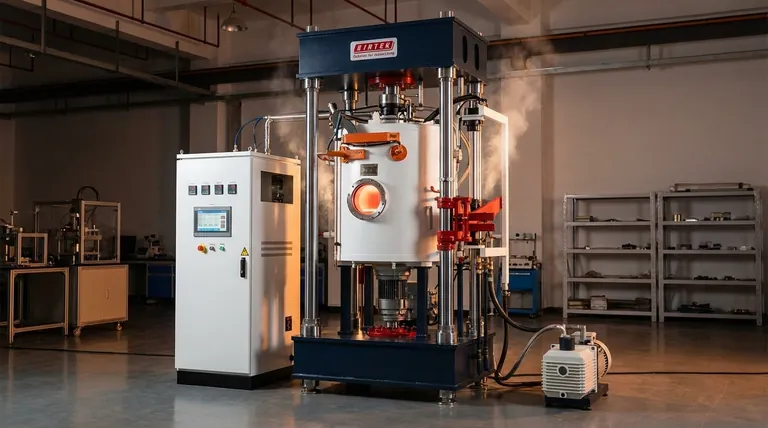
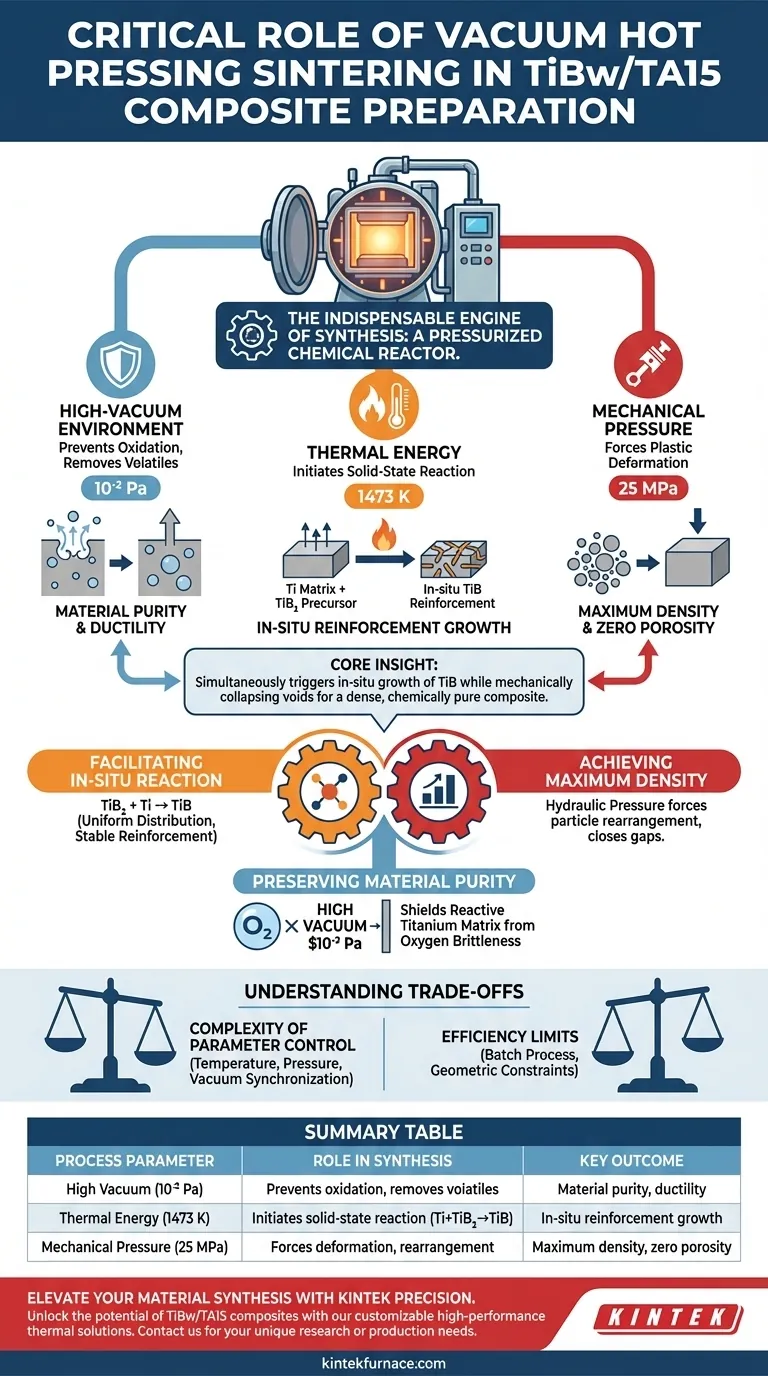
The vacuum hot pressing sintering furnace is the indispensable processing engine for creating in-situ synthesized TiBw/TA15 composites. It serves a triple function: it creates a high-vacuum environment (approx. $10^{-2}$ Pa) to prevent oxidation, applies thermal energy (1473 K) to drive chemical reactions, and exerts mechanical pressure (25 MPa) to force physical densification.
Core Insight: The furnace does not merely heat the material; it acts as a pressurized chemical reactor. Its primary value lies in its ability to simultaneously trigger the in-situ growth of TiB reinforcement phases while mechanically collapsing voids, ensuring the final composite is both chemically pure and structurally dense.
Facilitating the In-Situ Chemical Reaction
To create a high-performance TiBw/TA15 composite, you cannot simply mix ingredients; you must synthesize the reinforcement phase within the matrix.
Triggering the Transformation
The furnace provides the specific thermal conditions (e.g., 1473 K) required to initiate a solid-state reaction.
Under these conditions, the added $\text{TiB}_2$ reacts with the Titanium (Ti) matrix. This reaction transforms the precursors into the desired TiB reinforcement phase directly inside the material.
Uniform Distribution
Because this reaction occurs "in-situ" (in place) under heat and pressure, the resulting reinforcement phase is thermodynamically stable and chemically compatible with the matrix.
Achieving Maximum Density
A common failure mode in powder metallurgy is porosity—tiny air gaps that weaken the material. The vacuum hot pressing furnace solves this through mechanical force.
Mechanical Pore Elimination
While the material is hot and malleable, the furnace applies significant hydraulic pressure (e.g., 25 MPa).
This pressure forces the powder particles to rearrange and undergo plastic deformation. It physically closes the gaps between particles that thermal sintering alone might leave behind.
Ensuring Structural Integrity
By eliminating these pores, the process maximizes the relative density of the composite. This is critical for achieving the high strength and fatigue resistance required of TA15 titanium alloys.
Preserving Material Purity
Titanium alloys are notoriously reactive; they act as "oxygen sponges" at high temperatures, which destroys their ductility.
The Role of High Vacuum
The furnace maintains a high-vacuum environment ($10^{-2}$ Pa) throughout the heating cycle.
This effectively shields the Titanium matrix from oxidation. Without this vacuum, the titanium would react with atmospheric oxygen, leading to embrittlement and composite failure.
Removal of Volatiles
The vacuum also assists in evacuating any adsorbed gases trapped within the powder interstices before the pores are sealed by the pressure.
Understanding the Trade-offs
While vacuum hot pressing is superior for quality, it introduces specific constraints that must be managed.
Complexity of Parameter Control
Success relies on the precise synchronization of three variables: temperature, pressure, and vacuum level.
If pressure is applied too early (before adequate heating), particle bonding may be weak. If applied too late, the material may not densify fully.
Efficiency Limits
Unlike continuous sintering methods, vacuum hot pressing is typically a batch process.
It limits production speed and limits the geometric complexity of the parts produced, as the pressure is usually uniaxial (applied in one direction).
Making the Right Choice for Your Goal
When configuring your sintering process for TiBw/TA15, tailor your parameters to your specific performance requirements.
- If your primary focus is Mechanical Strength: Prioritize the pressure parameters (25 MPa) to ensure maximum pore elimination and the highest possible density.
- If your primary focus is Ductility and Purity: Focus on maintaining a rigorous vacuum level ($10^{-2}$ Pa) to prevent interstitial oxygen contamination that causes brittleness.
Summary: The vacuum hot pressing furnace is the critical link that translates raw powder and chemical potential into a dense, high-purity, and reinforced structural composite.
Summary Table:
| Process Parameter | Role in TiBw/TA15 Synthesis | Key Outcome |
|---|---|---|
| High Vacuum ($10^{-2}$ Pa) | Prevents oxidation and removes volatiles | Material purity and ductility |
| Thermal Energy (1473 K) | Initiates solid-state reaction (Ti + $\text{TiB}_2$ $\rightarrow$ TiB) | In-situ reinforcement growth |
| Mechanical Pressure (25 MPa) | Forces plastic deformation and particle rearrangement | Maximum density and zero porosity |
Elevate Your Material Synthesis with KINTEK Precision
Unlock the full potential of your TiBw/TA15 composites with KINTEK’s industry-leading thermal solutions. Backed by expert R&D and manufacturing, KINTEK offers high-performance Vacuum, Muffle, Tube, Rotary, and CVD systems—all fully customizable to meet your specific research or production requirements.
Whether you need to optimize mechanical strength through precise pressure control or preserve purity with high-vacuum environments, our team is ready to design the perfect furnace for your laboratory. Contact us today to discuss your unique needs and experience the KINTEK advantage in high-temperature engineering.
Visual Guide
Related Products
- 600T Vacuum Induction Hot Press Vacuum Heat Treat and Sintering Furnace
- Vacuum Heat Treat Sintering Furnace with Pressure for Vacuum Sintering
- 9MPa Air Pressure Vacuum Heat Treat and Sintering Furnace
- Vacuum Hot Press Furnace Machine Heated Vacuum Press Tube Furnace
- 2200 ℃ Tungsten Vacuum Heat Treat and Sintering Furnace
People Also Ask
- Why use Vacuum Hot Press (VHP) for ZnS Ceramics? Achieve Superior IR Transparency and Mechanical Strength
- How does a vacuum hot press sintering furnace mitigate copper sintering swelling? Solve Fe-Cu Expansion Issues
- How does the vacuum environment in a vacuum hot press sintering furnace protect chromium-containing ceramics? Find out.
- What are the benefits of using a vacuum hot press sintering furnace for the preparation of SiCw/2024 aluminum matrix composites? Achieve High-Performance Aerospace Materials
- What are the key advantages of vacuum hot press sintering furnaces? Achieve Superior Density and Purity in Materials



















