
Benchtop Spark Plasma Sintering (SPS) systems provide a decisive advantage in titanium alloy R&D by combining rapid heating rates with exceptional process control. These compact units allow researchers to consolidate small-scale powder batches under vacuum conditions, significantly reducing the time required to iterate and validate material properties.
The core value of benchtop SPS lies in its high-efficiency thermo-mechanical coupling. This capability enables the rapid identification of optimal processing parameters, allowing researchers to precisely induce ultra-fine alpha-phases in the titanium microstructure without the material waste associated with larger systems.
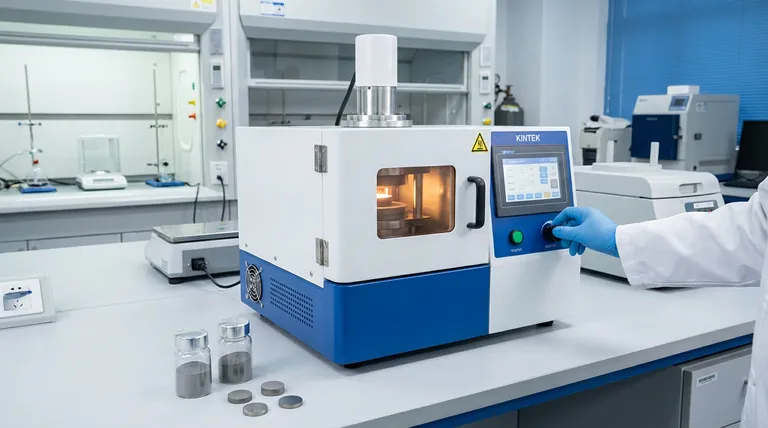
Precision Control in Early-Stage Development
Mastering Thermal Dynamics
The primary benefit of using benchtop SPS or Field Assisted Sintering Technology (FAST) is the ability to achieve rapid heating rates. This speed prevents unwanted grain growth that often occurs during slower conventional heating cycles.
Exact Temperature Management
Researchers can maintain rigorous control over processing temperatures, typically within the 975 to 1200 °C range. This specific window is critical for manipulating the phase transformations inherent to titanium alloys.
Clean Processing Environments
These systems operate under vacuum conditions. This is essential for titanium, which is highly reactive to oxygen and nitrogen at elevated temperatures, ensuring the integrity of the final consolidated sample.
Microstructural Engineering
Thermo-Mechanical Coupling
SPS systems utilize high-efficiency thermo-mechanical coupling. This mechanism ensures that thermal energy is applied directly where it is needed, facilitating faster densification of the alloy powder.
Targeting Specific Phases
The precise control offered by benchtop units allows for the targeted precipitation of ultra-fine alpha-phases. Achieving this specific microstructure is often the key to unlocking superior mechanical properties in titanium alloys.
Iterative Parameter Discovery
Because the system is designed for small-scale batches, researchers can quickly run multiple experiments. This allows for the rapid identification of optimal processing parameters without consuming large quantities of expensive titanium powder.
Understanding the Trade-offs
Scalability Constraints
While benchtop systems are ideal for defining parameters, they are limited by sample size. Parameters optimized on a small scale may require adjustment when transferring to industrial-sized SPS units due to changes in thermal mass.
Sample Geometry Limitations
These systems are generally restricted to simple shapes (disks or small cylinders). Researchers looking to prototype complex net-shape components may find the geometric constraints of benchtop molds limiting.
Making the Right Choice for Your Goal
To maximize the value of a benchtop SPS system, align your usage with your specific research objectives.
- If your primary focus is microstructural design: Focus on the 975–1200 °C range to precisely control the precipitation of ultra-fine alpha-phases.
- If your primary focus is process efficiency: Utilize the system's rapid heating and small batch size to iterate through multiple parameter sets quickly.
- If your primary focus is material conservation: Leverage the ability to consolidate small-scale powder batches to test expensive or experimental alloy compositions economically.
Benchtop SPS offers the most efficient pathway to understanding the fundamental processing windows of new titanium alloys before committing to full-scale production.
Summary Table:
| Feature | Advantage for Titanium R&D |
|---|---|
| Heating Rates | Prevents grain growth via rapid thermal cycles |
| Atmosphere | Vacuum conditions prevent oxidation and contamination |
| Temperature Range | 975 - 1200 °C range for precise alpha-phase control |
| Batch Size | Small-scale consolidation reduces expensive material waste |
| Process Speed | Enables rapid iteration of optimal sintering parameters |
Elevate Your Material Research with KINTEK
Unlock the full potential of your titanium alloy development with KINTEK’s advanced sintering solutions. Backed by expert R&D and world-class manufacturing, KINTEK offers a comprehensive range of laboratory equipment including Muffle, Tube, Rotary, Vacuum, and CVD systems, all of which are fully customizable to meet your unique research specifications.
Whether you are refining ultra-fine alpha-phases or optimizing thermo-mechanical parameters, our high-precision thermal systems provide the reliability and control you need to bridge the gap between discovery and production.
Ready to accelerate your lab's performance? Contact our technical experts today to find the perfect customizable furnace solution for your high-temperature applications.
References
- Samuel Lister, Martin Jackson. Titanium‐S23: A New Alloy with Ultra‐High Tensile Toughness Directly from the Solid‐State Processing of Recycled Ti–6Al–4V and Ti–5Al–5Mo–5V–3Cr Powders using Field Assisted Sintering Technology. DOI: 10.1002/adem.202500572
This article is also based on technical information from Kintek Furnace Knowledge Base .
Related Products
- Spark Plasma Sintering SPS Furnace
- Slide PECVD Tube Furnace with Liquid Gasifier PECVD Machine
- MPCVD Machine System Reactor Bell-jar Resonator for Lab and Diamond Growth
- Chairside Dental Porcelain Zirconia Sintering Furnace with Transformer for Ceramic Restorations
- 915MHz MPCVD Diamond Machine Microwave Plasma Chemical Vapor Deposition System Reactor
People Also Ask
- How does the heating mechanism of Spark Plasma Sintering (SPS) function? Enhance TiC/SiC Composite Fabrication
- Why is it necessary to maintain a high vacuum environment during the SPS of SiC? Key to High-Density Ceramics
- What are the technical advantages of using an SPS sintering furnace? Elevate Al2O3-TiC Material Performance
- What are the steps in the discharge plasma sintering process? Master Fast, High-Density Material Consolidation
- What are the advantages of spark plasma sintering (SPS) over traditional forging? Precision Microstructural Control




