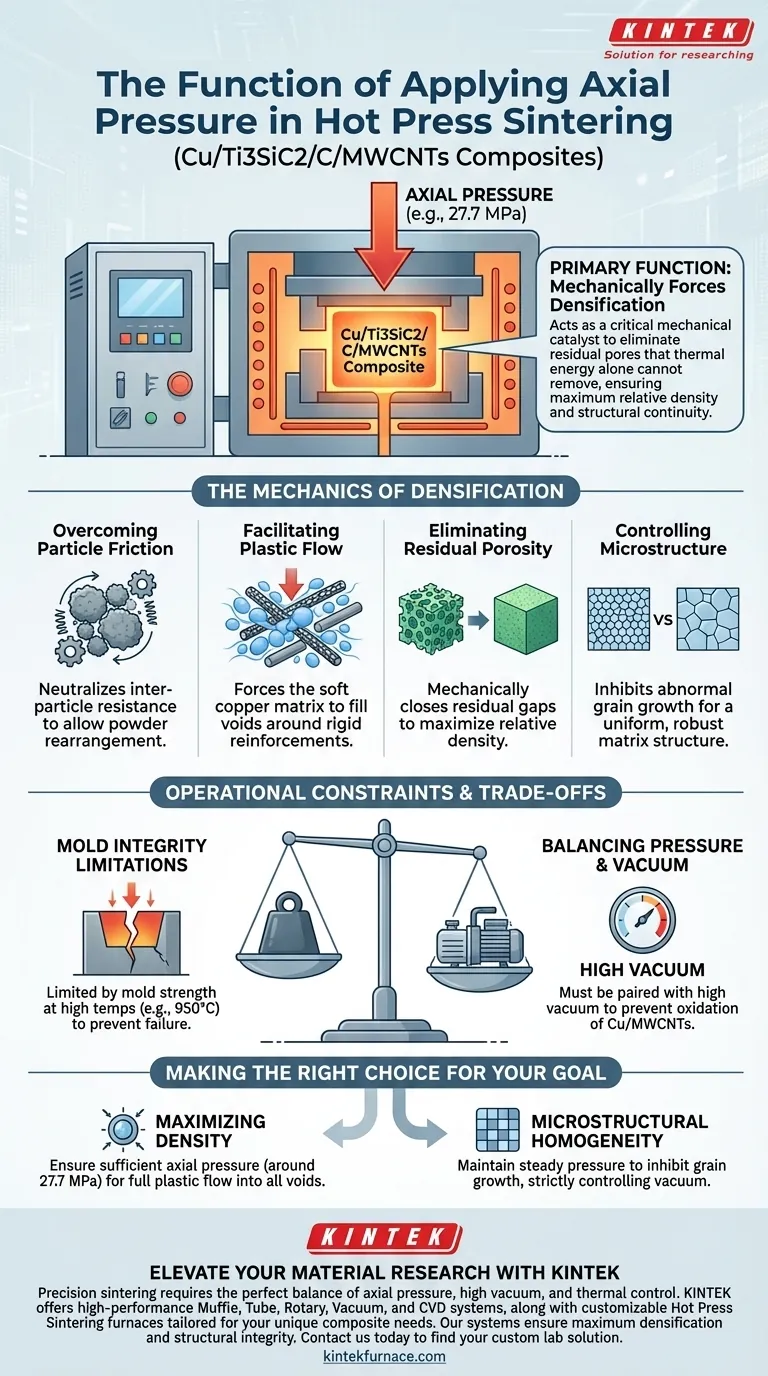
The primary function of applying axial pressure during hot press sintering is to mechanically force the densification of the composite material. By applying a specific load (e.g., 27.7 MPa) through a hydraulic system, the process overcomes inter-particle friction and drives the plastic flow of the copper matrix to fill voids around the rigid Ti3SiC2 and MWCNT skeletons.
Axial pressure acts as a critical mechanical catalyst, forcing the plastic deformation of the metal matrix to eliminate residual pores that thermal energy alone cannot remove. This ensures the composite achieves maximum relative density and structural continuity.
The Mechanics of Densification
Overcoming Particle Friction
In a powder mixture, individual particles naturally resist movement due to friction. Axial pressure is applied specifically to overcome this frictional resistance between the powder particles.
Without this external force, the particles would remain statically packed, preventing the rearrangement necessary for a dense final product.
Facilitating Plastic Flow
The composite consists of a soft matrix (Copper) and rigid reinforcements (Ti3SiC2 and MWCNTs). Pressure forces the plastic flow of the copper particles.
This deformation allows the copper to physically move and fill the interstitial spaces surrounding the harder, rigid skeletons of the reinforcement phases.
Eliminating Residual Porosity
During the sintering process, "necks" form between particles, but voids often remain. Physical pressure is essential for eliminating these residual pores.
By mechanically closing these gaps, the process maximizes the relative density of the material, which is the primary indicator of the composite's structural integrity.
Controlling Microstructure
Beyond simple densification, the application of pressure helps dictate the final grain structure. It aids in inhibiting abnormal grain growth, ensuring a more uniform and robust matrix.
Operational Constraints and Trade-offs
Mold Integrity Limitations
While higher pressure generally yields higher density, it is limited by the mechanical strength of the mold at high temperatures.
The mold acts as both the container and the pressure transmitter; exceeding its limits during the high-heat phase (e.g., 950°C) can lead to mold failure or deformation, compromising the sample.
Balancing Pressure and Vacuum
Pressure must be applied in concert with a high-vacuum environment.
If pressure is applied without maintaining a vacuum, trapped oxygen can oxidize the copper matrix or degrade the MWCNTs, rendering the densification efforts useless due to brittle inclusions.
Making the Right Choice for Your Goal
To optimize the sintering of Cu/Ti3SiC2/C/MWCNTs composites, consider the following regarding axial pressure:
- If your primary focus is Maximizing Density: Ensure the axial pressure is sufficient (around 27.7 MPa) to force the plastic flow of copper into all interstitial voids.
- If your primary focus is Microstructural Homogeneity: Maintain steady pressure to inhibit abnormal grain growth while strictly controlling the vacuum to prevent oxidation.
Effective axial pressure bridges the gap between a porous aggregate and a fully dense, high-performance composite.
Summary Table:
| Mechanism | Function in Sintering Process |
|---|---|
| Overcoming Friction | Neutralizes inter-particle resistance to allow powder rearrangement. |
| Plastic Flow | Forces the soft copper matrix to fill voids around rigid reinforcements. |
| Pore Elimination | Mechanically closes residual gaps to maximize relative density. |
| Microstructure Control | Inhibits abnormal grain growth for a uniform, robust matrix structure. |
Elevate Your Material Research with KINTEK
Precision sintering requires the perfect balance of axial pressure, high vacuum, and thermal control. Backed by expert R&D and manufacturing, KINTEK offers high-performance Muffle, Tube, Rotary, Vacuum, and CVD systems, along with customizable Hot Press Sintering furnaces tailored for your unique composite needs.
Whether you are working with metal-matrix composites like Cu/Ti3SiC2 or advanced MWCNT structures, our systems ensure maximum densification and structural integrity. Contact us today to find your custom lab solution and leverage our technical expertise for your next breakthrough.
Visual Guide
Related Products
- Molybdenum Disilicide MoSi2 Thermal Heating Elements for Electric Furnace
- 1200℃ Controlled Inert Nitrogen Atmosphere Furnace
- Multi Zone Laboratory Quartz Tube Furnace Tubular Furnace
- Chairside Dental Porcelain Zirconia Sintering Furnace with Transformer for Ceramic Restorations
- Vacuum Heat Treat Sintering Furnace Molybdenum Wire Vacuum Sintering Furnace
People Also Ask
- What are the typical application temperatures for molybdenum disilicide (MoSi2) heating elements? Master High-Temp Performance
- What is the primary use of molybdenum disilicide? Ideal for High-Temp Heating Elements
- What are the characteristics of molybdenum disilicide heating elements? Unlock High-Temp Performance
- What are the properties of molybdenum disilicide (MoSi2) that make it suitable for high-temperature applications? Discover Its High-Temp Resilience
- What are the applications of molybdenum disilicide heating elements? Achieve Extreme Heat Stability for Industrial Processes